

Between baby classes and full preschool, there is a gentle middle step many families overlook: the playgroup. In Singapore, a playgroup usually means short, structured sessions for toddlers, often a couple of hours at a time, a few days a week. It gives your child a taste of routines, group play and other adults, without the long days of childcare. This guide walks you through how playgroup Singapore options typically work, the formats you will come across, what to look for when you visit, and how to use a playgroup as a stepping stone to preschool.
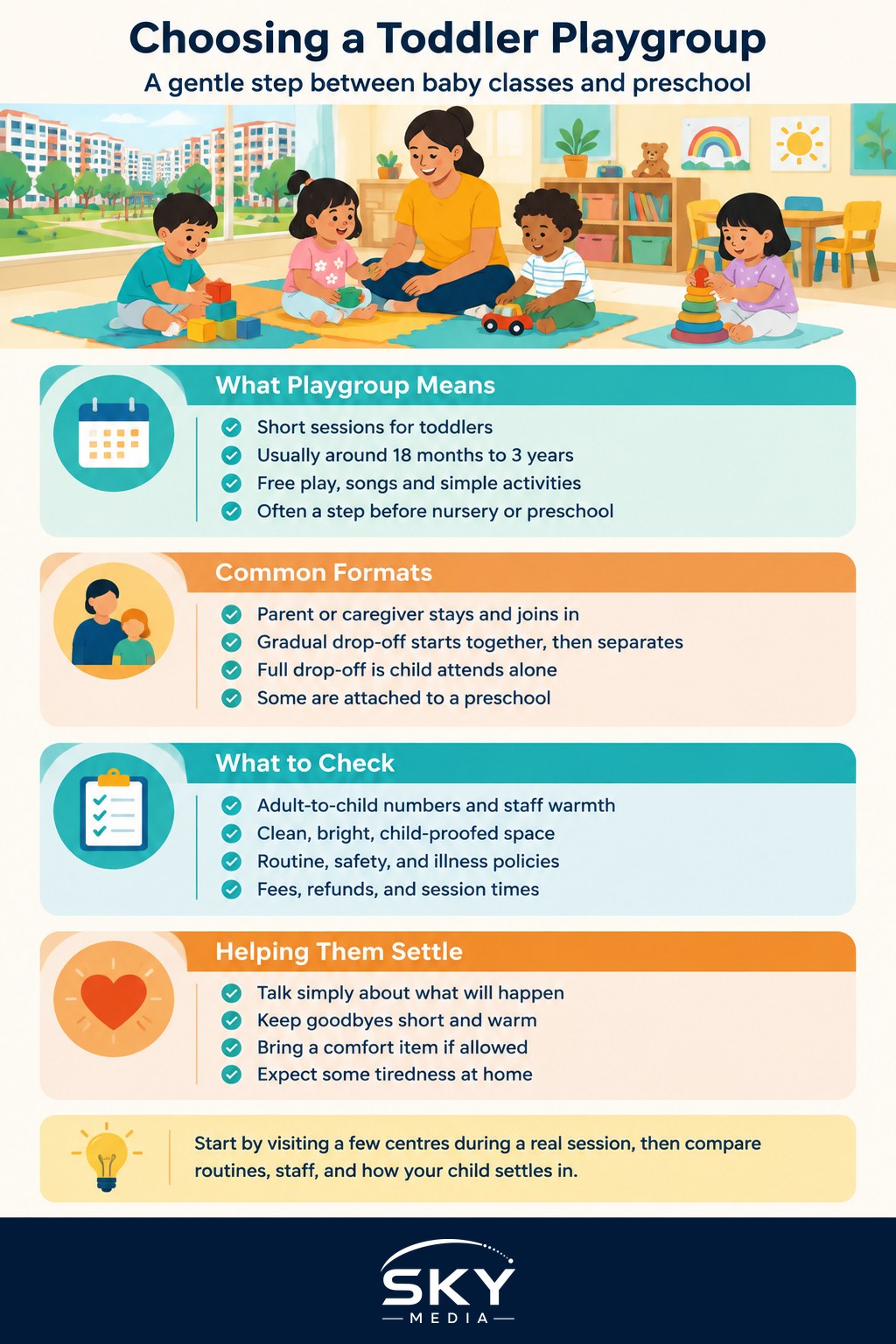
What a Playgroup Is (and Is Not)
A playgroup is a short-session programme for young children, typically somewhere between around 18 months and three years old, though age bands vary by provider. Sessions commonly include free play, songs, stories, simple art, sensory activities, snack time and some outdoor or gross motor play.
It differs from other options in a few important ways:
- Shorter hours. Sessions are usually a few hours, not a full or half day.
- Fewer days. Many run two to three times a week, though some offer daily sessions.
- Lighter structure. The focus is on social and play skills, not academics.
- Often a preparation step. Many parents use playgroup in the year before nursery or preschool.
Playgroups are offered by different kinds of providers. Some are run inside preschools that are licensed by ECDA (the Early Childhood Development Agency, which regulates preschools in Singapore). Others are run by enrichment centres, community spaces, churches or parent groups, which may not fall under the same licensing. Neither is automatically better, but it is worth knowing which you are looking at, because standards, staff qualifications and oversight can differ. Ask the provider directly and check ECDA’s website if they say they are a licensed preschool.
Playgroup Formats Compared
The biggest decision is whether you stay with your child or drop them off. Here is how the common formats compare:
| Format | How it works | Suits children who | Things to consider |
|---|---|---|---|
| Parent or caregiver accompanied | You or your helper stay and join in the activities | Are younger or more clingy, or new to group settings | Needs your time on weekdays; less practice at separating |
| Gradual drop-off | Starts accompanied, then the adult steps out for longer stretches | Are ready to separate but need a gentle transition | Ask how the centre handles crying and how long the transition usually takes |
| Full drop-off | Child attends alone from the start | Are older, confident or already used to other carers | Closest to preschool; check teacher ratios and settling-in support |
| Preschool-attached playgroup | A short programme inside a preschool, often with a path into its nursery class | Families who already like that preschool | May come with a waitlist or priority for the next level; ask how it works |
There is no single right choice. Many families start with accompanied sessions and move to drop-off as their child grows more confident.
What to Check When You Visit
Visit at least two or three places during a session if you can. Watching real children in the space tells you more than a brochure.
People
– How many adults are there for the number of children?
– Do the teachers get down to the children’s level, speak warmly and notice quieter children?
– What training or early childhood qualifications do the staff have?
Space and safety
– Is the room clean, bright and child-proofed, with safe flooring and covered sockets?
– Is there outdoor or active play space?
– How do they handle drop-off and pick-up, and who is allowed to collect your child?
– What is the policy on illness, allergies and first aid?
Routine and approach
– What does a typical session look like, from arrival to goodbye?
– Is play child-led, teacher-led or a mix?
– How do they support toddlers who are not yet toilet trained? Our guide to toilet training your toddler can help if this is on your mind.
– How do they manage conflicts such as grabbing toys?
Practicalities
– Session times, how they fit your child’s nap schedule, and travel time from home
– Fees, deposits, term structure and what happens with missed sessions
– Notice period and refund terms if it does not work out
Fees vary widely by provider, format and location, so compare written fee schedules rather than relying on word of mouth. If you are considering a preschool-attached playgroup, ask whether any government subsidies apply to that programme; subsidies for licensed preschools have their own rules, so confirm with the operator and ECDA.
Helping Your Toddler Settle In
The first few weeks are the real test. Some toddlers march in happily; others need time. Both are normal.
- Talk about it beforehand. Use simple words: “You will play, have snack, and then Mummy comes back.”
- Visit together first. Let your child explore the room with you there.
- Keep goodbyes short and warm. A quick hug and a clear “I’ll be back after snack” works better than slipping away.
- Bring a comfort item if the centre allows it.
- Arrive on time so your child does not walk into a busy room midway.
- Expect some tiredness or clinginess at home. New routines take energy.
Playgroup is also where many toddlers first practise taking turns and handling frustration with other children. Our guides on teaching toddlers to share and toddler tantrums and behaviour offer gentle ways to support that at home.
If your child is still very distressed after several weeks, talk to the teachers about what they see. They can often suggest small adjustments, such as shorter sessions for a while. If you have broader concerns about your child’s development or wellbeing, your paediatrician or polyclinic is the right place to start.
Using Playgroup as a Step Toward Preschool
The main benefit of a playgroup is not academic. It is the soft skills that make the move to preschool smoother:
- Separating from parents for a set time
- Following a simple routine with transitions
- Sitting for a short story or circle time
- Washing hands, eating snack at a table and tidying up
- Listening to an adult who is not family
- Playing near and with other children
When you start looking at nursery or preschool places, think about how your child responded to playgroup. Did they enjoy more structure or more free play? Did a smaller group suit them better? These observations help you choose the next setting. For the final stretch, our guide to preparing your toddler to start preschool covers routines, separation and what to pack.
A playgroup is optional, and plenty of children go straight into preschool and thrive. But if you want a gentle introduction to group life, a few short sessions a week can make the bigger step feel familiar.
Official sources: Early Childhood Development Agency (ECDA)