
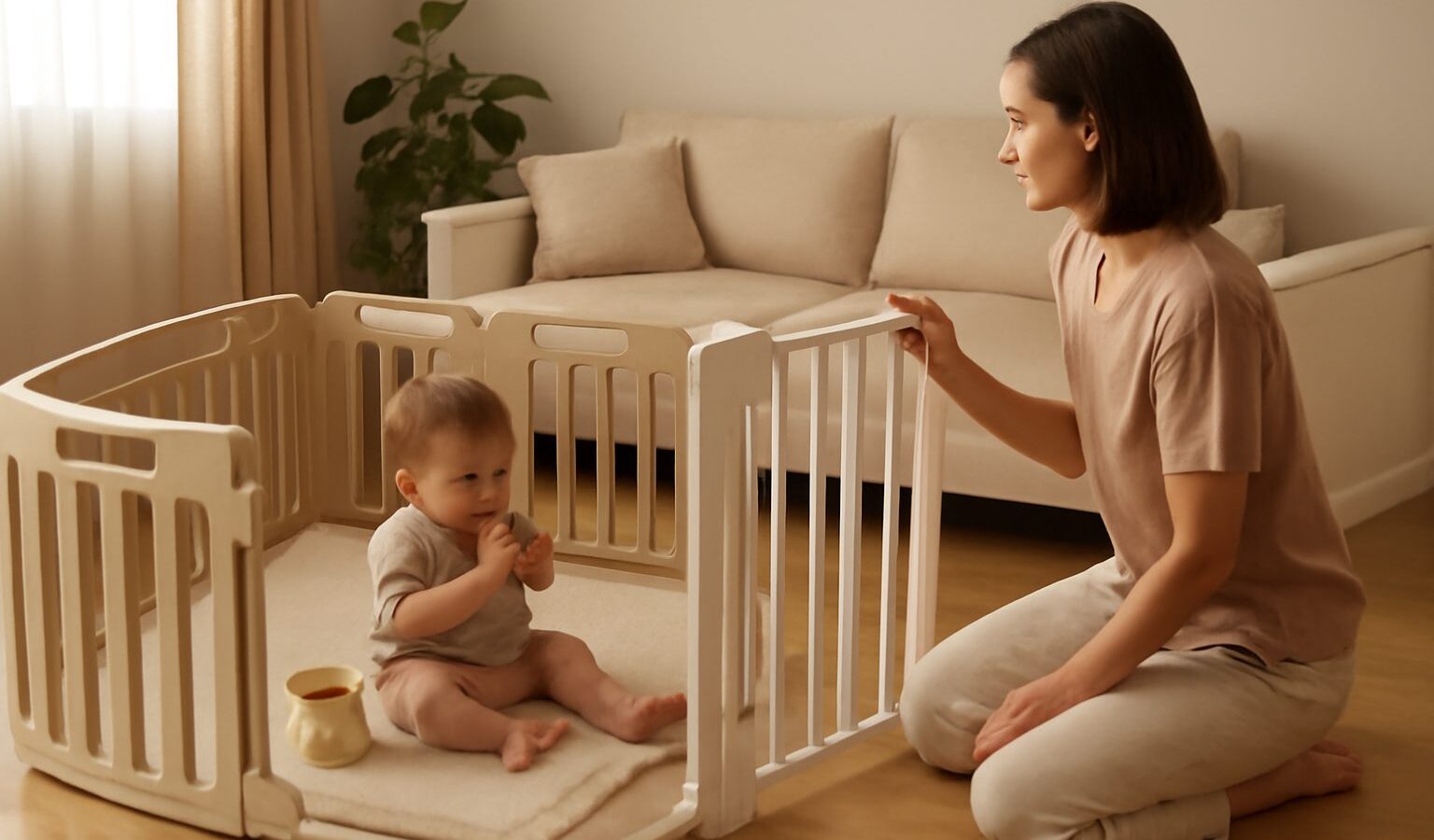
Walk into any baby fair and you will see huge foldable play yards, panel playpens and rows of safety gates. It is easy to assume every family needs all of them. But a baby playpen in Singapore has to fit into homes that are often compact, with open-concept kitchens, narrow corridors and very few stairs. This guide helps you decide whether a playpen, a play yard or a gate is genuinely worth the money and floor space in an HDB flat, and which option suits your layout and routine.
This article focuses on the buying decision. It is general information, so always follow the manufacturer’s instructions and your doctor’s or nurse’s safe sleep advice.

What Problem Are You Actually Solving?
Before buying anything, be clear about why you want it. Parents usually want one of three things:
- A safe spot for a few minutes. You need to cook, take a shower or answer the door, and want your crawling baby contained.
- A barrier to one room. You want to keep a toddler out of the kitchen, the service yard or a room with a balcony.
- A dedicated play area. You want a padded space where toys stay put and the rest of the living room stays usable.
Each of these has a different best answer. A large panel playpen solves the third, a doorway gate solves the second, and the first can often be handled by either, or simply by a well-childproofed room.
Playpen vs Play Yard vs Gate: Comparing Your Options
| Option | Best for | Space needed | Watch out for |
|---|---|---|---|
| Panel playpen (interlocking panels) | A large, flexible play zone in the living room | High, often takes over a good part of a small living room | Can be climbed or pushed once toddlers are strong; floor mats slide on tiles |
| Foldable play yard (travel cot style) | Short spells of containment, naps if approved for sleep, travel | Moderate, folds away | Bored babies protest quickly; only use the mattress supplied |
| Doorway or kitchen safety gate | Blocking one area such as the kitchen or service yard | Minimal | Trip hazard with pressure-mounted bars at the base |
| Room divider gate (extra-wide, freestanding) | Open-concept layouts with no doorway | Moderate | Freestanding versions can be pushed over by older toddlers |
Many families in HDB flats end up with just one well-chosen gate and no playpen at all, or a small play yard for the newborn and crawling months only.
When a Playpen Is Worth It in a Small Flat
A playpen tends to earn its place if:
- You are often home alone with the baby. Having a safe spot for a quick shower or cooking session gives real peace of mind.
- You have pets or older siblings. A playpen can keep small toys, which can be choking hazards, away from the baby, or keep a curious cat out.
- Your living room has hard-to-childproof features, such as a display cabinet, low shelving or many cables behind the TV.
- You want to protect a room you rent. Tenants who cannot drill into walls may prefer freestanding solutions.
It is less useful if your baby strongly dislikes being contained, if your living room is already tight, or if a caregiver (grandparent or helper) is always within arm’s reach. Many parents report that a panel playpen gets heavy use between roughly six months and early toddlerhood, then gets packed away once the child learns to climb. Check the manufacturer’s age and height limits and stop using it when your child exceeds them or can climb out.
Do You Need Baby Gates Without Stairs?
Most HDB flats are single-level, so the classic “top of the stairs” gate is not needed. Maisonettes and some landed homes are exceptions. For a typical flat, the spots parents most often gate are:
- The kitchen entrance, especially in older layouts with a separate kitchen and a door frame that fits a standard gate.
- The service yard or utility area, where detergents, the washing machine and drying racks are kept.
- Bedrooms or the study, to keep a toddler out of an adult workspace.
- The main door area. Many flats already have a metal main gate, but some parents add an inner gate so a toddler cannot reach the door when it is opened. See Main Door and Gate Ideas for HDB Flats for layout ideas.
Open-concept kitchens, now common after renovation, have no doorway to fit a gate. In that case, look at extra-wide freestanding room dividers, or plan a half-height gate during your renovation. If you are renovating anyway, our guide on Renovating Your HDB Flat covers the approval steps for structural changes.
Remember that a gate is not a substitute for window grilles or locked windows. Window safety in high-rise homes remains essential whatever else you buy.
What to Look for When Buying
- Safety standards. Look for products that state they meet a recognised safety standard for playpens or safety gates, such as European (EN) or American (ASTM) standards. Ask the seller to show you the label if it is not obvious.
- Mounting type. Pressure-mounted gates wedge into a doorway without drilling, which suits renters, but they can loosen and usually have a bar at the base that can trip you. Hardware-mounted gates screw into walls or frames and are sturdier. Ask your landlord before drilling, and avoid drilling into areas where concealed pipes or wiring may run.
- Opening mechanism. A one-handed opening that an adult can work while carrying a baby, but a toddler cannot, is worth paying for. Auto-close gates help if several family members use the doorway.
- Gaps and spacing. Bars and mesh should be close enough that a child cannot trap a head, arm or leg. Avoid horizontal bars that act as a ladder.
- Flooring. On homogeneous or vinyl tiles, playpen panels can slide. Look for rubber feet or place the playpen on a non-slip foam mat.
- Cleaning. Singapore’s humidity encourages mould on fabric play yards. Choose washable fabrics and dry them fully.
- Second-hand items. Check for recalls, missing parts and cracks, and never use a play yard with a mattress that did not come with it.
Safe Use Tips for Every Option
- Supervise. Playpens and gates reduce risk, but they do not replace an adult watching.
- Keep it clear. Do not place playpens near curtains with cords, windows or furniture a child could climb.
- Follow safe sleep guidance. If you use a play yard for naps, it must be approved for sleep, with a firm, flat mattress and no pillows, bumpers or soft toys.
- Check fittings weekly. Pressure-mounted gates loosen over time, especially with daily use.
- Stop at the right time. When your child can climb over or open a gate, remove it, because a fall from climbing can be worse than no gate at all.
A Simple Way to Decide
If your flat has a separate kitchen, a single doorway gate is usually the best first buy. If your home is open-concept and you are often alone with your baby, a small play yard or a modest panel playpen may be worth it for a year or so. And if space is very tight, a thoroughly childproofed living room, with covered sockets, anchored furniture and secured cables, can work just as well as any baby playpen in Singapore.
Further reading: Choosing a Baby High Chair: Types, Safety and Small-Flat Fit