
A power bank is one of the most useful things to pack for a long trip, and one of the most likely to cause trouble at the airport. Security screeners at Changi regularly pull power banks out of checked bags, and some travellers have had units confiscated at the gate because the capacity label was missing or too high. Airlines have also tightened what you can do with a power bank once you are on board.
This guide explains the power bank rules for a flight from Singapore: where the power bank must be packed, how to read its watt-hour rating, which sizes need airline approval, and what in-flight use rules you are likely to meet. It is about flying with one, not choosing one. Rules are set by aviation regulators and individual airlines and they do change, so always check your airline’s dangerous goods page before you fly.
Why Power Banks Must Go in Your Carry-On
Power banks contain lithium-ion or lithium-polymer cells. If one is damaged, badly made or short-circuited, it can overheat and catch fire, a process called thermal runaway. In the cabin, crew can see and deal with a smoking battery quickly. In the cargo hold, nobody can.
That is why airlines around the world, following guidance from the International Civil Aviation Organization (ICAO) and the International Air Transport Association (IATA), treat spare lithium batteries the same way:
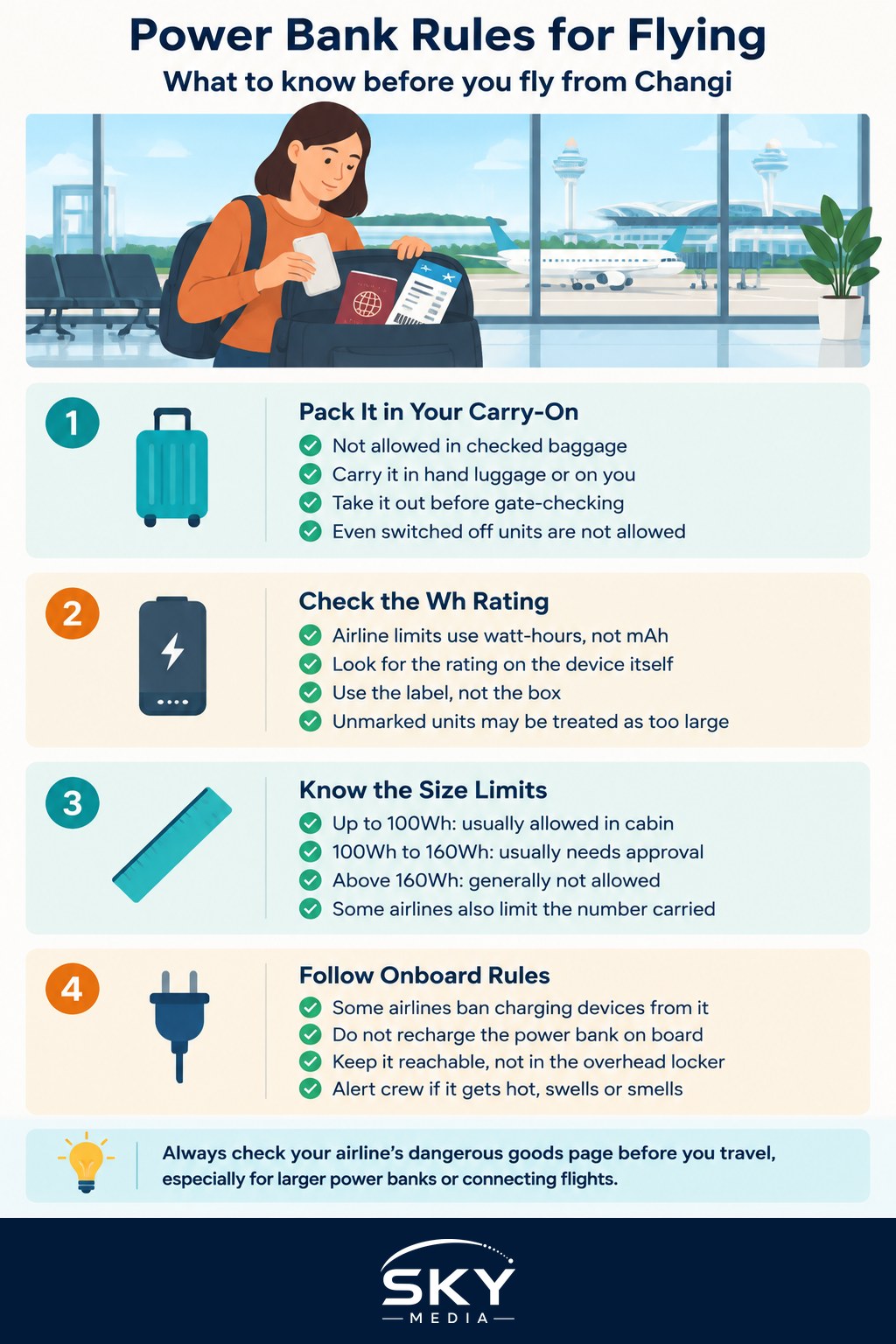
- Power banks are not allowed in checked baggage. This applies even if the power bank is switched off or fully drained.
- They must travel in your carry-on or on your person.
- If your cabin bag is gate-checked because the overhead lockers are full, take the power bank out first and keep it with you.
If a screener finds a power bank in a checked bag at Changi, you may be called to open the bag, or the item may be removed. To avoid delays, pack every power bank, spare camera battery and loose lithium cell in your hand luggage from the start.
How to Read Your Power Bank’s Watt-Hour Rating
Airline limits are written in watt-hours (Wh), but most power banks are marketed in milliamp-hours (mAh). The watt-hour figure tells you how much energy the battery stores, which is what matters for safety.
Many power banks print the Wh rating on the casing. If yours only shows mAh, you can estimate it:
Wh = (mAh × voltage) ÷ 1,000
Most power bank cells are rated at a nominal 3.6 or 3.7 volts, and that cell voltage is the figure to use, not the 5V or higher USB output. Some worked examples using 3.7V:
- 10,000 mAh × 3.7 ÷ 1,000 = 37Wh
- 20,000 mAh × 3.7 ÷ 1,000 = 74Wh
- 27,000 mAh × 3.7 ÷ 1,000 = about 100Wh
A few practical points:
- Unmarked power banks are a common problem. If staff cannot see a capacity rating, they may treat the power bank as exceeding the limit. Keep the label readable and avoid units with worn-off markings.
- Do not rely on the box. The rating needs to be on the device itself.
- Be wary of unrealistic claims. Very cheap power banks sometimes advertise capacities their size cannot support, and poor-quality cells are a safety risk. For tips on choosing a reliable unit, see our guide to power banks and charging gear in Singapore.
Capacity Limits: The 100Wh and 160Wh Thresholds
Most airlines follow the same broad bands based on IATA guidance. Your airline may be stricter, especially on the number of units allowed, so treat this as a starting point.
| Power bank rating | Typical mAh equivalent (at 3.7V) | What usually happens |
|---|---|---|
| Up to 100Wh | Up to about 27,000 mAh | Allowed in carry-on without airline approval, subject to quantity limits |
| Over 100Wh up to 160Wh | About 27,000 to 43,000 mAh | Usually needs airline approval in advance; often limited to two per passenger |
| Over 160Wh | Above about 43,000 mAh | Generally not allowed on passenger aircraft |
| No visible rating | Unknown | May be refused at screening or boarding |
Quantity limits vary. Some airlines cap the number of power banks per passenger regardless of size, while others apply a limit only to the larger band. If you travel with several devices, such as a power bank for your phone and a larger one for a laptop, check both the size and the count rules for your airline.
In-Flight Use: Charging and Storage Rules on Board
Carrying a power bank in the cabin is one thing; using it during the flight is another. A number of airlines, including Singapore’s home carriers, have introduced rules that stop passengers from using power banks to charge devices on board, or from charging the power bank itself from the seat power outlet. Some also ask that power banks be kept where they can be reached, rather than buried in a bag in the overhead locker, so that any overheating can be noticed and handled.
Because these policies differ by airline and have changed in recent years, read the rules for your specific carrier before you fly, and listen to the cabin announcements. Common requirements include:
- No charging devices from a power bank during the flight, or only at certain times.
- No recharging the power bank from the in-seat USB or power socket.
- Keep the power bank on you or under the seat in front, not in the overhead locker.
- Tell the crew immediately if a power bank or device becomes hot, swells, smokes or smells of burning. Do not try to deal with it yourself.
If you need your phone charged for arrival, top it up at the gate or use the aircraft’s in-seat power directly for the phone, where the airline allows it. Many seats on longer flights have USB ports.
Packing Tips Before You Leave for Changi
A little preparation saves time at security and at the gate:
- Protect the terminals. Keep each power bank in its own pouch, sleeve or the original packaging so the ports cannot touch keys, coins or other batteries.
- Do not pack damaged units. A power bank that is swollen, dented, unusually hot or has been dropped hard should not fly. Dispose of it properly instead.
- Keep it within easy reach in your cabin bag so you can take it out for screening if asked.
- Check the rules for every leg. If your trip includes a connecting flight on another airline, or a domestic flight in another country, that airline’s or regulator’s rules apply on that sector. Some countries have added their own requirements, such as certification marks for power banks on domestic flights, so check before connecting.
- Budget airlines can be stricter. Low-cost carriers sometimes have tighter quantity limits. Our guide to budget airlines from Singapore covers other fare and baggage rules worth knowing.
- Travelling with children? Power banks for tablets and handheld games are common in family carry-ons, so count them all against the limit. See our tips on flying with a baby or toddler from Singapore.
Where to Check the Current Rules
Power bank rules for a flight are set at several levels: international guidance from ICAO and IATA, national regulators such as the Civil Aviation Authority of Singapore (CAAS), and each airline’s own dangerous goods policy. The airline’s rules are the ones applied at check-in and boarding, so they are the most important to read.
Before you travel, look up:
- Your airline’s dangerous goods or restricted items page
- Any approval form needed for power banks between 100Wh and 160Wh
- In-flight use rules for power banks on your route
- Rules for any connecting airline or domestic sector abroad
If you are unsure, it is better to ask the airline before you leave home than to lose a power bank at the gate. This article is general information and does not replace the official guidance from your airline or the authorities.
Frequently Asked Questions
Do flights in China require a certification mark on power banks? Some countries have added their own rules, such as certification marks for power banks on domestic flights, and these have changed in recent years. Check the regulator’s guidance and the airline’s page for every leg of your trip. A power bank without the required mark may be refused at screening.
Do the rules also apply to spare camera batteries and battery cases? Yes, spare lithium batteries must travel in your carry-on, not in checked baggage, and the same watt-hour limits apply. Battery-powered phone cases and loose cells count as well. Protect the terminals in pouches or original packaging, and check your airline’s dangerous goods page for quantity limits.
Can I check in smart luggage with a built-in battery? Airlines commonly require a removable battery to be taken out and carried in the cabin, and some do not accept smart luggage with a non-removable one. Rules vary by airline and country, so check your carrier’s dangerous goods policy before you buy or pack. Ask at check-in if you are unsure.
Further reading: Preventing Lithium-Ion Battery Fires From Power Banks and Gadgets at Home