

A customer slips on a wet floor in your café. A pop-up booth’s banner falls and dents a car. A contractor you sent to a client’s home cracks their marble countertop. Any of these can turn into a claim for medical bills, repairs or legal costs, and for a small business that can be a serious blow. Public liability insurance in Singapore is the cover designed for exactly these situations, and it is often a condition of signing a shop lease or booking an event venue.
This guide focuses on one type of cover: what it pays for, why landlords and venues insist on it, how premiums are usually set, and what to check before you buy. It is general information, not insurance or legal advice. The actual cover always depends on your policy wording, so read it carefully and ask the insurer or a licensed broker to explain anything unclear.
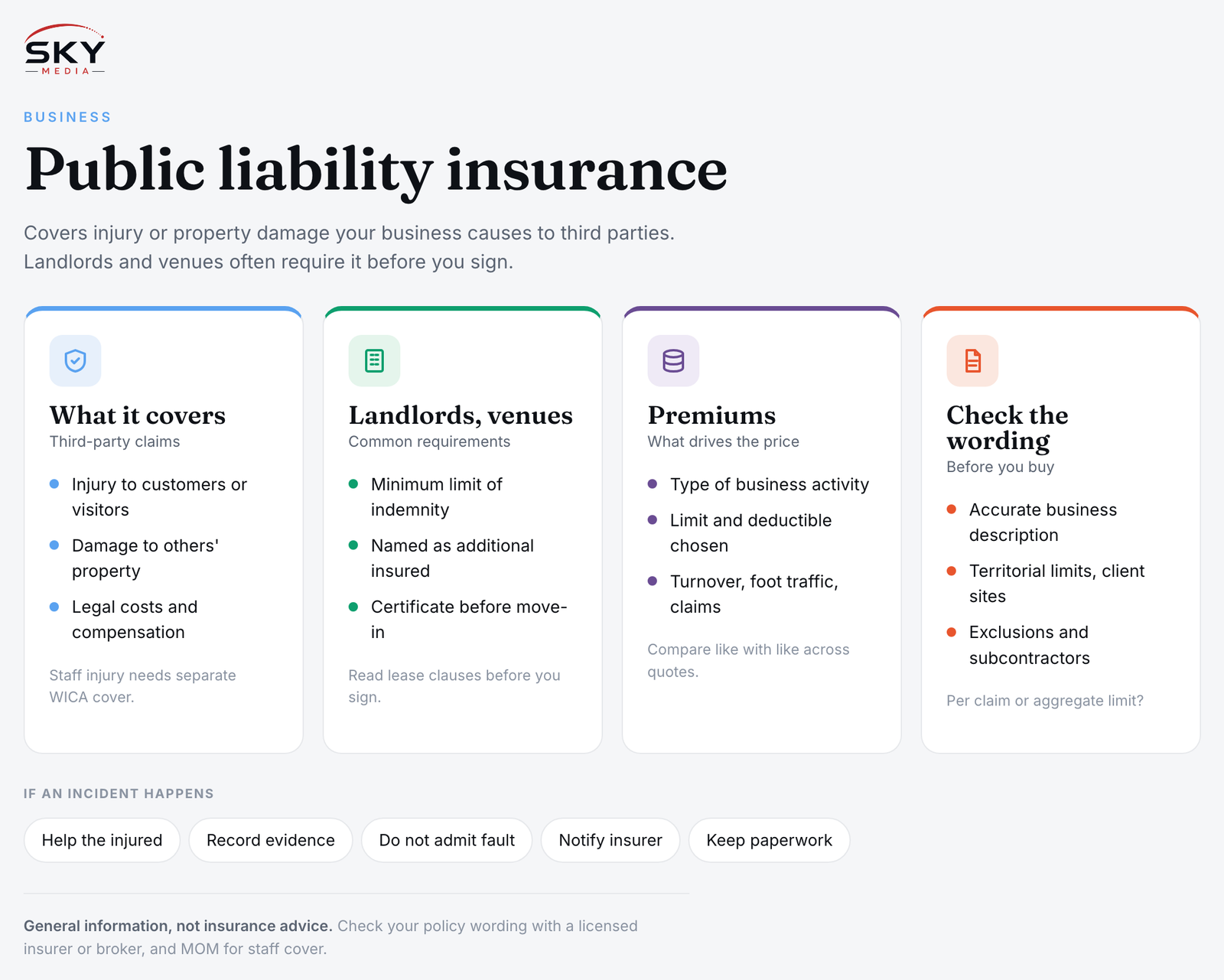
What Public Liability Insurance Covers
Public liability insurance protects your business when a third party, meaning someone who is not your employee, suffers injury or property damage because of your business activities, and holds you legally responsible. Typical policies cover:
- Bodily injury to third parties. A customer, visitor or member of the public who is hurt on your premises or by your work.
- Damage to third-party property. Damage you cause to someone else’s property, such as a client’s home, a venue’s fittings or a neighbouring unit.
- Legal defence costs. Lawyers’ fees and related costs of defending a claim, usually subject to the insurer’s approval.
- Compensation awarded. Amounts you are legally liable to pay, up to the policy’s limit.
Just as important is what it usually does not cover. Injury to your own employees falls under work injury compensation insurance, which is regulated separately by the Ministry of Manpower (MOM) and is compulsory for many employees. Damage to your own stock or equipment needs property insurance. Mistakes in professional advice usually need professional indemnity insurance. Deliberate acts, contractual penalties and some specific risks are commonly excluded too.
Why Landlords and Venues Ask for It
If you are renting a retail unit, a stall in a mall or an event space, you may find a clause requiring you to hold public liability insurance with a minimum limit. Landlords and venue operators ask for it because, when something goes wrong on their property, the injured person may pursue the owner as well as you. Your policy gives them comfort that there is money behind you.
Common requirements you may see in a lease or venue agreement include:
- A minimum limit of indemnity, which is the maximum the insurer will pay per claim or per year.
- Naming the landlord or venue as an additional insured or noting their interest on the policy.
- Providing a certificate of insurance before you move in or before event day.
- Keeping the policy in force for the whole lease or event period, including setup and teardown days.
Read these clauses before you sign, not after. If the required limit seems high for your business, ask whether it is negotiable, and get a quote early so you are not rushing on the week of the event. If your event involves performances or entertainment, you may also need a separate licence; see our guide to public entertainment licences.
Annual Policy or One-Off Event Cover
Small businesses generally choose between ongoing annual cover and short-term cover for a single event. The right choice depends on how often you face the public.
| Situation | Usual cover type | Points to check |
|---|---|---|
| Shop, café, studio or clinic with walk-in customers | Annual public liability policy | Premises address, business activities described correctly |
| Contractor or service provider working at clients’ homes | Annual policy covering work away from premises | Whether work at third-party sites is included |
| Market stall, pop-up or roadshow a few times a year | Event cover per booking, or annual if frequent | Setup and teardown days, venue’s minimum limit |
| One-off launch party, workshop or community event | Single-event liability cover | Expected attendance, activities, food and drinks served |
| Home-based business with occasional visitors | Check home policy first, then consider business cover | Home policies often exclude business activity |
If you run more than a handful of events a year, compare the total cost of several single-event policies against one annual policy that covers events. The annual option is often simpler.
How Premiums Are Usually Worked Out
Insurers do not publish one standard price, and premiums change with the market, so treat any figure you see online as a rough guide only. What drives the quote is your risk profile. Factors insurers commonly look at include:
- Type of business activity. A bookkeeping office has fewer injury risks than a fitness studio or renovation contractor.
- Limit of indemnity chosen. Higher limits cost more, though the increase is often not proportional.
- Annual turnover or headcount. Larger operations generally mean more exposure.
- Premises size and foot traffic. More visitors mean more chances of an accident.
- Claims history. Previous claims can raise premiums or lead to extra conditions.
- Deductible or excess. Agreeing to pay a larger share of each claim yourself lowers the premium.
Get at least two or three quotes, and make sure each one quotes the same limit, deductible and activities so you are comparing like with like.
What to Check in the Policy Wording
Two policies with the same headline limit can behave very differently when you make a claim. Before you buy, read or ask about:
- Description of business. If your actual activities are wider than what is written, a claim could be disputed. Describe what you really do.
- Territorial limits. Confirm the policy covers all locations where you operate, including clients’ premises and event venues.
- Per claim versus aggregate limit. Know whether the limit applies to each incident or to the whole policy year.
- Exclusions. Look for exclusions relating to food, alcohol, height work, hot work, contractors or specific activities you carry out.
- Subcontractors. If you hire freelancers or subcontractors, check whether their work is covered or whether they need their own policy.
- Claims conditions. Most policies require you to notify the insurer promptly and not admit liability without their consent.
If your contracts with clients or landlords carry large potential liabilities, ask a broker whether a higher limit or additional cover makes sense. Our guide on umbrella liability cover explains how extra layers of protection work.
What to Do if an Incident Happens
Even with cover in place, how you respond in the first hours matters:
- Make sure anyone injured gets help first, and call emergency services if needed.
- Record what happened: photos, the time, names of witnesses and any CCTV that may exist.
- Be polite and caring, but avoid admitting fault or promising payment before speaking to your insurer.
- Notify your insurer or broker as soon as possible, following the steps in the policy.
- Keep all letters, emails and invoices related to the incident.
Fixing the hazard that caused the accident also matters, both for safety and because a repeat incident can affect future premiums.
Making Public Liability Cover Part of Your Setup
For most small businesses that deal with the public, public liability insurance is a basic part of operating responsibly, alongside licences and registrations. Treat it as part of your opening checklist, review the limit whenever you sign a new lease or take on bigger jobs, and keep your certificate handy for venue bookings. For specific questions about your situation, speak to a licensed insurer or broker, and check MOM’s website for your separate obligations on employee injury cover.
Further reading: Key Person Insurance for Singapore SMEs: How It Works · How to Start a Home Care or Eldercare Services Business in Singapore · How to Exhibit at a Trade Show in Singapore as a Small Business