

Project Silver Screen is a community screening programme in Singapore that checks seniors for common problems with eyesight, hearing and teeth. These are the kinds of issues that creep up slowly. A parent who stops reading the newspaper, turns the TV up louder or avoids hard foods may not think of it as a health problem at all, yet each one can affect safety, mood and independence.
This guide explains what the programme covers, who generally qualifies, where screening usually takes place and what happens if a problem is found. It is general information, not medical advice. Programme details, eligibility and subsidies are set by the Health Promotion Board (HPB) and the Ministry of Health (MOH) and can change, so always confirm the current details on the HPB or HealthHub website.
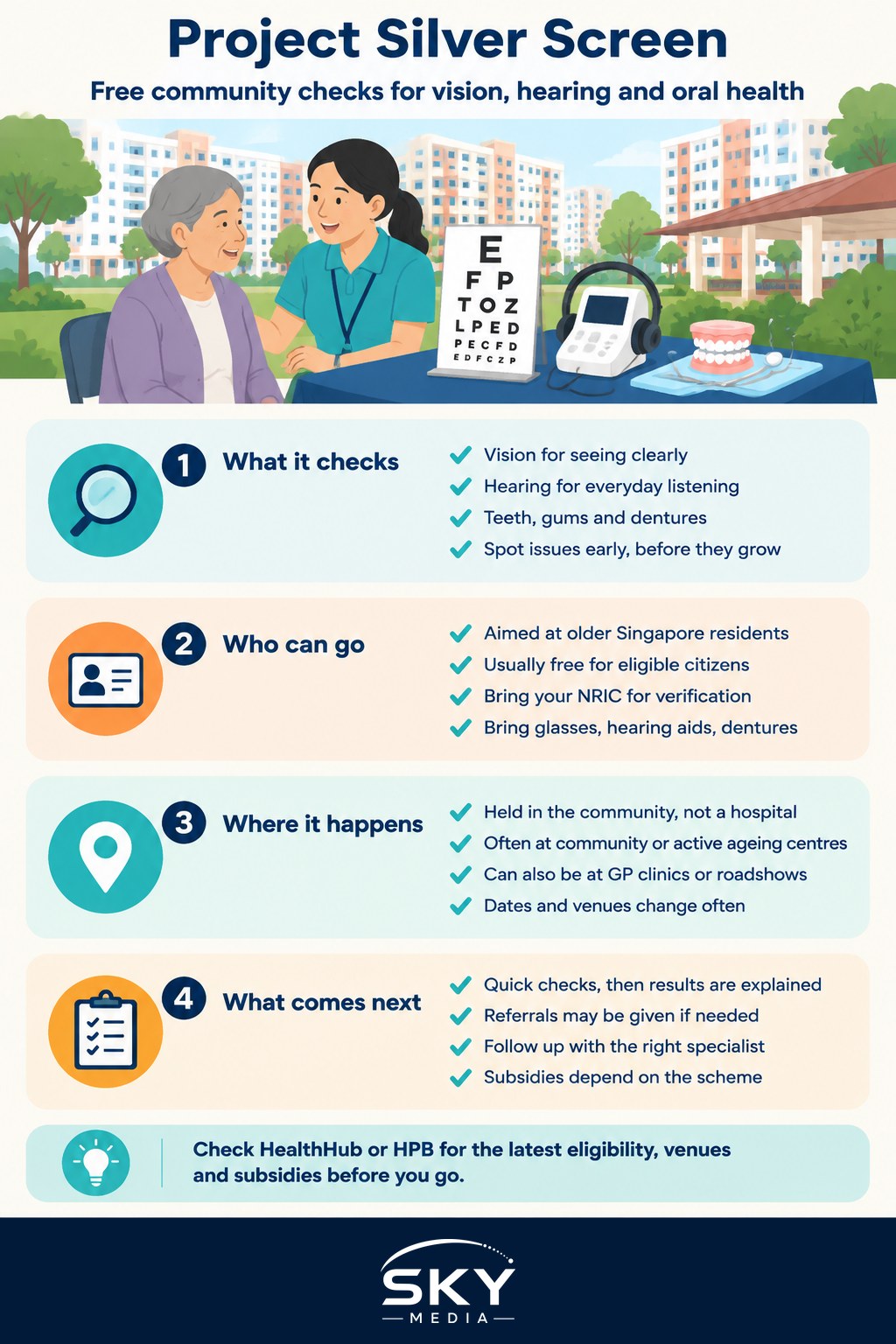
What Project Silver Screen Is
Project Silver Screen is often described as functional screening. Rather than testing for diseases such as diabetes or high blood pressure, it checks how well key senses and functions are working in daily life. The three main areas are:
- Vision: A simple eye check to pick up difficulty seeing, which can point to issues such as refractive error or cataract that may need further assessment.
- Hearing: A basic hearing test to spot hearing loss that may benefit from a fuller assessment or hearing aids.
- Oral health: A check of teeth, gums and dentures to look for problems with chewing or signs that a dental visit is needed.
The aim is early detection. Problems with sight and hearing are linked to falls, social isolation and difficulty managing medicines. Poor oral health can make eating harder and affect nutrition. Catching these early means seniors can get help before small problems become big ones.
It is different from Screen for Life, the national subsidised screening for chronic diseases and certain cancers. Many seniors benefit from both.
Who Can Get Screened
Project Silver Screen is aimed at older Singapore residents, and it has generally been offered free to Singapore Citizens above a minimum age, typically seniors aged 60 and above. Eligibility rules, including the age threshold and whether Permanent Residents are included, are set by HPB and may be updated. Check the current criteria on the HPB or HealthHub website, or ask staff at the screening venue.
Some practical points:
- Bring your NRIC so staff can verify your eligibility.
- Bring your glasses, hearing aids and dentures if you use them, as staff may need to see how well they work.
- Bring a list of your medicines or any recent medical letters if you have them.
- Caregivers are welcome to accompany seniors who need help with registration or understanding instructions.
Where Screening Takes Place
Project Silver Screen is designed to come to the community rather than requiring a hospital visit. Screening is commonly run at places such as:
- Community centres and residents’ network centres
- Active ageing centres and senior activity spaces
- Community health posts and health roadshows in the neighbourhood
- Selected GP clinics or partner venues, depending on how the programme is run at the time
Locations and dates change frequently. To find a session near you:
- Check HealthHub or the HPB website for screening events
- Ask your nearest active ageing centre or community centre
- Watch for notices at your HDB block, residents’ committee or town council
- Ask your family doctor, particularly if you are enrolled with a GP under Healthier SG
What Happens at Each Stage
The table below gives a general picture of the screening journey. Exact steps may vary by venue.
| Stage | What usually happens | What you should do |
|---|---|---|
| Registration | Staff check your NRIC and eligibility and record basic details | Bring your NRIC and any glasses, hearing aids or dentures |
| Vision check | A short test of how well you see, sometimes with and without glasses | Tell staff about any eye conditions or recent eye surgery |
| Hearing check | A simple hearing test in a quiet spot | Mention if you already use hearing aids or have ear problems |
| Oral check | A look at your teeth, gums and dentures | Mention pain, loose teeth or trouble chewing |
| Results and referral | Staff explain the findings and refer you for follow-up if needed | Keep any referral letter and book the follow-up promptly |
Screening is quick and non-invasive. It does not replace a full eye examination, a hearing assessment by an audiologist, or a dental check-up by a dentist.
Follow-Up Care and Subsidies
Screening is only useful if seniors act on the results. If a problem is found, you will usually be referred for further assessment. Common follow-up routes include:
- Vision: Referral to an optometrist, a polyclinic or a hospital eye clinic, depending on what the screening suggests. Some seniors simply need spectacles; others may need a doctor to assess conditions such as cataract.
- Hearing: Referral for a full hearing assessment. If hearing aids are recommended, seniors may be able to get help with the cost through government assistance schemes. Our guide to hearing loss and hearing aids for seniors explains the options.
- Oral health: Referral to a dentist for treatment, cleaning or denture work. Eligible seniors may receive subsidised dental care at participating clinics under CHAS (the Community Health Assist Scheme) or schemes for Pioneer and Merdeka Generation seniors.
Subsidies for spectacles, hearing aids and dental treatment depend on schemes such as CHAS and assistive device funds, and are often means-tested. Amounts and conditions change, so ask the screening staff, your GP or the Agency for Integrated Care (AIC) which schemes currently apply to you. Do not assume a fixed amount until it has been confirmed.
Tips for Seniors and Caregivers
A few steps make the experience smoother:
- Do not wait for symptoms. Many vision and hearing changes happen so gradually that people adapt without noticing.
- Go with a buddy. Attending with a friend or family member makes it easier to remember the results.
- Ask questions. If you do not understand a result, ask staff to explain it again, in your preferred language if possible.
- Keep records together. Store referral letters, test results and appointment slips in one folder.
- Follow through. Book follow-up appointments soon after screening, and help the senior get there if transport is a challenge.
- Repeat screening. Ask staff when you should be screened again, as recommended intervals can differ.
For families supporting an older parent, our guide to caring for a parent with vision or hearing loss has practical home adjustments. If dentures are part of the picture, dentures for seniors covers daily care.
The Bottom Line
Project Silver Screen makes it easy for seniors to check three senses that quietly shape daily life: seeing, hearing and eating comfortably. It is free for eligible seniors, held close to home, and usually takes little time. The real benefit comes from acting on the results, so treat the referral letter as the start of the process, not the end. For the latest eligibility rules, venues and subsidies, check HealthHub, HPB or ask your nearest active ageing centre.
Frequently Asked Questions
What signs at home suggest my parent should get screened? Look for a parent who stops reading, holds things close or squints, turns the TV up loud, asks people to repeat themselves, or avoids hard foods. Missing dentures or mouth pain also count. These changes build slowly, so a screening session is a gentle way to check early.
Do I need to book in advance for a Project Silver Screen session? Practices differ by venue and over time, so check HealthHub, HPB or the community centre or active ageing centre running the session. Some sessions take walk-ins while others ask for registration. Bring your NRIC and any glasses, hearing aids or dentures, whichever way you register.
Is any follow-up treatment after the screening also free? Not necessarily. The screening is aimed at spotting problems, while follow-up care such as spectacles, hearing aids or dental treatment may cost money. Support depends on schemes like CHAS and is often means-tested, so ask your GP, screening staff or AIC what currently applies to you.
How can I persuade a reluctant parent to go for screening? Frame it as a quick, free community check rather than a medical problem, and offer to go along. Pointing to real daily frustrations, like missing the doorbell or struggling with small print, helps more than general health warnings. Choose a venue they already know, such as the nearby community centre.
What happens if my parent’s results are normal? Good news, but not a lifetime clearance. Vision, hearing and oral health can change gradually, so ask staff when to be screened again, since intervals can differ. Keep going for regular eye, hearing and dental check-ups with professionals if symptoms appear.
Official sources: Agency for Integrated Care
Further reading: Presbyopia and Reading Glasses: Why Near Vision Changes After 40 · Diabetic Eye Screening for Seniors in Singapore · Earwax Build-Up in Seniors: Safe Removal and Hearing Effects