

Many newcomers start life in Singapore in a rented room, and a large share of those rooms are in homes where the owner still lives. Listings often say “owner staying” or “landlord staying”, and it changes the experience a lot. You are not just a tenant in a flat; you are sharing someone’s home, routines and kitchen.
If you plan to rent room with owner staying, this guide explains what that typically means day to day: house rules, cooking, visitors, privacy and how to agree the important points before you move in. It is general information, not legal advice. Rules for HDB room rentals are set by HDB, and private property rules by URA and the condo’s management, so check the official sources for current requirements.
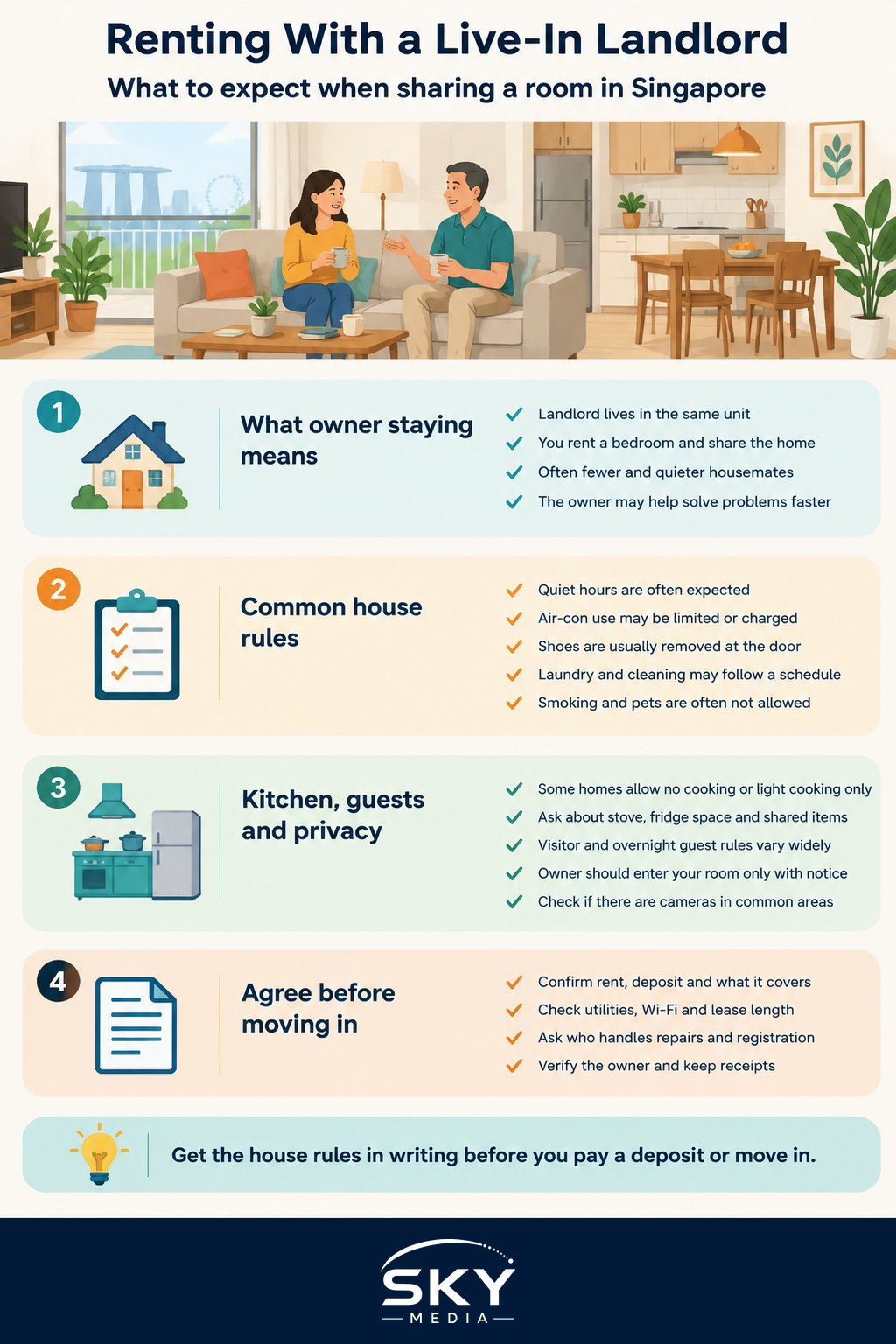
What “Owner Staying” Usually Means
An owner-staying listing means the landlord, often with family members, lives in the same unit. You rent a bedroom (a common room without attached bathroom, or a master room with one) and share the rest of the home.
Compared with renting a room in a flat where the owner lives elsewhere, expect:
- More structure. The owner sets the household rhythm, from quiet hours to how the kitchen is used.
- Fewer, often quieter, housemates. Many owner-staying homes take only one or two tenants.
- Someone on site for problems. A broken fan or leaking tap is often dealt with quickly.
- Less anonymity. Your comings and goings, guests and habits are more visible.
Many tenants love the arrangement, especially those who are new to Singapore and appreciate a local who can explain how things work. Others find it too restrictive. Our comparison of renting a room vs a whole unit helps if you are still deciding which route suits you.
The House Rules You Will Commonly See
Rules vary by household, and none of these are universal, but these are common in owner-staying homes:
- Quiet hours in the late evening, especially where there are children or elderly family members.
- Air-conditioning limits, such as use only at night, or a separate charge if you use it heavily. Some homes include utilities up to a cap.
- Shoes off at the door, which is standard in most Singapore homes.
- Laundry arrangements, such as set days or times for the washing machine, and where to hang clothes.
- Cleaning duties, either a rota for shared areas or the owner’s cleaner covering common spaces.
- No smoking indoors, and sometimes not on the balcony or at the window either.
- Pets are generally not allowed for tenants.
- Religious or cultural practices, such as no beef or pork brought into the home, or prayer altars that should not be disturbed.
Ask for the rules in writing before you sign, and ask about anything not covered. A rule that seems minor at a viewing can become a daily irritation.
Cooking and Kitchen Limits
The kitchen is the most common source of friction. Typical arrangements include:
- No cooking at all, sometimes called “no cooking” or “light cooking only” in listings.
- Light cooking, meaning boiling, reheating, microwaving or simple stir-fries without heavy smoke or strong smells.
- Full cooking with a shared fridge shelf and cupboard space.
- Cooking at set times so you are not competing with the family’s meal preparation.
Questions to settle at the viewing:
- Can I use the stove, oven and rice cooker, or only the microwave and kettle?
- Is there fridge and freezer space for me, and how much?
- Are strong-smelling foods an issue? This matters for many cuisines, including frying fish, durian or heavily spiced dishes.
- Who buys shared items like dish soap and cooking oil?
If you cook most of your meals, a no-cooking home will cost you more in hawker meals and may feel limiting. Be honest with yourself about how you eat.
Visitors, Overnight Guests and Privacy
Owners are usually protective of their homes, so visitor rules can be strict.
| Topic | Common owner-staying arrangement | What to clarify before signing |
|---|---|---|
| Daytime visitors | Allowed with notice, or only in your room | Notice needed, which areas guests may use |
| Overnight guests | Often not allowed | Any exceptions, such as visiting family |
| Partner visits | Varies widely by household | Frequency allowed, and whether staying over is ever acceptable |
| Owner entering your room | Should be with notice except emergencies | How much notice, and whether you get your own key and lock |
| Shared bathroom | Shared with the owner or other tenants | Cleaning, shower times, storage space |
On privacy:
- Your room is your space. Agree that the owner will not enter without notice except in an emergency or for agreed repairs.
- Cameras. It is reasonable to ask whether there are cameras in common areas. Cameras inside a tenant’s bedroom or bathroom are never acceptable.
- Mail and deliveries. Agree how parcels are handled and whether the owner can accept them for you.
- Personal life. Expect some curiosity, especially from older family members. Friendly boundaries usually work better than strict secrecy.
What to Agree Before You Move In
A written tenancy agreement protects both sides, even for a single room. Make sure it covers:
- Rent, deposit and what the deposit covers. One month’s deposit is common for a one-year room lease, but terms vary.
- Utilities and Wi-Fi. Whether they are included, capped, or split.
- Lease length and notice period, including any diplomatic or early termination clause for work pass holders.
- House rules, attached or written in.
- Repairs. Who fixes what. Our guide on repairs and maintenance for tenants explains the usual split.
- Registration. HDB owners renting out rooms must follow HDB’s rules, including registering tenants and limits on occupants, and private properties have their own minimum stay and occupancy rules under URA. Ask the owner to confirm the rental is properly registered, and check the current rules on the HDB or URA website.
Before handing over money, verify the person is the owner (for example by viewing the unit with them in person), never transfer a deposit for a room you have not seen, and keep receipts. Our checklist of what to check before renting a condo room covers more due diligence steps.
Making the Arrangement Work Day to Day
Most owner-staying arrangements succeed through small courtesies:
- Say hello and goodbye. It sounds minor, but it builds goodwill.
- Clean up immediately after cooking or using the bathroom.
- Mention changes early, such as working night shifts or a friend visiting from overseas.
- Respect family routines, such as festival preparations or prayers, and ask if unsure.
- Raise problems calmly and early, ideally in person and then confirmed by message, so there is a record.
If the relationship breaks down, review your agreement, give the required notice, and keep communication polite and in writing. For disputes over deposits or contract terms, the Small Claims Tribunals may be an option; check the current scope and process on the State Courts website.
A room with a live-in landlord can be an affordable and welcoming first home in Singapore, as long as the expectations on both sides are clear from day one.
Further reading: How to Rent Without a Local Credit Record · What to Do If Your Landlord Sells the Property · How to Find a Roommate in Singapore Safely