

For many people here, getting around is easy without a car at all. Public transport is dense, taxis and ride-hailing are everywhere, and the heartlands are walkable. So when the question of renting vs owning a car singapore comes up, the honest starting point is that neither one is automatically right. It depends on how often you drive, why you drive, and how much certainty you want in your monthly budget. This guide walks through the trade-offs in plain terms so you can weigh them against your own life.
This is general information to help you think it through, not financial or motoring advice. Your numbers will be personal to you, so do your own sums and check current costs before committing.
The two models, in plain terms
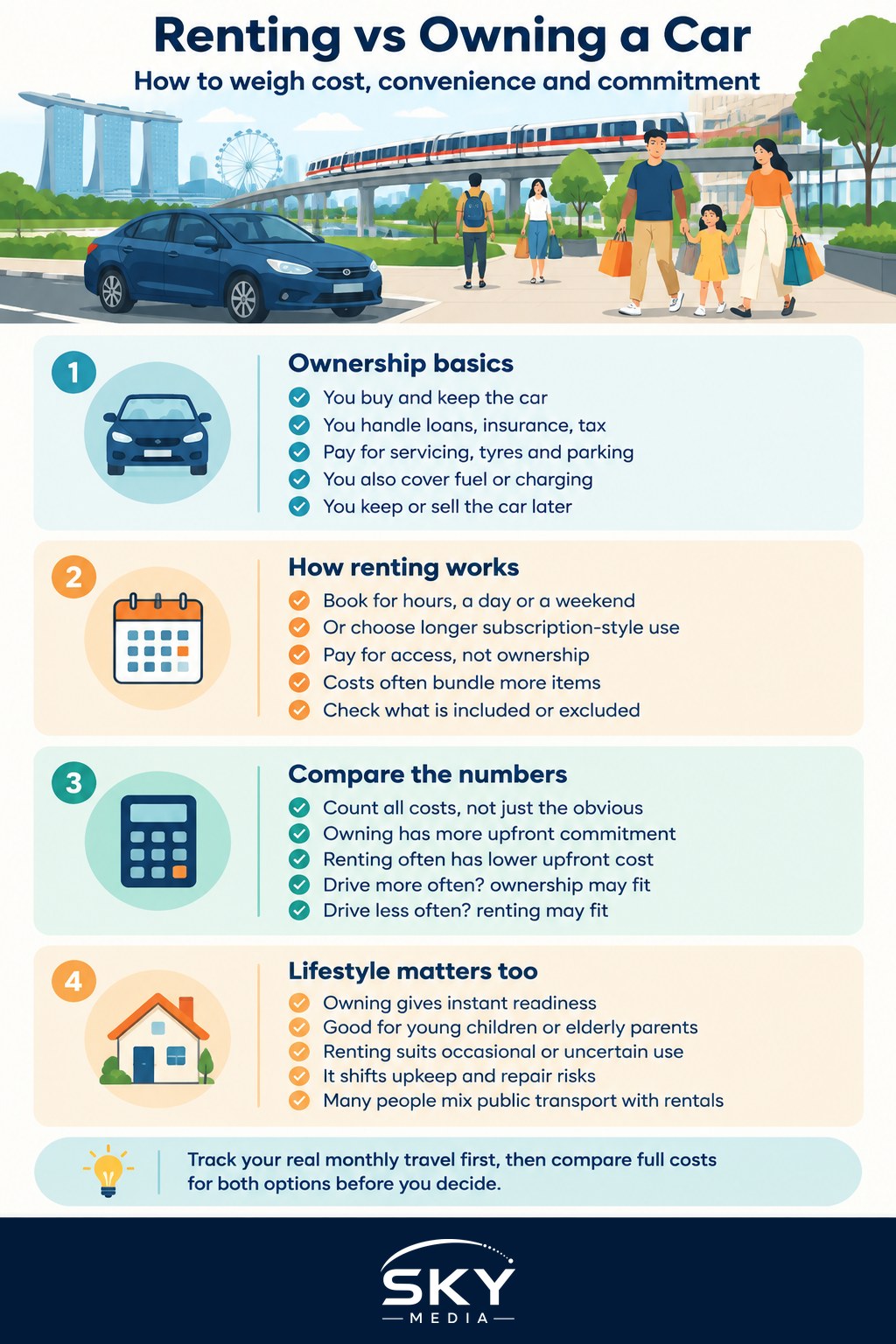
Owning a car means you buy the vehicle and hold responsibility for it. In Singapore, car ownership is famously more involved than in many countries because of the way vehicles are taxed and regulated, so the true cost of owning is much more than the sticker price. On top of the purchase, an owner is responsible for financing if a loan is used, insurance, road tax, servicing, tyres, parking, fuel or charging, and the eventual resale or scrapping of the car. Ownership rewards you with a car that is always there, set up exactly how you like it, ready at a moment’s notice.
Renting covers a spectrum. At one end is short-term rental, where you book a car for a few hours, a day, or a weekend and hand it back. At the other end is longer subscription-style or lease rental, where you pay a recurring fee that typically bundles the vehicle plus some of the running costs into one predictable amount. The common thread is that you pay for access rather than ownership, and you avoid tying up a large sum in the car itself.
Comparing the costs honestly
The most useful thing you can do is compare on a like-for-like basis. Owning tends to have a large upfront commitment and then ongoing running costs, some fixed and some variable. Renting tends to have little or no upfront outlay and a higher per-use or per-month rate that often folds several costs together.
A few principles help when you run your own figures:
- Count everything, not just the obvious. For ownership, that means insurance, road tax, maintenance, parking at home and at work, fuel or charging, and the fact that a car loses value over time. For renting, read what the rate includes and what it excludes, such as mileage caps, excess charges, and insurance terms.
- Match the model to your mileage. Broadly, the more you drive, the more owning tends to make sense per kilometre, because you spread the fixed costs over more use. The less you drive, the more renting can look attractive, because you only pay when you actually need a car.
- Think in total cost over a realistic period, not per month in isolation. A low monthly figure with a big commitment attached is not always cheaper than a higher figure with no strings.
Because prices and taxes here change over time, avoid anchoring on any single number you saw once. Get current quotes for your situation before you decide.
Beyond the money
Cost is only half the picture. The rest is about how a car fits your life.
Convenience and readiness favour owning. Your car is downstairs, your child’s seat is already fitted, and you can leave at 6am without booking anything. If you have young children, elderly parents, or a job that needs a vehicle at odd hours, that reliability has real value that a spreadsheet does not fully capture.
Flexibility and low commitment favour renting. If your driving is occasional, seasonal, or uncertain, renting lets you avoid a long financial tie. It also shifts the risks of maintenance, depreciation, and unexpected repairs onto the provider. If you are not sure whether you will still need a car in a year, that freedom is worth something too.
There is also a middle path many people take: rely on public transport and ride-hailing for daily life, and rent a car only for the trips that genuinely need one. For a lot of households, that combination works out cheaper and simpler than full ownership, without giving up the occasional road trip or big grocery run.
How to decide for your situation
Start by tracking how you actually move around for a typical month, not how you imagine you might. Note the trips a car would genuinely improve, and be honest about the ones public transport already handles well. Then price both models for that real pattern of use, including the costs that are easy to forget.
It helps to slot the decision into your wider money plan rather than treating the car in isolation. A vehicle is one of the larger recurring commitments a household takes on, so it deserves the same care as any big expense. Building the habit of budgeting in Singapore and understanding the cost of living in Singapore will make the trade-offs clearer. If you do lean towards owning and need to borrow, read up first on financing a car in Singapore so the loan does not stretch you thin. And if you are weighing this alongside a housing decision, the same rent-or-buy thinking applies to your home, as covered in rent vs buy your home in Singapore.
The practical wrap-up
There is no universal winner in the renting versus owning debate. Owning suits frequent drivers and households that value a car being ready at all times and are comfortable with the upfront commitment. Renting suits occasional or uncertain drivers who prefer predictable, low-commitment costs and want to skip the hassles of upkeep and depreciation. Run your own numbers on your real usage, count every cost on both sides, and pick the model that fits your life and your budget rather than what anyone else drives. Whatever you choose, keep it comfortably within what you can afford, and revisit the decision if your circumstances change.
Frequently Asked Questions
Is car sharing cheaper than renting or owning for occasional drivers? It often can be for occasional trips, since you pay only for the time you use. Compare the hourly or daily rate, mileage charges and fuel arrangements against your actual pattern. For frequent use, the per-use cost can add up.
What does a rental car’s insurance usually leave out? Terms differ, but commonly an excess applies if the car is damaged, and some charges, such as mileage caps or fines, may sit outside the cover. Read the rental agreement before you sign and ask what you would pay in an accident.
Do I need a Certificate of Entitlement to rent a car? No, the COE is a matter for the person who registers the vehicle, which is the rental company when you rent. That is part of why renting avoids tying up a large sum. Check LTA for current rules if you plan to own.
Can a foreign driving licence be used to rent a car here? It depends on your licence and how long you are staying, and LTA sets the rules on using a foreign licence. Rental companies also have their own requirements. Check LTA’s current guidance and ask the company before you book.
Is it worth keeping a car if I only use it on weekends? Often not, since the fixed costs of insurance, road tax, parking and depreciation continue every day. Add up what you spend in a year and compare it with renting for those weekends. The convenience may still be worth it for some households.
Further reading: Balloon Financing and Lease-to-Own Cars in Singapore