
If you have watched someone slap the touch screen of a maimai cabinet at full speed or drum a perfect run on Taiko no Tatsujin, you know rhythm games look as fun as they play. The good news is that the rhythm arcade Singapore scene is alive and welcoming, with music machines found in arcades across the island. This guide explains where these games usually live, how to find the machine you want, how arcade cards and queues work, and how to fit into the local player community.
If you are new to the genre itself, start with our explainer on getting into rhythm games, then come back here to find a cabinet.
The Main Rhythm Cabinets You Will See
Arcades rotate machines over time, but these are the rhythm games players most often look for:
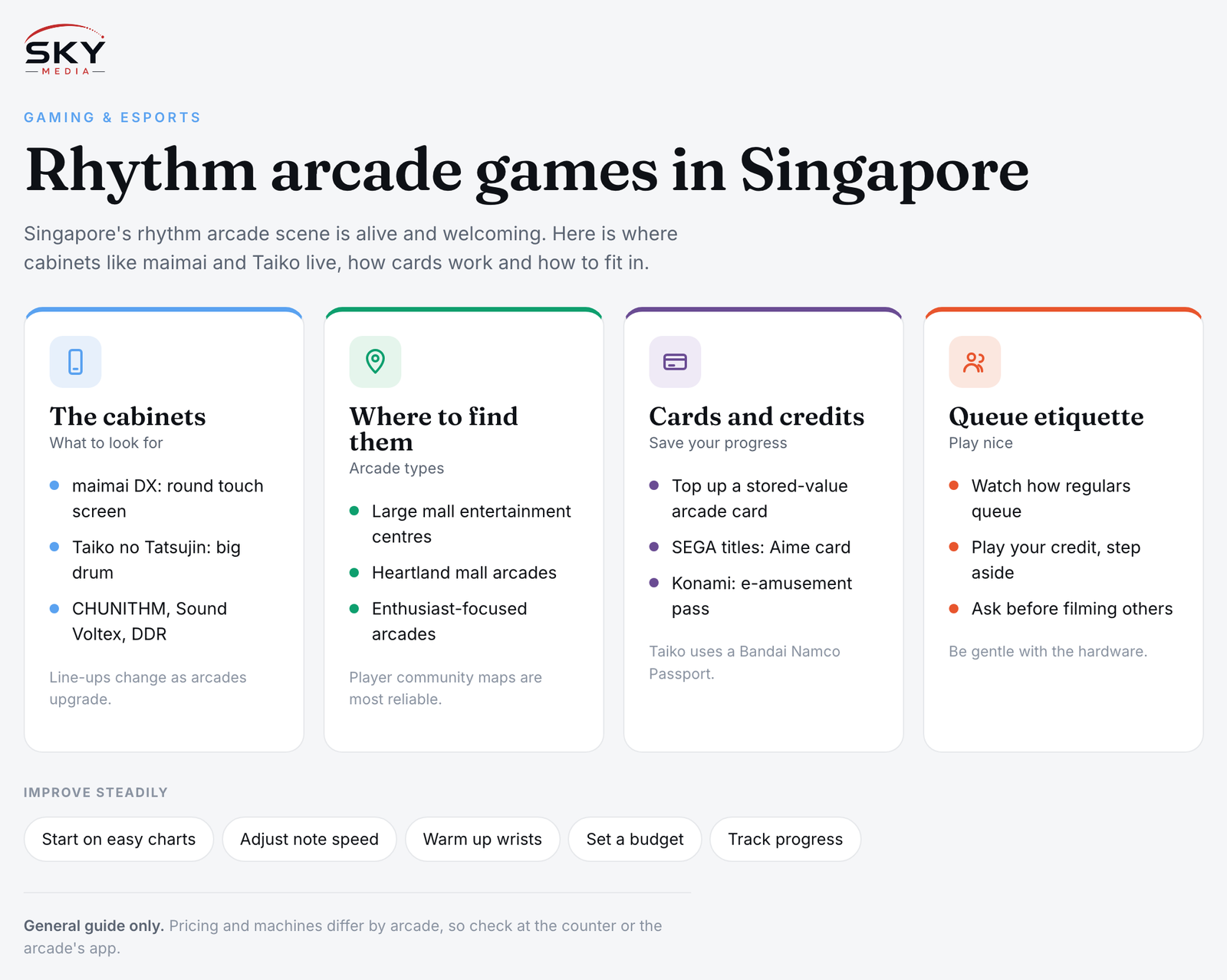
- maimai DX. SEGA’s game with a round, washing machine style screen ringed by buttons. You tap, hold and slide along the ring and touch screen. It is one of the most popular rhythm games among young adults and has a large following.
- Taiko no Tatsujin. Bandai Namco’s drumming game. You hit the face and rim of a big taiko drum with sticks. It is beginner friendly, great for pairs and a favourite for families.
- CHUNITHM. Another SEGA title, with a slider pad of touch sensors and air sensors above it that read hand movements. It suits players who like keyboard-style precision.
- Sound Voltex. Konami’s game with buttons and two knobs that control lasers on screen. It has a distinctive electronic music focus.
- Dance games. Titles such as Dance Dance Revolution and Pump It Up use floor panels for your feet. They are more of a workout and a great spectator draw.
- Other music games. Depending on the arcade you may also see beatmania IIDX, Jubeat, Groove Coaster or similar titles.
Not every arcade carries every game, and machine line-ups change as arcades upgrade, swap or retire cabinets.
Where Rhythm Machines Usually Live in Singapore
Without naming specific operators, here is where rhythm cabinets tend to turn up:
- Large arcades in major malls. Bigger family entertainment centres in shopping malls, both in town and in regional hubs, often have a dedicated music game corner. These tend to carry the newer versions.
- Heartland and neighbourhood mall arcades. Smaller arcades in suburban malls may have one or two popular rhythm machines, often Taiko or maimai, mixed in with claw machines and redemption games.
- Specialist and enthusiast-focused arcades. A few arcades lean towards Japanese titles and serious players, with multiple cabinets of the same game and better maintained controls.
- Entertainment complexes and attractions. Some leisure venues with bowling, karaoke or mini golf include a small arcade section. See our guide to mini golf and arcades in Singapore for the wider arcade scene.
The most reliable way to find a specific machine is to search player communities. Fans keep shared lists and maps of which cabinets are where, and official game websites for some titles have location finders. Social media groups and chat servers for each game are the quickest way to hear about new installs or removals.
How to Compare Arcade Options
| Arcade type | What to expect | Good for |
|---|---|---|
| Large mall entertainment centre | Newer versions, several music games, busy on weekends | Trying many games in one trip |
| Neighbourhood mall arcade | One or two rhythm cabinets, quieter on weekdays | Casual play close to home |
| Enthusiast-focused arcade | Multiple cabinets, regular players, well kept controls | Improving scores and meeting the community |
| Leisure venue arcade corner | Limited rhythm choice, mixed with other activities | A group outing with friends |
Arcade Cards, Credits and Saving Your Progress
Most arcades in Singapore run on a stored-value arcade card or a tap system rather than coins. You top up the card and tap it on the machine to play. Pricing differs by arcade, game and time of day, and some offer bonus credit for larger top-ups, so check at the counter or on the arcade’s own app or website.
Rhythm games also usually support a separate player card that saves your scores, unlocks and progress:
- SEGA games such as maimai DX and CHUNITHM commonly use an Aime card.
- Konami games such as Sound Voltex and Dance Dance Revolution use an e-amusement pass.
- Bandai Namco games such as Taiko no Tatsujin use a Bandai Namco Passport card.
These cards are usually sold at the arcade counter or from a vending machine where available. Some phones and transit-style cards can be registered on certain systems, but this varies, so ask staff or check community guides first. Linking your card to the game’s official website or app lets you track your scores and settings.
Queue Etiquette and Community Tips
Popular rhythm cabinets can have a queue, especially on weekend evenings and school holidays. The community runs on unwritten but widely shared habits:
- Join the queue properly. Many arcades use a “card on the cabinet” or coin-on-the-ledge style queue, or a simple line. Watch what regulars do, or ask politely.
- Respect play limits. If there is a queue, play your credit and step aside. Some arcades post a set number of plays per turn.
- Use your own gloves if you like. Many maimai and CHUNITHM players wear thin gloves for smoother slides and hygiene. Taiko players can bring their own sticks, but check that the arcade allows it.
- Be gentle with the hardware. Hitting buttons or the drum harder does not improve your score and wears out the machine. Report faulty buttons or sensors to staff rather than forcing them.
- Keep your volume in check. Headphones are allowed on many cabinets with a headphone jack, which helps you hear the music in a noisy arcade.
- Don’t record others without asking. Filming your own play is common, but ask before filming someone else’s run.
- Say hello. Regulars are often happy to share tips on settings like note speed and timing offsets.
Players also stay connected online through chat groups, social media pages and score-sharing sites. Communities sometimes organise casual meet-ups and friendly local tournaments. If you prefer something social but less fast-paced, our guide to where to play board games in Singapore is another good weekend option.
Getting Better Without Burning Out
Rhythm games are addictive in a good way, but they can be tiring on the wrists and wallet.
- Start on the easy difficulties. Clearing basic charts builds accuracy that carries over to harder songs.
- Adjust note speed. Many players raise the scroll speed early, which can make dense patterns easier to read.
- Warm up and rest. Stretch your hands and wrists, especially for maimai, CHUNITHM and Taiko, and take breaks if anything aches.
- Set a budget. Decide your top-up amount before you go, and stick to it.
- Track progress, not just ranks. Saving scores on your player card helps you see improvement over weeks and months.
Whichever cabinet becomes your favourite, the best part of the rhythm arcade scene is the people. Show up, be courteous, and you will soon find friends to queue, play and improve with.
Further reading: Where to Try Sim Racing and F1 Simulators in Singapore