
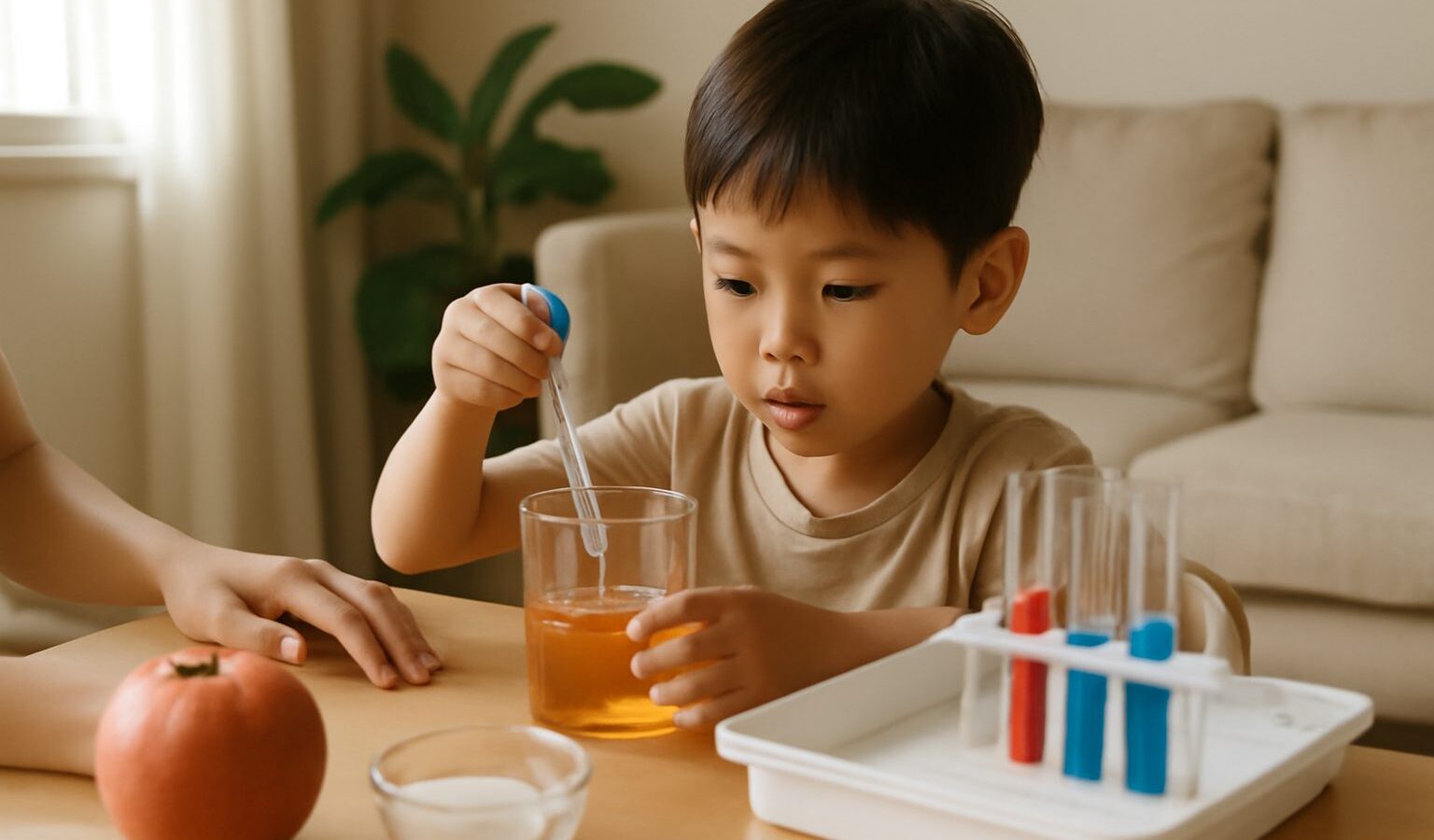
Science experiments for kids in Singapore do not need a laboratory, expensive kits or a science degree. Some of the best learning happens at the kitchen table with things you already have in the cupboard. A simple experiment turns an ordinary afternoon into a moment of wonder, and it teaches children something far more valuable than any single fact: how to ask a question, make a guess, test it and see what happens. This guide shares safe, easy experiments using household items, along with a gentle method for making the most of them and an important safety note to keep everyone happy and unharmed.
Why Home Experiments Are So Valuable
Children are natural scientists. They poke, mix, question and test the world constantly. Home experiments simply give that curiosity a shape. When a child predicts what will happen and then watches to find out, they are practising the heart of scientific thinking, and they are doing it through play.
There is another quiet benefit. Home science is low pressure. There are no marks, no right answers to memorise and no fear of getting it wrong. If an experiment flops, that is not a failure but a result to talk about. This relaxed setting helps children associate science with delight rather than stress, which serves them well long before and long after it appears on a school syllabus.
A Simple Method to Follow
You can make any experiment richer by wrapping it in a few gentle steps. You do not need to be formal about it. Just ask a few questions along the way.
- Ask. What do you think will happen? Let your child make a prediction out loud.
- Do. Carry out the experiment together, slowly enough to watch closely.
- Notice. What actually happened? Was it what you expected?
- Wonder. Why might it have happened that way? What could we change and try again?
That final question, what could we change, is where the real learning lives. Repeating an experiment with one small difference teaches children that science is about testing ideas, not just watching tricks.
Safety First
Before any experiment, a clear word on safety. Simple home science is very safe when a few rules are followed, and teaching those rules is part of the learning.
An adult should always supervise, especially with younger children. Stick to safe household items such as water, food colouring, baking soda, vinegar, salt, oil, washing-up liquid and paper. Never use bleach, strong cleaning chemicals or anything that is not meant to be handled, and never mix cleaning products together. Avoid experiments involving heat, flames, boiling water or the stove unless an adult is fully in charge of that part. Keep small items away from toddlers who might put things in their mouths, and wash hands afterwards. When in doubt, choose the gentler version of an activity. A calm, well supervised experiment is a happy one.
Easy Experiments to Try
Here are a few reliable favourites that use everyday items found in most Singapore homes. Each one invites a prediction before you begin.
The classic fizzing reaction. Put a spoon of baking soda in a cup or a small bowl, then slowly pour in some vinegar. It will fizz and bubble as a gas is released. Ask your child why they think it bubbles, then try adding a drop of food colouring or a squirt of washing-up liquid to change the effect.
Walking water. Line up a few clear cups, fill alternate ones with water tinted by different food colourings, and connect them with folded strips of kitchen paper. Over an hour or two, watch the water travel along the paper and mix new colours in the empty cups. It is slow, quiet and rather magical.
Sink or float. Fill a basin with water and gather small safe objects such as a coin, a plastic toy, a leaf, a cork and a spoon. Before dropping each one in, ask your child to guess whether it will sink or float, then test it. Talk about what the floating things have in common.
Rainbow in milk. Pour a thin layer of milk into a plate, add a few drops of different food colourings near the middle, then touch the surface with a cotton bud dipped in washing-up liquid. The colours swirl and dance as the soap moves the fats in the milk.
Grow a bean. Fold a damp piece of kitchen paper into a clear cup or jar and tuck a dried bean against the side where it can be seen. Keep the paper moist and place it near light. Over days, your child watches roots and a shoot appear, a wonderful lesson in patience and living things.
The table below sums up these starters, what they use and the idea behind each.
| Experiment | What you need | The idea it explores |
|---|---|---|
| Fizzing reaction | Baking soda, vinegar | A chemical reaction makes gas |
| Walking water | Cups, water, kitchen paper, colouring | Water moves and colours mix |
| Sink or float | Basin, water, small objects | Why some things float |
| Rainbow in milk | Milk, colouring, soap, cotton bud | Soap moves fats in milk |
| Grow a bean | Bean, jar, kitchen paper | How seeds sprout and grow |
Making It Last
The aim is not to rush through a list but to enjoy the exploring. Follow your child’s questions, even the odd ones, and be willing to try the same experiment again with a twist. If they want to know what happens with more vinegar, or warmer water, or a different object, that curiosity is the whole point.
Science experiments for kids in Singapore work best when they feel like play rather than schoolwork. Keep them short, keep them safe, and let your child lead the wondering. You are not just filling an afternoon. You are showing a child that the world is full of interesting questions and that they are perfectly capable of exploring the answers.