
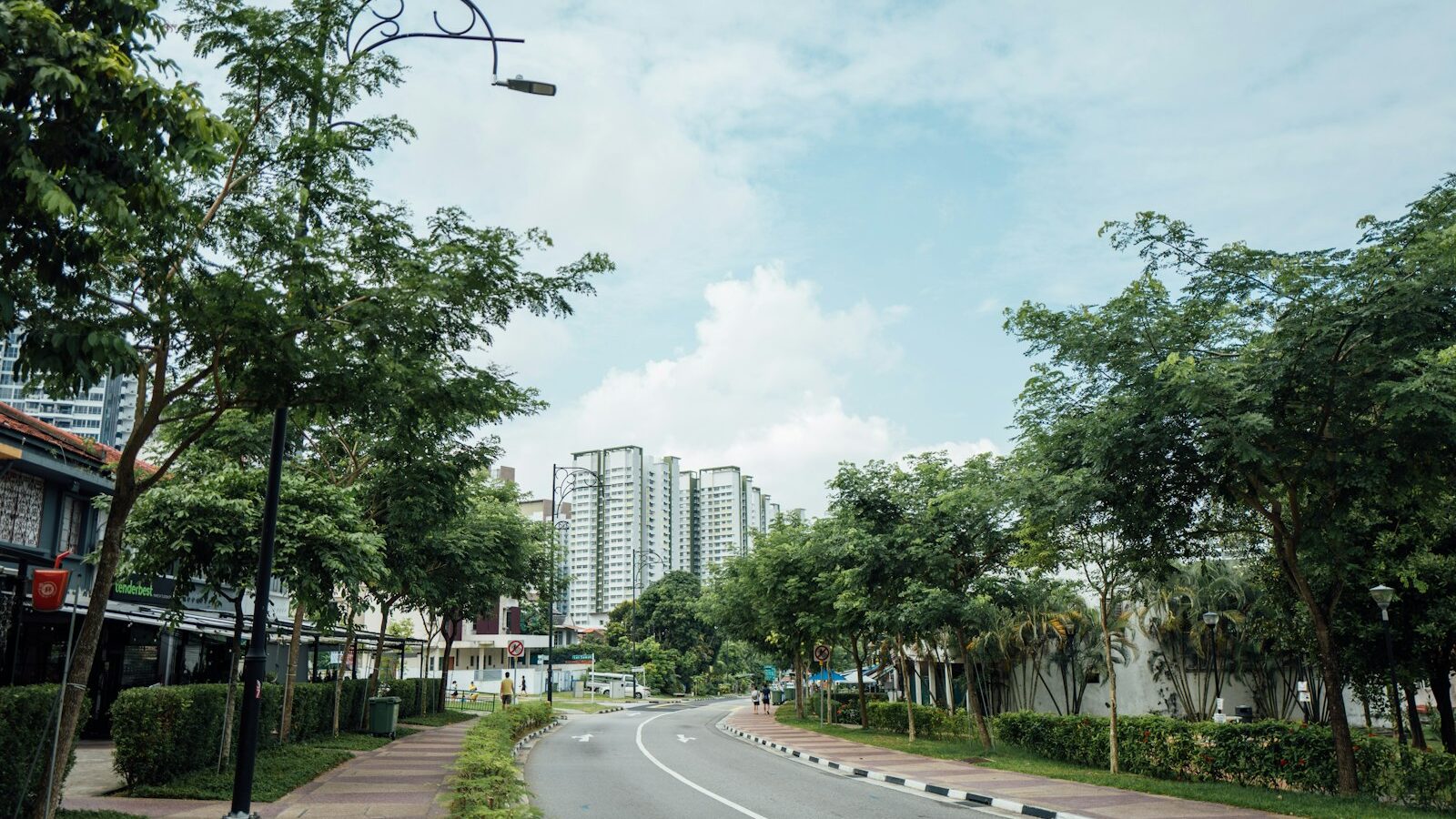
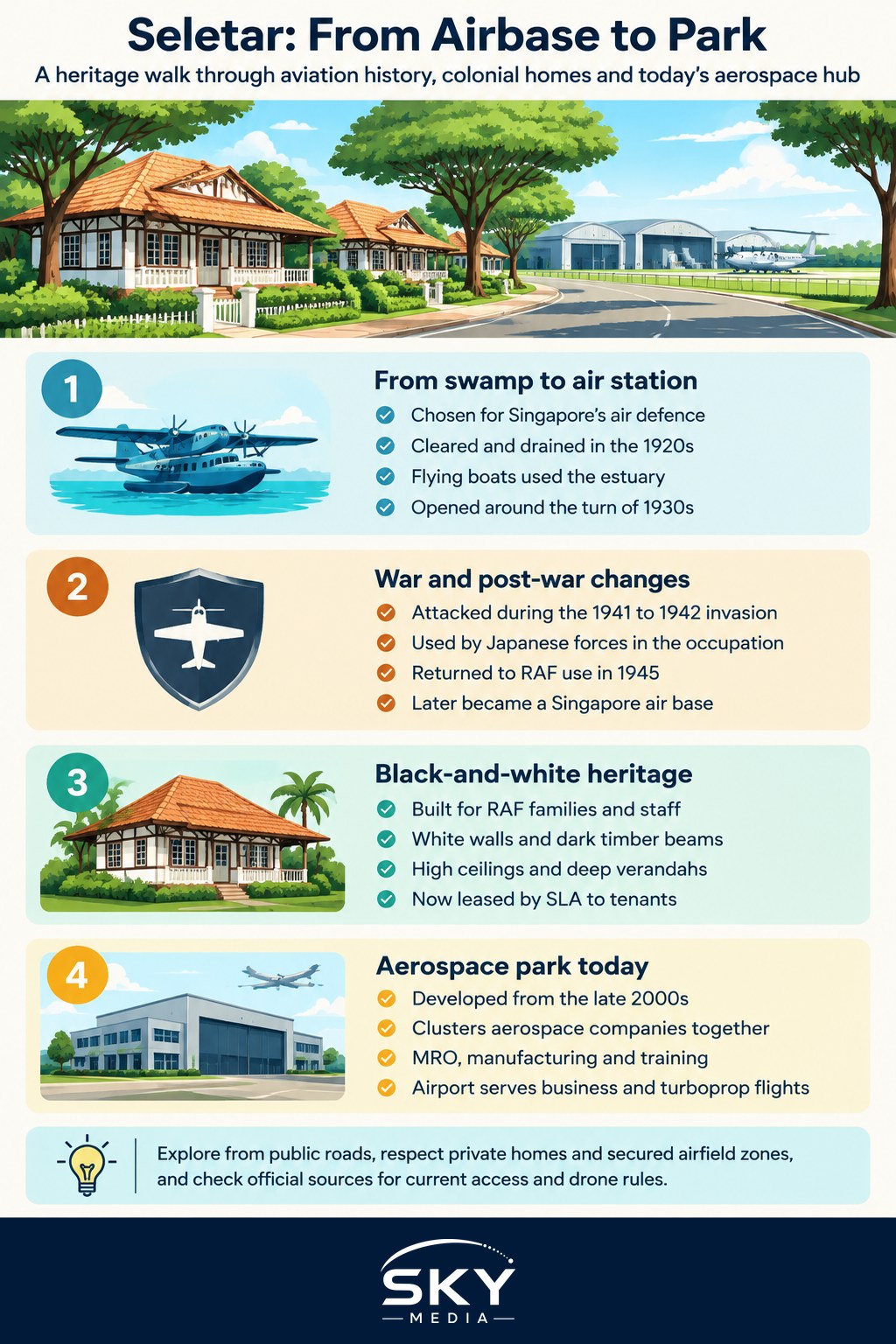
Drive into Seletar today and you pass gleaming aviation hangars, then turn a corner into leafy lanes lined with colonial bungalows that feel like another century. That contrast is the heart of Seletar heritage. This corner of north-eastern Singapore was once home to the first Royal Air Force station in the Far East, a key site in Singapore’s wartime and post-war story, and is now one of the country’s main aerospace hubs. Here is how Seletar got from there to here, and how to explore it thoughtfully.
The Birth of RAF Seletar
In the 1920s, the British decided to strengthen Singapore’s defences as part of their plan to make the island a fortress guarding their interests in Asia. Alongside the naval base at Sembawang, they chose the swampy, rubber-planted land at Seletar for an air base.
Clearing the land and draining the marshes was a large undertaking. Flying boats of the RAF’s Far East Flight arrived in the late 1920s, using the waters of the Seletar estuary to take off and land, and the station was formally opened around the turn of the 1930s. Seletar’s runway, hangars and slipways made it a major base for both land planes and flying boats, and for many years it was also used for civil flights before Kallang Airport opened in 1937.
Seletar is not the only place in Singapore with aviation roots. The island’s very first flight took place years earlier on a racecourse, a story told in our guide to Farrer Park heritage.
War, Occupation and the Post-War Years
When the Japanese invasion came in 1941 to 1942, Seletar was among the airfields attacked early in the Malayan campaign. After the fall of Singapore in February 1942, the base was used by Japanese forces during the occupation.
The British returned after the war in 1945, and RAF Seletar resumed its role as a major station. Through the 1950s and 1960s, it supported operations during the Malayan Emergency and later the period of Konfrontasi (the confrontation with Indonesia in the early 1960s). It was a busy, self-contained community, with families, schools, clubs, shops and sports grounds as well as aircraft.
When Britain announced the withdrawal of its forces east of Suez, the base was handed over to Singapore around the start of the 1970s. It became a Singapore military air base, and over the following decades the airfield took on a growing civil role as Seletar Airport, used by private, training and some commercial flights.
The Black-and-White Houses
Seletar’s most photographed heritage is its cluster of colonial houses built for RAF officers, airmen and their families. These are often called black-and-white houses, a style common to British colonial bungalows in Singapore: whitewashed walls, dark-painted timber beams and trims, raised floors, deep verandahs, high ceilings and large windows designed for airflow in the tropical heat, long before air-conditioning.
Highlights of the old camp estate:
- Street names from home. Many roads in the former camp were named after places in Britain, especially London, so you will see names that sound like a Monopoly board. They give the area its quirky, nostalgic feel.
- Varied house sizes. The houses ranged from grand bungalows for senior officers to more modest semi-detached homes and terrace-style quarters, reflecting military rank.
- Mature trees and open lawns. The generous garden plots and old rain trees create a calm, green setting.
Today, these properties are state-owned and managed by the Singapore Land Authority (SLA), which leases them to tenants. Some have become homes, while others are used as cafés, restaurants, schools or offices. Their conservation keeps a rare, intact picture of a colonial military village. If you are interested in historic greenery, our guide to heritage trees and historic parks is a good companion read.
Seletar Aerospace Park Today
From the late 2000s, the government began transforming the land around the airfield into Seletar Aerospace Park, developed by JTC Corporation (Singapore’s industrial land developer). The idea was to cluster aerospace companies in one place, close to a working airfield.
The park now houses a wide range of aerospace activity:
- Maintenance, repair and overhaul (MRO) of aircraft, engines and components.
- Manufacturing and assembly of aerospace parts.
- Business and general aviation, including private jets and training.
- Education and training for aviation careers.
Seletar Airport received a new passenger terminal in the late 2010s, and today it mainly handles turboprop flights, business jets and general aviation, while Changi handles the large jets. If you are flying from here, our Seletar Airport guide explains what travellers should know.
Then and Now at a Glance
| Era | What Seletar was | What you can still see |
|---|---|---|
| 1920s to 1941 | RAF’s first Far East air station, flying boats and land planes | Camp layout, British street names |
| 1942 to 1945 | Occupied airfield during the Japanese occupation | Historical records and memorial accounts |
| 1945 to around 1971 | Busy RAF station and family community | Black-and-white houses, mature trees |
| 1970s onwards | Singapore military and civil airfield | Seletar Airport and runway |
| Late 2000s to today | Seletar Aerospace Park and business aviation hub | Modern hangars beside conserved houses |
How to Explore Seletar Respectfully
Seletar is a working area, not a museum, so plan your visit with care.
- Remember people live here. Many black-and-white houses are private homes on lease. Admire and photograph from public roads, and do not enter gardens, peer through windows or block driveways.
- Respect restricted zones. The airfield and some aerospace facilities are secured areas. Obey all signs and do not fly drones near the airport, as drone rules around aerodromes are strict. Check the Civil Aviation Authority of Singapore (CAAS) website for current drone regulations.
- Go early or late. Midday heat in Singapore is intense. Morning or late afternoon gives softer light for photos and is more comfortable for walking. Carry water and use sun protection.
- Getting there. Seletar is not as well served by public transport as central areas, so check bus routes on a journey planner or consider a ride-hailing service. Driving is straightforward, but follow parking rules.
- Combine with nearby green spaces. You can pair a Seletar walk with a visit to Upper Seletar Reservoir Park, or head north-west to Sembawang for its own naval heritage.
For deeper history, the National Archives of Singapore, the National Library Board’s Infopedia and National Heritage Board resources hold photographs and accounts of RAF Seletar and its community. Heritage groups also run occasional guided walks, so check their channels for upcoming dates.
Why Seletar Matters
Seletar tells Singapore’s story in miniature: a colonial military outpost, a wartime battleground, a post-war community, and finally a modern, high-tech industrial hub. Few places let you stand among 1930s officers’ bungalows and hear modern aircraft engines in the same moment. Taking time to understand that layered history makes a quiet drive through Seletar’s lanes far more rewarding.