
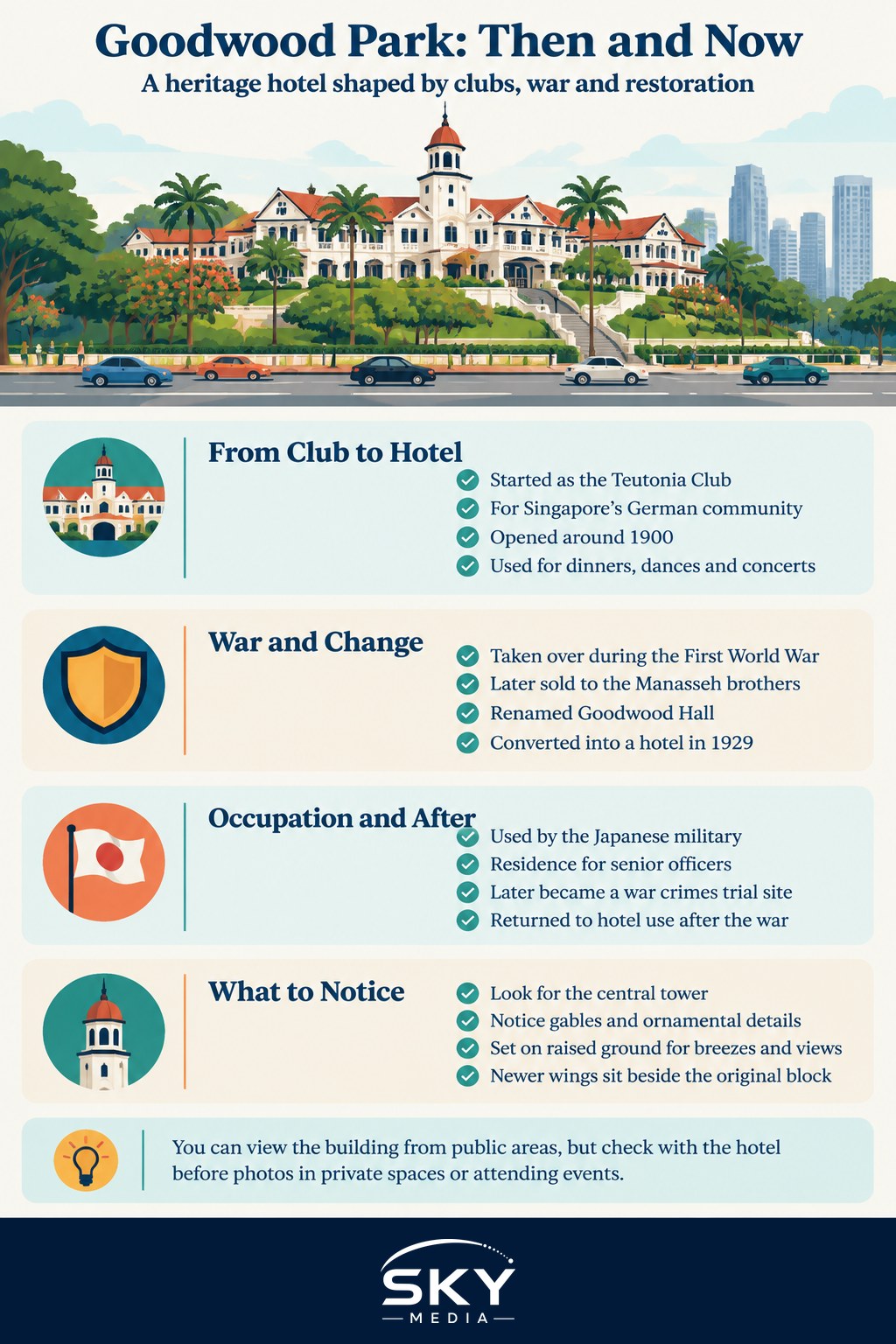
Tucked on a small hill off Scotts Road, just a short walk from the Orchard Road crowds, stands a white building with a distinctive tower that looks like it belongs in a Rhine valley town. Goodwood Park Hotel history stretches back more than a century, to a time when the building was not a hotel at all but a private club for Singapore’s German community. Since then it has been an entertainment hall, a wartime headquarters, a war crimes court and one of Singapore’s best-known heritage hotels.
This guide traces that story and explains what to look out for if you visit. For exact dates and architectural details, the National Heritage Board’s Roots.gov.sg portal and the Preservation of Sites and Monuments division are the best official references.
The Teutonia Club Years
In the late 19th century, Singapore had a small but active German community of merchants, traders and shipping agents. Like other expatriate groups of the time, they had their own social club, the Teutonia Club. As the community grew, the club built a new clubhouse on a rise of land off what is now Scotts Road, which opened around 1900.
The design reflected the members’ homeland. The architect, commonly credited as R.A.J. Bidwell of the firm Swan and Maclaren, gave the building a romantic, European look with a prominent tower, gables and decorative details that recall German and Central European architecture. Bidwell is also associated with other well-known Singapore buildings of the era, including parts of Raffles Hotel.
For members, the club was a place for dinners, dances, concerts and social gatherings. It was a slice of home in a hot, distant colony, set in landscaped grounds that were then on the quiet edge of town.
War, Seizure and a New Name
The outbreak of the First World War in 1914 changed everything. Germany and Britain were now enemies, and Singapore was a British colony. German nationals were interned, and the Teutonia Club property was taken over by the colonial authorities as enemy property.
After the war, the property was sold. It was bought by the Manasseh brothers, members of a Baghdadi Jewish family active in Singapore business, who renamed it Goodwood Hall. Through the 1920s it became a venue for events, performances and social functions. In 1929 it was converted into a hotel, Goodwood Park Hotel, and soon gained a reputation as one of the finer places to stay in Singapore.
The Second World War and After
During the Japanese Occupation of Singapore from 1942 to 1945, the hotel was taken over by the Japanese military and used as a residence for senior officers. Like many grand buildings of the time, it was absorbed into the occupying administration’s needs.
After the Japanese surrender, the British returned and the building took on a sombre role. It was used as a venue for war crimes trials, where Japanese personnel accused of wartime atrocities were tried. This chapter is less often mentioned in glossy hotel histories, but it is an important part of the site’s story and connects it to Singapore’s wider memory of the war.
The property was later returned to private hands and resumed life as a hotel. Over the following decades it changed ownership and was expanded with new wings, while the original clubhouse remained its heart.
The table below sums up the building’s main roles over time.
| Period | Role of the building | Key point |
|---|---|---|
| Around 1900 to 1914 | Teutonia Club | Social club for Singapore’s German community |
| 1914 to 1918 | Enemy property | Taken over by colonial authorities during the First World War |
| Late 1910s to 1920s | Goodwood Hall | Entertainment and event venue under the Manasseh family |
| 1929 onwards | Goodwood Park Hotel | Converted to a hotel, gaining a reputation for luxury |
| 1942 to 1945 | Japanese military use | Residence for senior officers during the Occupation |
| Post-war | War crimes court, then hotel again | Site of trials before returning to hotel use |
| 1989 | National monument | The original tower block gazetted for preservation |
Becoming a National Monument
In 1989, the original Tower Block of Goodwood Park Hotel was gazetted as a national monument. National monuments are buildings and structures given the highest level of protection in Singapore because of their historical, cultural, architectural or social significance. Once gazetted, a monument must be preserved, and changes to it are closely controlled by the authorities.
Being both a working hotel and a national monument is a balancing act. The building must meet modern expectations for comfort, safety and accessibility, while keeping the character that made it worth protecting. Restoration work over the years has aimed to keep the tower, facades and key interiors faithful to the original design.
Goodwood Park is one of a small group of heritage hotels in Singapore. The best-known comparison is Raffles Hotel, which has its own long colonial story. If you are interested in how the two differ, our guide to Raffles Hotel history and heritage tells that side of the story.
Architecture to Notice on a Visit
You do not need to be a hotel guest to appreciate the building from its grounds and public areas, though do be respectful of guests and staff, and check with the hotel before taking photos in private spaces or attending events.
Things to look out for:
- The tower. The signature feature is the tall central tower with its decorative roof, which gives the building its fairy-tale silhouette from Scotts Road.
- Gables and mouldings. Look for the stepped and curved gables, ornamental plasterwork and arched windows typical of the European revival styles popular at the turn of the 20th century.
- The hilltop setting. The building sits on raised ground, which was a deliberate choice in colonial times for better breezes and views. It still gives the hotel a sense of separation from the busy streets below.
- Contrast with the newer wings. Notice how the later extensions sit alongside the original block. It is a good example of how a heritage site can grow while keeping its historic core visible.
- Gardens and pools. The landscaped grounds give a sense of how the club once felt as a retreat on the edge of town.
The Hotel’s Place in Food Culture
Many Singaporeans know Goodwood Park less for its history and more for its food. The hotel’s restaurants and cafe have long been associated with festive treats, cakes and local favourites, and its spreads draw families who return year after year. This food reputation is part of what keeps the building alive in public memory, much like other hotels that preserve long-running traditions. Our piece on Singapore heritage buffets and why hotels preserve them explores that wider culture. Menus and offerings change, so check the hotel directly for current details.
Why Goodwood Park’s Story Matters
Goodwood Park Hotel history is a small window onto big changes in Singapore: the colonial expatriate communities, two world wars, the Japanese Occupation and its aftermath, and the post-independence effort to protect the built heritage that tells those stories. It is a reminder that many of Singapore’s national monuments are not museums but living buildings that people still sleep, eat and celebrate in.
If you enjoy exploring places with layered histories, other sites with wartime and colonial chapters include the coastal fort at Labrador Park and the former British base areas covered in our Changi heritage and history guide.
Further reading: Seletar Heritage Guide: From RAF Airbase to Aerospace Park