
If you have built a life in Beijing, Shanghai, Shenzhen or Guangzhou, Singapore will feel both familiar and foreign at once. The singapore vs china cities comparison is not really about which is objectively better, because each does different things well, but about which trade-offs suit you. This is a general overview to help newcomers weigh daily life honestly, and it stays qualitative on purpose. Costs, rules and school places change often, so treat everything here as relative and check current figures and official sources before you commit.
Mainland Tier-1 cities are vast, fast and endlessly convenient, with a scale and energy Singapore cannot match. Singapore is smaller, greener, more orderly and more international. Understanding that contrast up front makes everything else easier to read.
Daily Living and Convenience
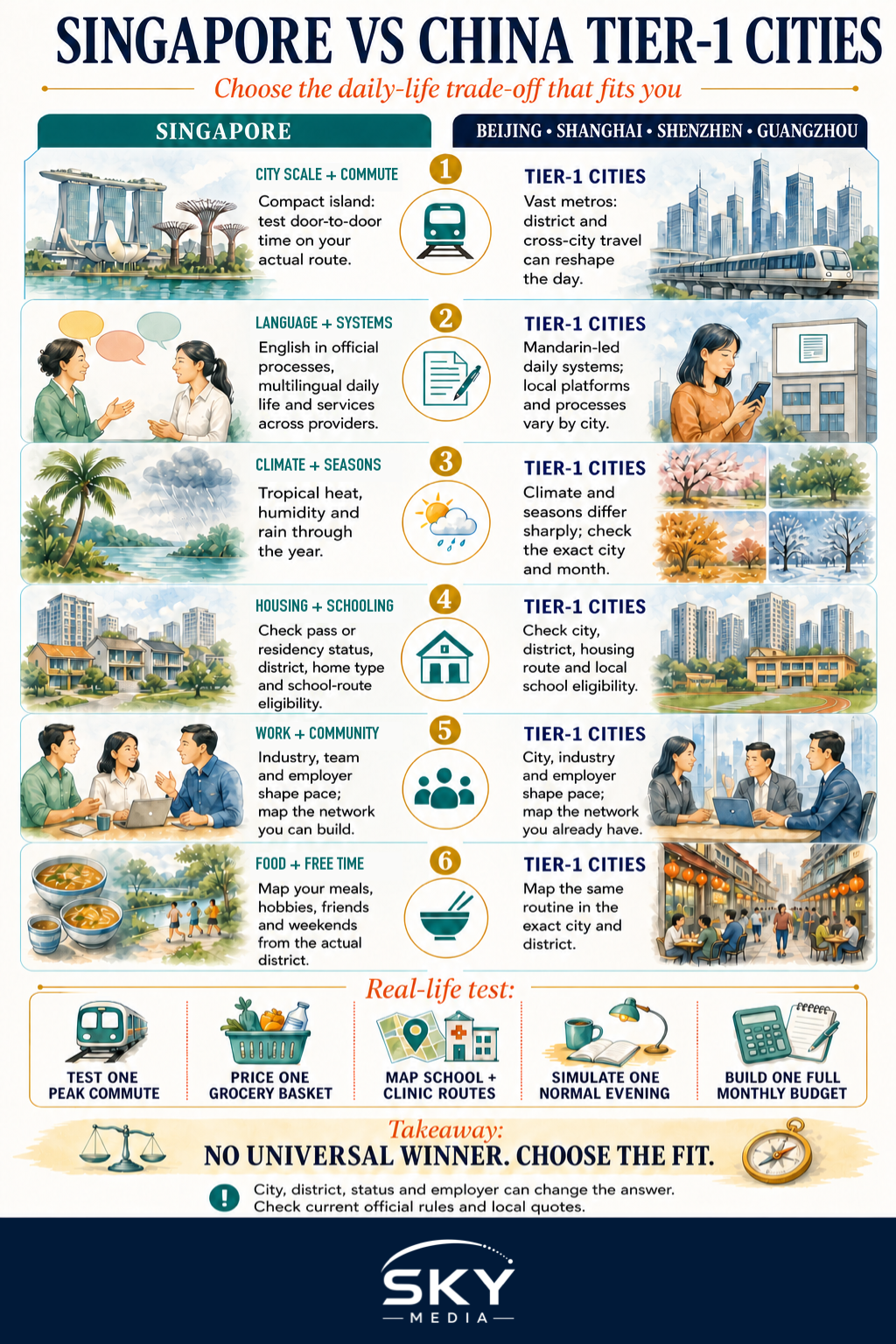
China’s Tier-1 cities set a high bar for everyday convenience. Super-apps handle payments, food delivery, bikes and services seamlessly, delivery is near instant, and shops stay open late across sprawling districts. Singapore is convenient too, clean and well organised, but the ecosystem is more fragmented across several apps, and some newcomers miss the sheer speed and cheapness of mainland delivery and services.
What Singapore offers instead is ease of a different kind: English is widely used in official life, systems are transparent, queues and rules are predictable, and things simply work without workarounds. Many mainlanders find the lower friction and lack of bureaucratic surprises a relief, even as they miss the round-the-clock buzz of home.
Housing and Space
In both places, housing is the defining cost and the defining compromise. Central Shanghai and Beijing rents rival Singapore’s at the top end, while Shenzhen and Guangzhou can be more affordable. Singapore’s private condominiums are expensive but usually come with facilities like pools and gyms, and public HDB flats offer solid, well-maintained homes that most residents live in happily.
Space is tight everywhere at this level of city, so do not expect large flats in either country without a large budget. What Singapore adds is consistency: reliable management, safe common areas and proximity to transport are the norm rather than the exception.
Air Quality and Environment
This is one of Singapore’s clearest advantages. Its air is generally clean for most of the year, greenery is abundant, and the “City in a Garden” reputation is earned. The main exception is the seasonal haze that can drift in from regional fires, which is unpredictable but usually temporary.
China’s Tier-1 cities have improved air quality markedly over the past decade, and Shenzhen and Guangzhou in the south often enjoy good days, but Beijing in particular can still see difficult winter spells. Families with young children or health concerns tend to rate Singapore’s steadier environment highly. The trade-off is Singapore’s heat and humidity all year, which some find harder than a Chinese winter.
Schooling
Both settings take education seriously, but the routes differ. Singapore offers local MOE schools taught mainly in English, plus international schools for those planning further moves abroad. The English-first classroom is the biggest adjustment for mainland children, though it is also a long-term asset. Competition exists but feels more structured than the intense tutoring culture of Tier-1 China.
In China, your child learns in a familiar system and language, with world-class results in maths and science, but pressure and the hukou-linked school access can complicate things for families who move cities. Singapore’s clarity on admissions, once you understand the rules, appeals to many parents, while others value the depth and rigour their child already knows at home.
Safety and Order
Both Singapore and China’s Tier-1 cities are notably safe by global standards, with low violent crime and a strong sense of public order. Singapore is renowned for it, and women and children moving around alone at night generally feel secure. Mainland cities are also very safe day to day, backed by extensive surveillance and policing.
The difference is more in feel than in fact. Singapore’s safety comes with a lighter, rules-based touch in daily life, while newcomers often describe both places as reassuringly low-risk compared with many Western cities.
Work Culture
Work culture is a real point of contrast. China’s Tier-1 cities are famous for intensity, long hours and a demanding pace in many industries, which drives opportunity but can strain work-life balance. Singapore also works hard, and some sectors are demanding, but norms lean more towards defined hours, international teams and a calmer, more process-driven office life.
For mainland professionals, Singapore can feel less frantic and more balanced, though some miss the raw ambition and speed of promotion possible in a booming mainland market. Which suits you depends on the stage and pace you want in your career.
Food and Pace of Life
Food is a joy in both. China’s Tier-1 cities offer astonishing regional depth at low prices, and Singapore answers with its hawker centres, blending Chinese, Malay, Indian and Western food affordably in one place. Newcomers rarely go hungry for good options, though authentic, cheap regional Chinese food is easier to find at scale back home.
Pace of life is where many feel the biggest shift. Mainland Tier-1 cities are relentless and stimulating; Singapore is calmer, more compact and easier to navigate, with regional travel a short flight away. Some find that soothing, others find it quiet after the mainland’s energy.
| Aspect | Singapore | China Tier-1 cities |
|---|---|---|
| Everyday convenience | Orderly, transparent, English-friendly | Faster, cheaper, super-app driven |
| Housing | Costly but consistent and well managed | Ranges from very costly to moderate |
| Air and environment | Clean, green, humid; occasional haze | Improving; Beijing winters can be tough |
| Schooling | English-first, structured admissions | Familiar system, intense competition |
| Safety | Very safe, light-touch order | Very safe, heavily monitored |
| Work culture | Balanced, international, process-led | Intense, fast, high opportunity |
| Food | Diverse and affordable hawker fare | Deep, cheap regional variety |
| Pace of life | Calmer, compact, easy to travel from | Relentless, stimulating, vast |
What Mainlanders Tend to Find Easier or Harder
Newcomers usually settle fastest into Singapore’s cleaner air, safety, English-language systems and balanced work life, and appreciate the low-tax, well-run backdrop. The harder parts are the higher day-to-day housing cost, the loss of ultra-cheap instant delivery, the year-round heat, and, for some, a slower social tempo. Children adjust to English over time, which pays off later.
There is no universal winner. If you value order, environment and balance, Singapore rewards you. If you thrive on scale, speed and mainland convenience, you will feel the loss most keenly. Weigh your own priorities, check the current rules and costs, and choose the trade-off that fits the life you want to build.
Explore more: Moving to Singapore from China · Cost of Living in Singapore · Settling in Singapore: A Guide for Newcomers from China