
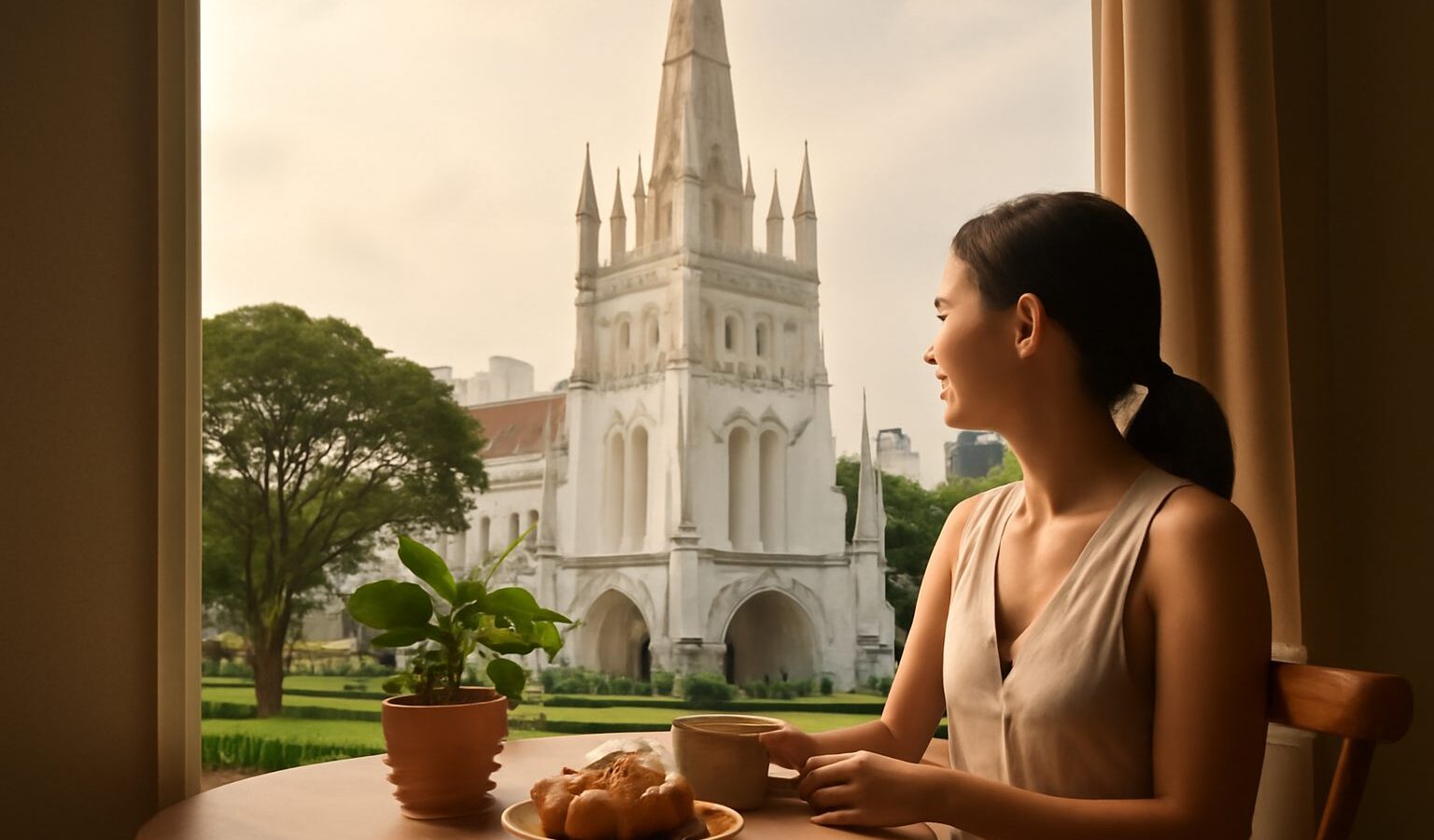
Its white walls gleam against the green of the surrounding lawn, and its slender spire draws the eye upward above the traffic of the city centre. St Andrew’s Cathedral Singapore is the country’s oldest Anglican cathedral and one of the most recognisable landmarks of the Civic District. A working place of worship and a gazetted national monument at the same time, it welcomes both the faithful and the curious. This guide traces the cathedral’s history, describes what to see, and explains how to visit respectfully.
A Church for the Colonial Town
The cathedral stands on a site set aside for a church in the early plans for the settlement, on ground overlooking the open field that became the Padang. An earlier church building rose here first, dedicated to Saint Andrew, the patron saint of Scotland, in a nod to the Scottish merchants who were prominent in the young port. That first structure did not survive, and the congregation eventually built the cathedral that stands today in its place.
From the beginning the church anchored the civic and religious life of the colonial town. Its position beside the Padang, near the seat of government and the courts, placed it at the centre of public life. Over the generations it grew into the cathedral of the diocese, serving a widening community and taking on the ceremonial role that a cathedral holds within the Anglican tradition.
Gothic Revival Architecture and the Spire
St Andrew’s is a striking example of the Gothic Revival style, which looked back to the medieval churches of England for its pointed arches, buttresses and soaring vertical lines. The result is a building that feels both formal and uplifting, its whiteness a distinctive note in the tropical light. The tall spire is the cathedral’s crowning feature, rising above the trees and visible from around the civic green.
The brilliant white finish has a story of its own. The exterior was treated with a plaster made using traditional materials, a technique of the era that gave the walls their smooth, luminous surface. Inside, the nave stretches toward the chancel beneath a high ceiling, and the calm, ordered space rewards a quiet look around. Stained glass, memorials and furnishings accumulated over the years give the interior a layered sense of history. Because the cathedral is a protected national monument, its fabric is cared for under conservation guidance from the National Heritage Board.
What to See Inside and Around the Grounds
A visit rewards attention to detail. Look for the memorial windows and wall tablets that record figures from the community’s past, and take in the craftsmanship of the woodwork and the ordered rhythm of the arches along the nave. The chancel at the far end draws the eye, as it is designed to in a church of this tradition. Moving slowly and quietly is the best way to appreciate the atmosphere.
Outside, the cathedral sits within an open compound of lawns and mature trees, a green pause in the busy heart of the city. The grounds are pleasant to walk, and the setting beside the Padang and the civic buildings makes the cathedral part of a larger heritage landscape. From here the towers of the modern city rise beyond the trees, a reminder of how the historic precinct sits at the core of contemporary Singapore.
A Living Place of Worship
It is worth remembering that St Andrew’s is not a museum but an active cathedral with a regular pattern of services and a living congregation. Alongside worship, it has long played a role in community and welfare work, and it remains a gathering point for its members. This dual identity, a heritage landmark and a working church, shapes how visitors should approach it. The building belongs first to the people who pray in it, and visitors are guests in a sacred space.
The table below outlines the cathedral’s main features and what they mean for a visitor.
| Element | What it is | For the visitor |
|---|---|---|
| The spire | The tall Gothic Revival tower | The cathedral’s signature silhouette above the green |
| The nave | The main worship hall | A calm interior for quiet, respectful viewing |
| Memorials and glass | Windows and wall tablets | Records of the community’s history to look for |
| The grounds | Lawns and trees around the church | An open, peaceful setting beside the Padang |
Visiting St Andrew’s Cathedral Respectfully
The cathedral is one of the easiest heritage sites in Singapore to reach, sitting directly above the City Hall MRT interchange, with several bus routes stopping nearby along the surrounding roads. Step out of the station and the white cathedral and its green compound are right there, at the edge of the Civic District.
As this is a place of worship, a few points of etiquette matter. Dress modestly, with shoulders and knees covered, keep your voice low, and be mindful that services and private prayer may be in progress. Photography is often welcome in the general areas, but look for any signs asking for restraint, and never photograph worshippers without consent or intrude during services. Silence phones before you enter. If a service is under way and you have come only to look, it is courteous to wait or to explore the grounds instead.
Opening times for visitors, service schedules and any guided-tour arrangements are set by the cathedral and can change, so check the official cathedral website before you go rather than relying on fixed hours. Entry to view the cathedral is generally without charge, but a respectful, quiet manner is always expected.
A visit pairs naturally with the rest of the Civic District. The Padang lies just across the way, the historic performance halls and museums are a short stroll off, and the whole precinct rewards an unhurried morning of heritage walking in the centre of the city.
Explore more
Once you have taken in St Andrew’s Cathedral, continue your walk around the civic green to the Padang, the historic field just beside the cathedral. From there the grand riverside halls of the Victoria Theatre and Concert Hall and the collections of the Asian Civilisations Museum are both within easy reach, rounding out a day in the heart of heritage Singapore.