
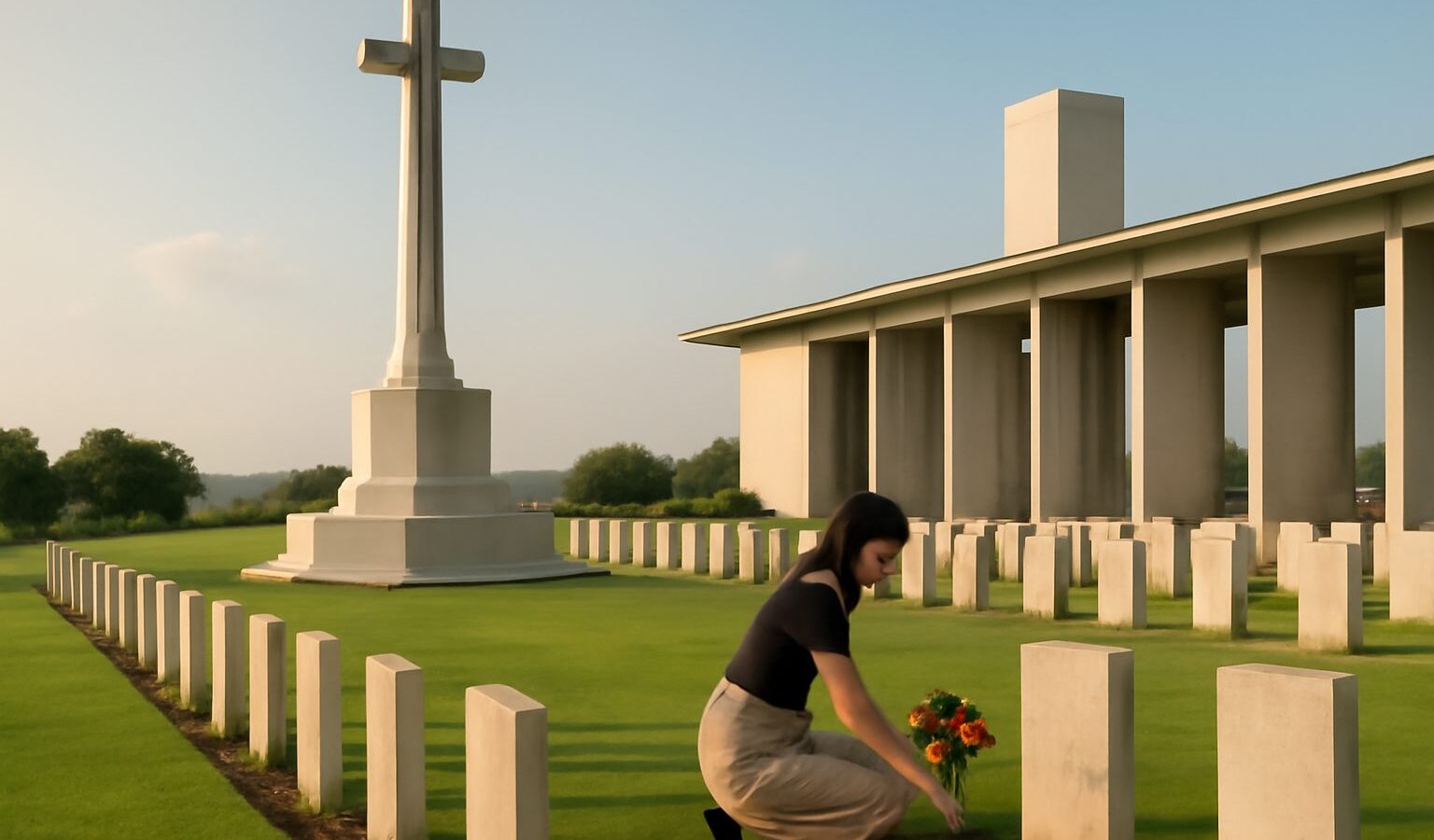
On a quiet rise in the north of the island, looking out towards the Johor Strait, the Kranji War Memorial Singapore is one of the most solemn and moving places in the country. Maintained by the Commonwealth War Graves Commission, it is the resting place and place of remembrance for thousands of servicemen and women who died defending Singapore and the wider region during the Second World War. For many families across the Commonwealth, this hillside is where a name on a distant register finally has a place. For Singaporeans and newcomers, it is a reminder that the story of the nation was shaped, in part, by events that reached far beyond these shores.
This guide walks through the memorial’s history, what you will see on the grounds, and how to visit respectfully. Because it is an active site of remembrance and a working cemetery, please treat every part of your visit with the dignity it deserves.
The History Behind Kranji War Memorial
Kranji’s association with the war began during the fighting for Singapore in early 1942, when the area near the Johor Strait saw heavy action as forces landed and advanced. After the fall of Singapore, the site was used during the Japanese Occupation, and in the years after the war it was developed into a permanent war cemetery and memorial. Graves that had been scattered across the island and the region were brought together here so that the fallen could rest in one carefully tended place.
The Commonwealth War Graves Commission, the organisation responsible for honouring those who died in the two world wars, maintains the grounds to the same standard found at its cemeteries around the world. The uniform headstones, the ordered rows and the quiet planting are all part of a deliberate design meant to give every person, whatever their rank or background, equal honour. Out of respect for the families involved and the guidance of official historians, this guide does not attribute specific casualty figures; visitors who wish to understand the scale of loss should consult the Commission and the National Heritage Board.
What You Will See at the Memorial
The site brings together several distinct elements, each with its own purpose. Walking through them in turn helps the meaning of the place unfold.
| Feature | What it is | Why it matters |
|---|---|---|
| The War Cemetery | Rows of headstones on the terraced hillside | The resting place of Commonwealth servicemen and women |
| The Singapore Memorial | A tall central structure with a wing-like roof | Commemorates those who died in the region and have no known grave |
| The Kranji Military Cemetery | An adjoining burial ground | Includes non-war and post-war military graves |
| The State Cemetery | A separate plot on the grounds | Resting place of two of Singapore’s early presidents |
The Singapore Memorial is the visual heart of the site. Its large central pylon and sweeping roofline are visible from the entrance, and its walls carry the names of many who were lost and have no known grave. Standing before it, reading name after name, is often the most affecting moment of any visit.
Below and around it, the war cemetery spreads across the terraced slope in calm, even rows. Each headstone is tended with care, and many carry a short personal inscription chosen by a family long ago. The adjoining Kranji Military Cemetery holds further graves, and nearby you will also find the State Cemetery, where two of independent Singapore’s early presidents are buried, linking this ground of Commonwealth remembrance to the young nation’s own story.
Kranji’s Place in the Singapore Story
Kranji sits within a wider landscape of wartime memory across the island, from the beaches and ridges where battles were fought to the museums that now interpret them. Together these places help Singaporeans and visitors understand the Japanese Occupation and the years that led to independence. The National Heritage Board and related agencies encourage the public to engage with this history thoughtfully, and Kranji is often visited during remembrance events and on days that hold meaning for veterans and their descendants.
For newcomers, a visit here reframes the north of Singapore. Kranji today is associated with nature, farms, the reservoir and the Causeway to Johor, yet this hillside holds a much older and heavier memory. Understanding that layer adds depth to the whole area, and it connects the local landscape to families in Britain, Australia, India, Malaysia and beyond who still make the journey to pay their respects.
The memorial also reflects a shared, deliberately respectful approach to war memory. There is no triumphalism here and no attempt to sensationalise loss. The design and upkeep speak instead of quiet dignity, equality in death, and the simple human wish to remember people by name.
Visiting Kranji War Memorial
The memorial is located in the north of Singapore near the Kranji area, and it is generally reachable by public transport with a combination of MRT and bus, followed by a short walk uphill to the entrance. Because service routes and timings change, check current directions before you set out. Many visitors combine the trip with other northern attractions, though the memorial itself calls for a calmer, more reflective pace.
A few points will help you visit well:
- Check official information first. Opening hours and any arrangements for special ceremonies are set by the Commonwealth War Graves Commission, so confirm details on the official website before your visit rather than relying on assumptions.
- Dress and behave respectfully. This is a cemetery and a place of mourning. Speak quietly, keep to the paths, and avoid picnicking, loud activity or disruptive photography.
- Give yourself time. Reading the memorial walls and walking the terraces slowly is part of the experience. An unhurried visit is far more meaningful than a quick look.
- Bring sun protection and water. The grounds are open and can be warm, and there is a fair amount of walking on gentle slopes.
If you are researching a specific name, the Commonwealth War Graves Commission maintains records that can help you locate a grave or panel, and it is worth preparing before you arrive.
A Place Worth Remembering
Kranji War Memorial is not a destination in the ordinary sense. It asks something of its visitors: attention, quiet and respect. In return it offers a clear, unforced encounter with a part of Singapore’s past that still matters. Whether you come as a descendant, a student of history or simply someone who wants to understand the country better, the hillside at Kranji leaves a lasting impression, precisely because it does so with such restraint.
Explore more
If you are tracing Singapore’s wartime heritage, continue at the Changi Chapel and Museum, which tells the story of prisoners of war during the Japanese Occupation. For the fighting on the island’s ridges, visit Reflections at Bukit Chandu, and for coastal defence and wartime tunnels head to Labrador Park.