
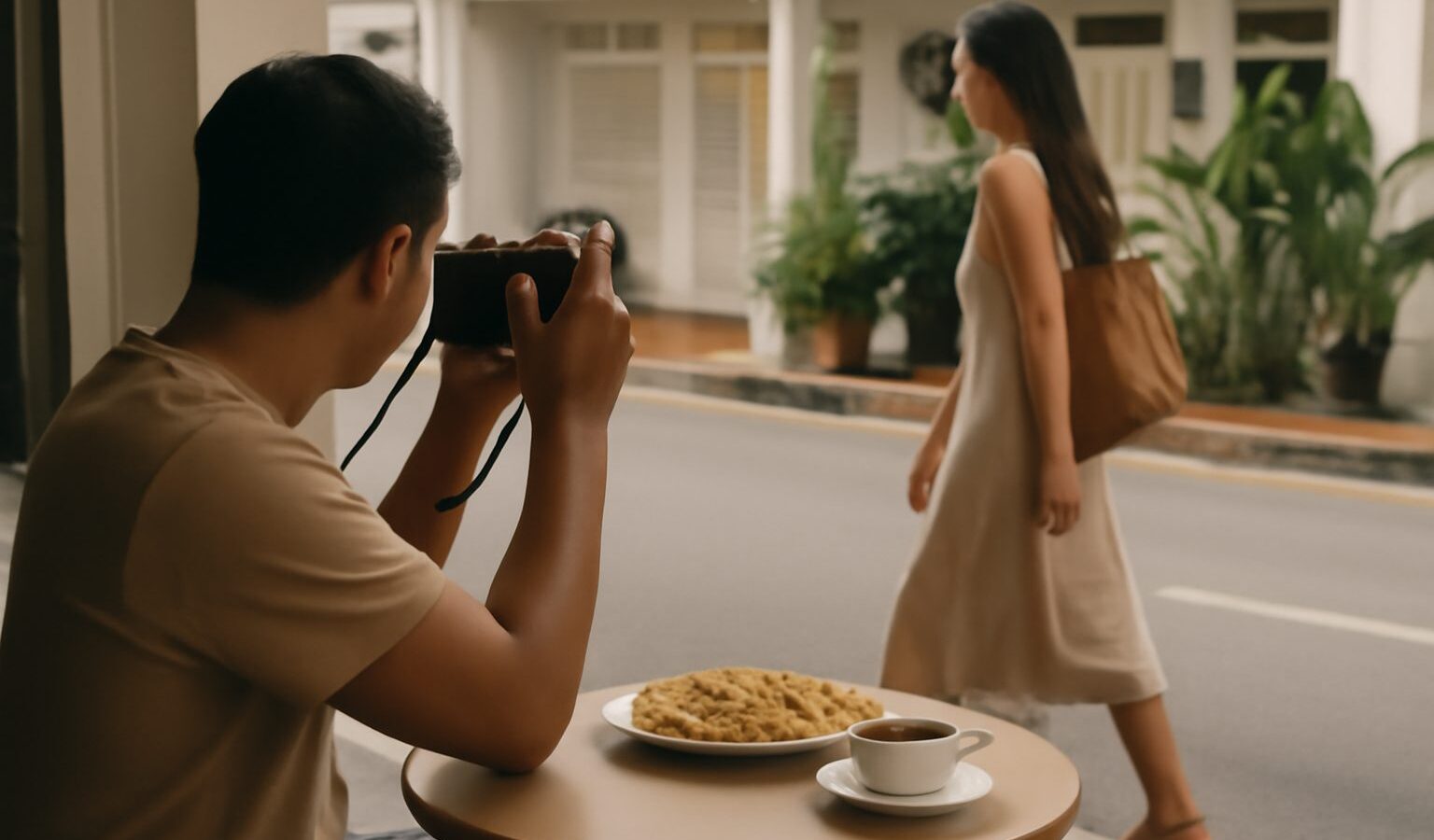
Good street photos rarely happen by luck. What separates a snapshot of a crowd from a picture you keep looking at is arrangement: where the lines lead, what sits in front of what, and the split second you press the button. Street photography composition is the craft of ordering a messy, moving scene so a viewer knows exactly where to look. This guide skips the gear talk and focuses on how to see and frame, using the busy, layered streets of Singapore as your practice ground.
You do not need permission from the world to compose well, only patience and a plan. Walk slower, look longer, and start building each frame on purpose.
What Street Composition Really Means
Composition is simply the decision about what to include, what to leave out, and how the pieces relate inside the rectangle. On a quiet landscape you have time; on the street the scene rearranges itself every few seconds, so you learn to spot a promising background first and then wait for the right element to complete it.
A useful habit is to think in two stages. First find your stage: a pool of light on a five-foot way in Chinatown, a strong diagonal shadow across a void deck, a clean colourful wall along a Kampong Glam lane. Then wait for an actor to walk into it. This “compose then wait” approach turns you from a reactive shooter into someone who builds pictures. It also steadies your framing, because you have already decided your edges before anyone arrives.
Keep the basics of the rule of thirds in mind, but treat them as a starting point rather than a rule. Placing a subject off centre, giving them room to walk into the frame, and lining up a horizon with a third all help. Once those feel natural, you can break them on purpose.
Build Depth with Layers and Foreground
Streets are three dimensional, yet a flat photo throws that away. Layering means arranging interest in the foreground, middle and background so the eye travels through the frame instead of stopping at the surface.
Singapore is ideal for this because our streets stack activity so densely. Try these:
- Shoot through a foreground element, such as a hawker stall’s steam, a rack of drying laundry, or people at a nearer table, so the main subject sits deeper in the scene.
- Look for a middle subject doing something clear, then let the background add context, like heritage shophouses behind a trishaw rider.
- Use puddles after one of our sudden downpours for reflections that add a whole second layer to the picture.
The trick with layers is separation. Each element should be readable and not merge into the one behind it. A small change of position, a step left or a crouch lower, is usually all it takes to open a gap between a person and a lamp post so they no longer overlap awkwardly.
Use Lines, Light and Frames to Direct the Eye
Every street is full of lines: kerbs, covered walkways, MRT railings, the long repeating columns of a shophouse arcade. Leading lines pull a viewer’s gaze toward your subject, so position yourself so those lines point where you want attention to land. Strong diagonals feel more dynamic than flat horizontals, which is why a corridor or staircase shot at an angle carries energy.
Light is a compositional tool too, not just an exposure setting. In our harsh midday tropical sun, look for hard shadows and bright shafts of light between buildings, and let a subject step into that light while the surroundings fall dark. This natural spotlight does your framing for you.
Framing devices are the third tool. Shoot through a doorway, under an overhead bridge, between two pillars, or through the window of a kopitiam so the surroundings form a natural border around your subject. A frame within the frame adds depth and tells the viewer this, here, is the point.
Watch Your Backgrounds
Beginners fixate on the subject and forget everything behind it, which is why so many street shots have a signboard sprouting from someone’s head or a bright rubbish bin stealing attention. The background is half your composition, so scan it before you shoot.
- Check the edges and corners for distractions, bright objects, or half a stranger poking in.
- Watch for mergers, where a pole, tree or sign lines up unluckily with your subject.
- Prefer clean, simple backdrops when your subject is busy, and busier context when your subject is simple.
- Move your feet. Backgrounds are fixed, but you are not, so a couple of steps often clears the clutter.
A plain wall in Tiong Bahru or a shaded stretch of covered walkway can turn an ordinary passer-by into a clean, graphic portrait. Quiet backgrounds let gesture and expression carry the frame.
Timing and the Decisive Moment
Once your background is set, everything rests on timing. The photographer Henri Cartier-Bresson called it the decisive moment: the instant when the elements line up and gesture, expression and position peak together. Half a second early or late and the magic is gone.
To catch it, pre-focus on your chosen spot, hold the frame steady, and watch the edges for someone approaching. Anticipate rather than react. If your camera or phone allows, a short burst raises your odds of landing the exact stride or glance you want. Patience pays: it is normal to let many people pass through a good scene before the right one arrives.
| Situation | Weak approach | Stronger composition |
|---|---|---|
| Busy hawker centre | Wide shot of the whole crowd | One vendor mid-action, framed by steam and stalls |
| Long covered walkway | Snap as you walk past | Wait for a lone figure to hit the light between columns |
| Colourful heritage wall | Photograph the empty wall | Let a person in matching or contrasting colour walk by |
| Rainy five-foot way | Shoot the grey street flat | Use a puddle reflection and an umbrella for a second layer |
Photographing People with Respect
Street photography involves strangers, so composition and courtesy go together. In Singapore, being considerate is not only polite, it keeps the scene relaxed and your photos natural.
Photographing people in a public place is generally acceptable, but respect matters more than any rule. For wide scenes where individuals are not the focus, most people will not mind. For a close, recognisable portrait, it is kind to catch the person’s eye, smile, and gesture with your camera to ask; a nod is your permission and often gives you a warmer frame anyway. Never photograph inside homes or through windows into private spaces, and honour any posted no-photography signs, especially in temples, mosques and other places of worship. Be gentle around children, and if anyone asks you to delete a photo, simply do it. A respectful photographer is welcome back tomorrow.
Composition and consideration make the same point in the end: pay attention. Notice the light, the layers and the people, and your street photos will feel both stronger and kinder.
Explore more
Ready to sharpen your eye further? Start with the rule of thirds and composition basics, then get comfortable working close to people in how to photograph people candidly. Since light shapes every street frame, our guide to using natural light in photography is a natural next step.