
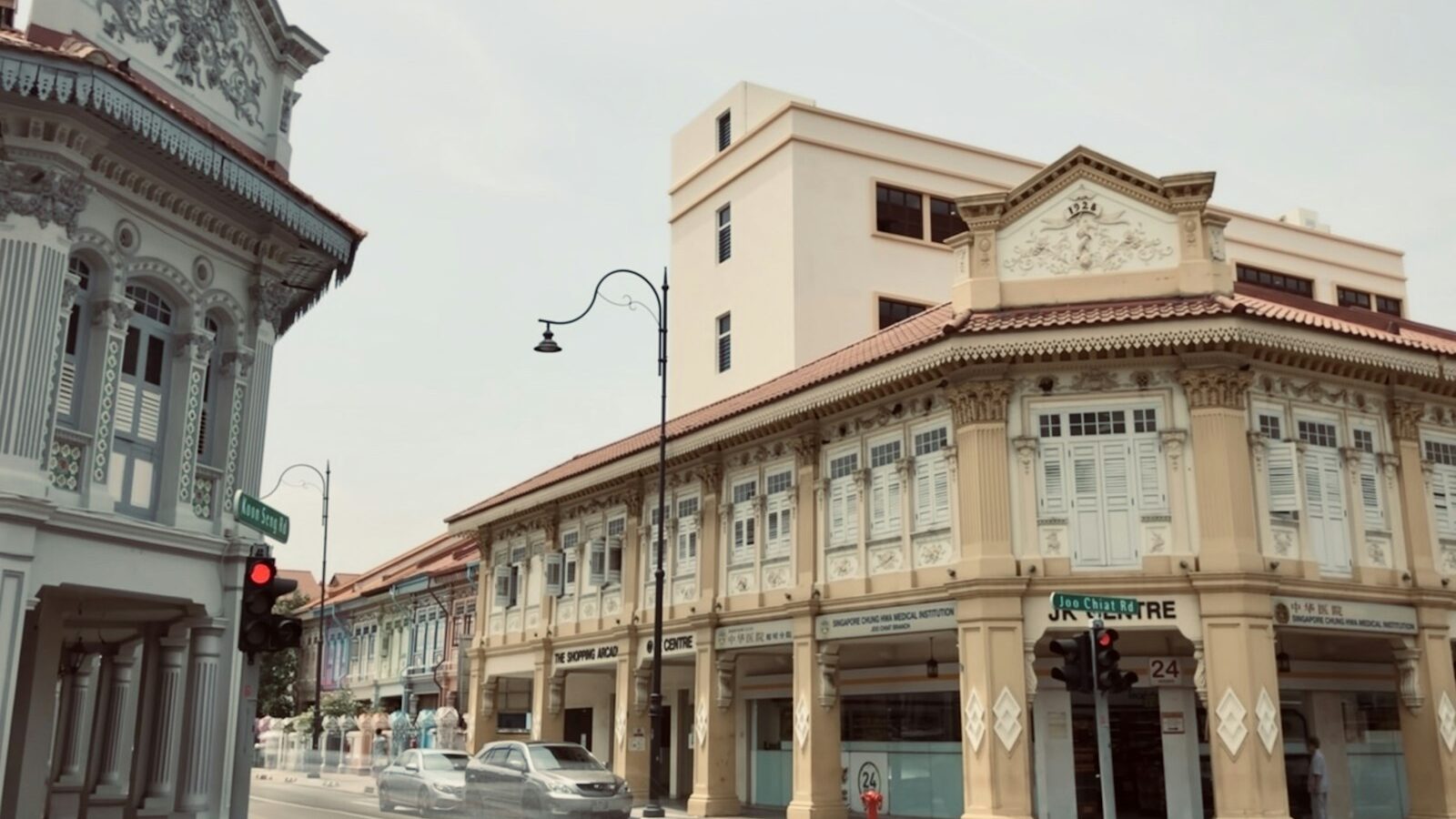
Few streets in Singapore carry as much history as Telok Ayer Street. This Telok Ayer heritage guide follows a road that was once the very edge of the sea, the first ground many immigrants touched as they stepped off ships into a new life. Along its length stand some of the country’s most important places of worship, built by grateful arrivals who had survived the crossing. The name Telok Ayer is Malay for bay of water, a clue to a coastline that reclamation has long since pushed away.
The Street That Was a Shoreline
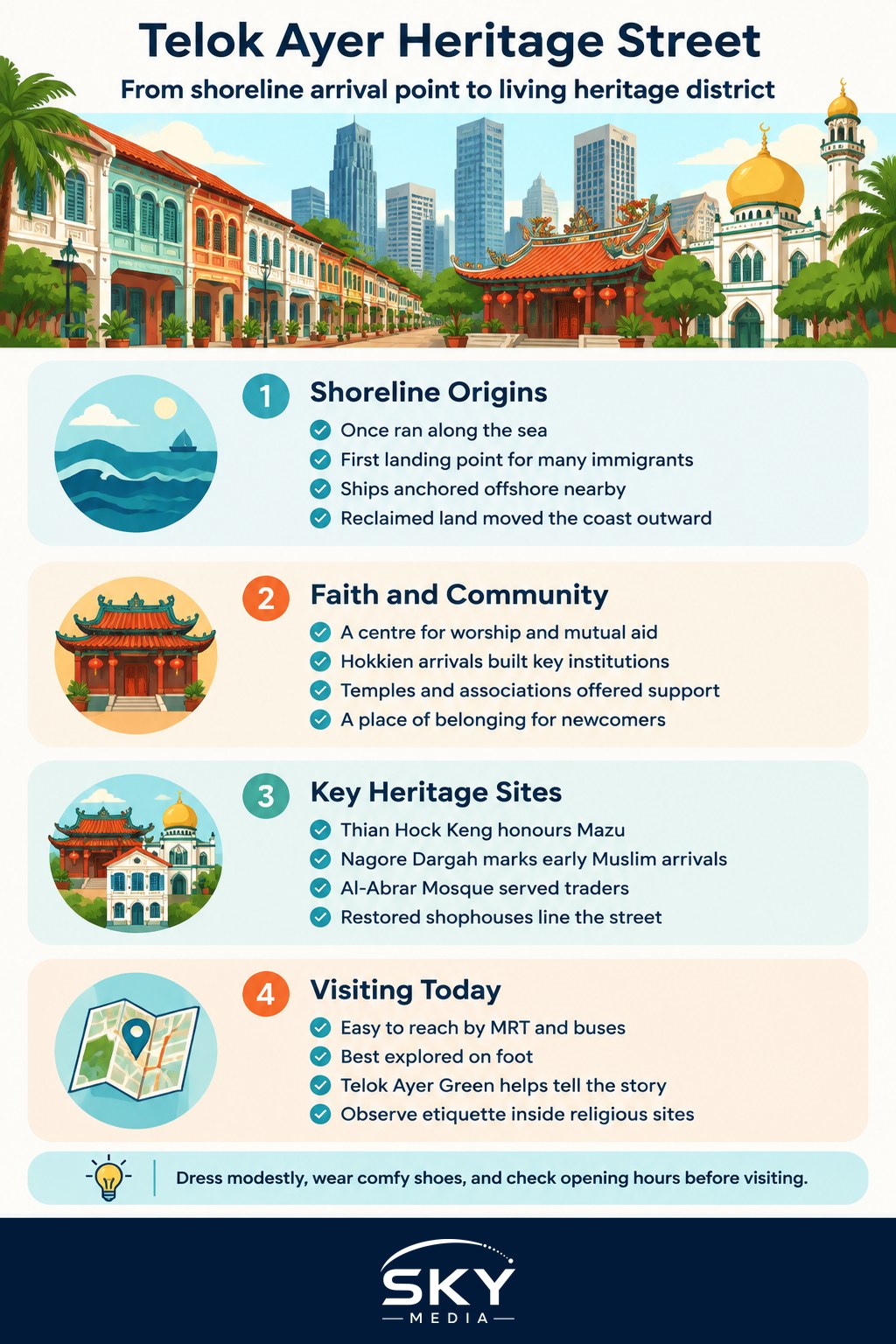
When Singapore’s town was young in the nineteenth century, Telok Ayer Street ran right along a curving bay. Ships anchored offshore and passengers and cargo came in by smaller boats to land here. For immigrants arriving from southern China, India, and elsewhere, this shore was the threshold of the island, and it quickly became one of the busiest and most significant streets in the settlement.
Because it was the point of arrival, the street drew traders, lodging houses, and, above all, places of worship where newcomers gave thanks for a safe voyage and prayed for good fortune. Later land reclamation extended the coast outward, so today Telok Ayer Street sits well inland, its old sea wall long buried beneath the modern city. For the detailed history of the bay and its reclamation, the National Heritage Board and Urban Redevelopment Authority are the authoritative sources.
An Immigrant and Hokkien Heart
Telok Ayer is closely tied to the story of Singapore’s early Chinese immigrants, and to the Hokkien community in particular. Many who landed here were Hokkien from Fujian province, and they established some of their most important institutions along this street. Clan and community organisations, businesses, and temples clustered nearby, making the area a centre of communal life for arrivals finding their feet in a strange land.
This was a place of both faith and mutual aid. New immigrants, often poor and far from home, relied on community networks anchored in the temples and associations here. The street’s religious buildings were not only spiritual centres but social ones, where help, information, and a sense of belonging could be found. That dual role, sacred and practical, is central to understanding why Telok Ayer matters.
Places of Worship Along the Street
Telok Ayer Street is remarkable for gathering several faiths within a short walk, a physical record of Singapore’s diverse arrivals. Each building deserves to be approached with respect: dress modestly, keep your voice low, remove footwear where asked, and follow posted etiquette on entry and photography.
The most celebrated landmark is Thian Hock Keng, a Hokkien temple dedicated to the sea goddess Mazu, protector of sailors, which early immigrants visited to give thanks for surviving the sea crossing. It is admired as one of the finest examples of traditional southern Chinese temple architecture in Singapore. Nearby stand Muslim landmarks including the Nagore Dargah, a shrine built by the early South Indian Muslim community, and the Al-Abrar Mosque, both reflecting the presence of Indian Muslim traders who also arrived along this coast. Together they show how communities of different faiths settled side by side.
Here is a simple overview of the street’s key heritage sites.
| Site | Community and faith | Significance |
|---|---|---|
| Thian Hock Keng | Hokkien Chinese, Taoist and folk | Temple of thanksgiving to the sea goddess Mazu |
| Nagore Dargah | South Indian Muslim | Historic shrine of the early Indian Muslim community |
| Al-Abrar Mosque | Indian Muslim | Early mosque serving arriving traders |
| Conserved shophouses | Mixed trades and residents | Restored streetscape of the old arrival quarter |
Conservation and the Street Today
Telok Ayer lies within an important conservation area, and the Urban Redevelopment Authority protects its historic buildings so that the temples, shrines, mosque, and shophouses remain intact even as the surrounding district fills with towers. Many restored shophouses now house cafes, restaurants, and offices, giving the street a lively daytime and evening scene layered over its sacred and commercial past.
Walking here today, you move between worlds. On one side rise the glass towers of the financial district; on the other stand centuries-old temples where incense still burns and worshippers still come. The nearby Telok Ayer Green, a small landscaped space, and interpretive markers help tell the story of the vanished shoreline. It is a compact, walkable stretch that repays slow attention.
Cultural Significance
Telok Ayer Street matters because it is, in a real sense, where modern Singapore’s immigrant story begins. It was the arrival point for many who built the city, and its clustered places of worship stand as enduring symbols of gratitude, community, and the peaceful coexistence of faiths that Singapore values. The street condenses the themes of migration, religion, and mutual support that run through the whole national story.
Its preservation lets each generation walk the same ground that newcomers once did, and stand before the same temple where survivors of the sea crossing gave thanks. That continuity, from a lost shoreline to a living heritage street, is precisely what makes it so meaningful.
Visiting Telok Ayer Street
Getting there is straightforward. Telok Ayer MRT station on the Downtown Line opens right into the area, and Tanjong Pagar and other nearby stations are within walking distance, with many buses serving the district. The street and its landmarks are easily explored on foot.
Give yourself an hour or two to walk the street, pause at each place of worship, and read the heritage markers. Dress modestly so you can enter the temples and mosque respectfully, wear comfortable shoes, and carry water for the heat. Opening hours for religious sites and their visitor areas vary, and some restrict access during prayers or ceremonies, so check official sources and observe any guidance you find on site.
Explore More
Telok Ayer flows naturally into the city’s other historic quarters. Continue the port and immigrant story just south in our Tanjong Pagar heritage guide, follow the river trade in our Boat Quay and Clarke Quay history, or explore the arts and civic district in our Bugis and Bras Basah heritage guide.
Further reading: Al-Abrar Mosque: A Heritage Guide to Telok Ayer’s Chulia Mosque · How Street Names Reflect Singapore’s Communities and Trades · Fuk Tak Chi Museum and the History of Telok Ayer’s Oldest Temple · Keong Saik and Bukit Pasoh Heritage Guide