
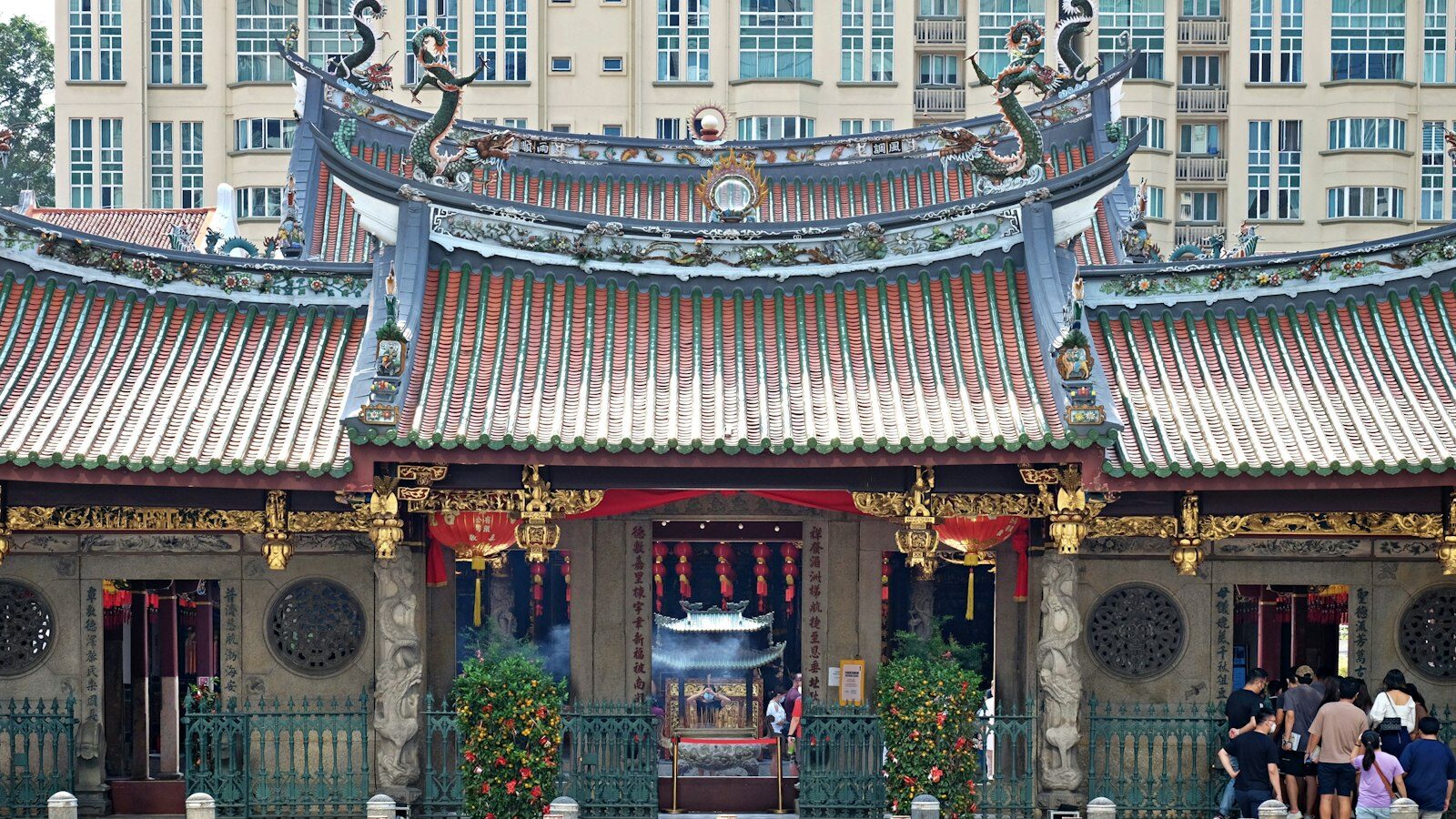
On a quiet stretch of Telok Ayer Street, hemmed in now by office towers, stands one of the most beautiful buildings in the country. Thian Hock Keng, the Temple of Heavenly Happiness, is the oldest Hokkien temple in Singapore and a masterpiece of southern Chinese architecture. For anyone tracing the roots of the island’s Chinese community, Thian Hock Keng Singapore is essential, a place where immigrants once gave thanks for surviving the sea voyage and where those same traditions still continue. This guide covers its history, its craftsmanship and how to visit with respect.
A temple built on the old waterfront
To understand Thian Hock Keng, picture Telok Ayer Street before the land reclamation that pushed the coastline outward. In the early days of the settlement the street ran right along the shore, and the name Telok Ayer means “bay water” in Malay. Chinese immigrants arriving by junk from the southern provinces of China would step ashore near here after a long and dangerous crossing, and the first thing many did was to give thanks for safe passage.
A modest shrine to Mazu, the Chinese goddess of the sea and protector of sailors, stood on this spot before the grand temple was raised. As the Hokkien community grew and prospered, its leaders, organised through the Hokkien Huay Kuan clan association, resolved to build a temple worthy of the goddess. Thian Hock Keng was constructed in the 1840s, funded by donations from merchants and ordinary migrants alike, among them prominent community figures whose names are still remembered in Singapore today. The temple became not only a house of worship but the social and organisational heart of the Hokkien community.
Craftsmanship from southern China
Thian Hock Keng is celebrated for being built in the traditional southern Chinese style, using materials and skills brought directly from China. Master craftsmen shaped the timber, granite and tiles, and, according to long-held accounts, the main structure was assembled using interlocking joinery rather than nails, in the manner of classical Chinese temple building. Columns of stone and richly carved timber support sweeping roofs whose ridges rise in graceful curves.
Look up and you will find the roofs crowded with detail: dragons chasing pearls, phoenixes, and scenes from folklore rendered in colourful ceramic shard work. Stone lions guard the entrance, carved dragons coil around the front pillars, and painted door gods watch over the threshold. Inside, the main hall is dedicated to Mazu, with other deities honoured in adjoining halls. The overall effect is both grand and intimate, a building that repays slow looking.
The temple has been carefully conserved over the years, and a major restoration was recognised with a UNESCO heritage award for the quality of the work. Thian Hock Keng was gazetted as a national monument in the 1970s, securing its protection for future generations.
More than a place of worship
For the early Hokkien community, Thian Hock Keng was a gathering point that did the work of many institutions at once. It was a temple, a meeting hall, a place where disputes were settled and where new arrivals could find help and connection. The Hokkien Huay Kuan, which built and managed the temple, grew into one of the most important community organisations in Singapore, later founding schools and supporting education for generations of children.
Telok Ayer Street itself is a remarkable heritage corridor. Within a short walk stand other landmarks raised by immigrant communities seeking blessing and belonging, including the nearby Nagore Dargah and Al-Abrar Mosque, reflecting how peoples of different faiths settled side by side along the old shoreline. Today the street is conserved, and the temple sits as a serene counterpoint to the financial district that has grown up around it.
Eras of Thian Hock Keng at a glance
This short timeline shows how the site evolved from a simple shrine to the conserved monument of today.
| Era | What happened |
|---|---|
| Early settlement | A modest shrine to Mazu stands on the Telok Ayer shoreline |
| Mid nineteenth century | The grand temple is built by the Hokkien community and Huay Kuan |
| Twentieth century | Land reclamation moves the coast away; the temple becomes a heritage landmark |
| Modern day | Gazetted national monument, restored and open to visitors |
Visiting Thian Hock Keng respectfully
Thian Hock Keng welcomes visitors, and it remains an active temple where worshippers come to pray and make offerings. A respectful visit keeps the atmosphere calm for everyone.
- Dress modestly, covering shoulders and knees, in keeping with a place of worship.
- Speak softly and move gently around worshippers, and do not touch altars, offerings or statues.
- Photography is generally allowed in the courtyards, but be discreet, avoid pointing cameras directly at people praying, and follow any posted notices.
- Step over, not on, the raised thresholds at the doorways, a traditional courtesy in Chinese temples.
- Opening hours can vary and may differ around festivals such as Chinese New Year and the birthday of Mazu, so check the temple’s official information before you go.
Getting there is simple. The temple stands on Telok Ayer Street in the heart of the Central Business District, and the nearest MRT station is Telok Ayer, with Tanjong Pagar and Raffles Place also within walking distance. Pair your visit with a stroll along the conserved shophouses of the surrounding lanes, where cafes and eating places make an easy stop.
Standing in its courtyard, with incense drifting and skyscrapers framing the curved roofs above, you feel the full sweep of the Singapore story in a single view. Thian Hock Keng is a monument to gratitude, to community and to the craftsmanship of an earlier age, and it remains one of the most rewarding heritage visits in the city.
Explore more
To continue exploring the heritage of Telok Ayer and Chinatown, read about Nagore Dargah, a short walk along the same street, and Sri Mariamman, the island’s oldest Hindu temple in nearby Chinatown. For a wider look at how immigrant communities shaped the district, the story of Sultan Mosque in Kampong Glam makes a natural next stop.