
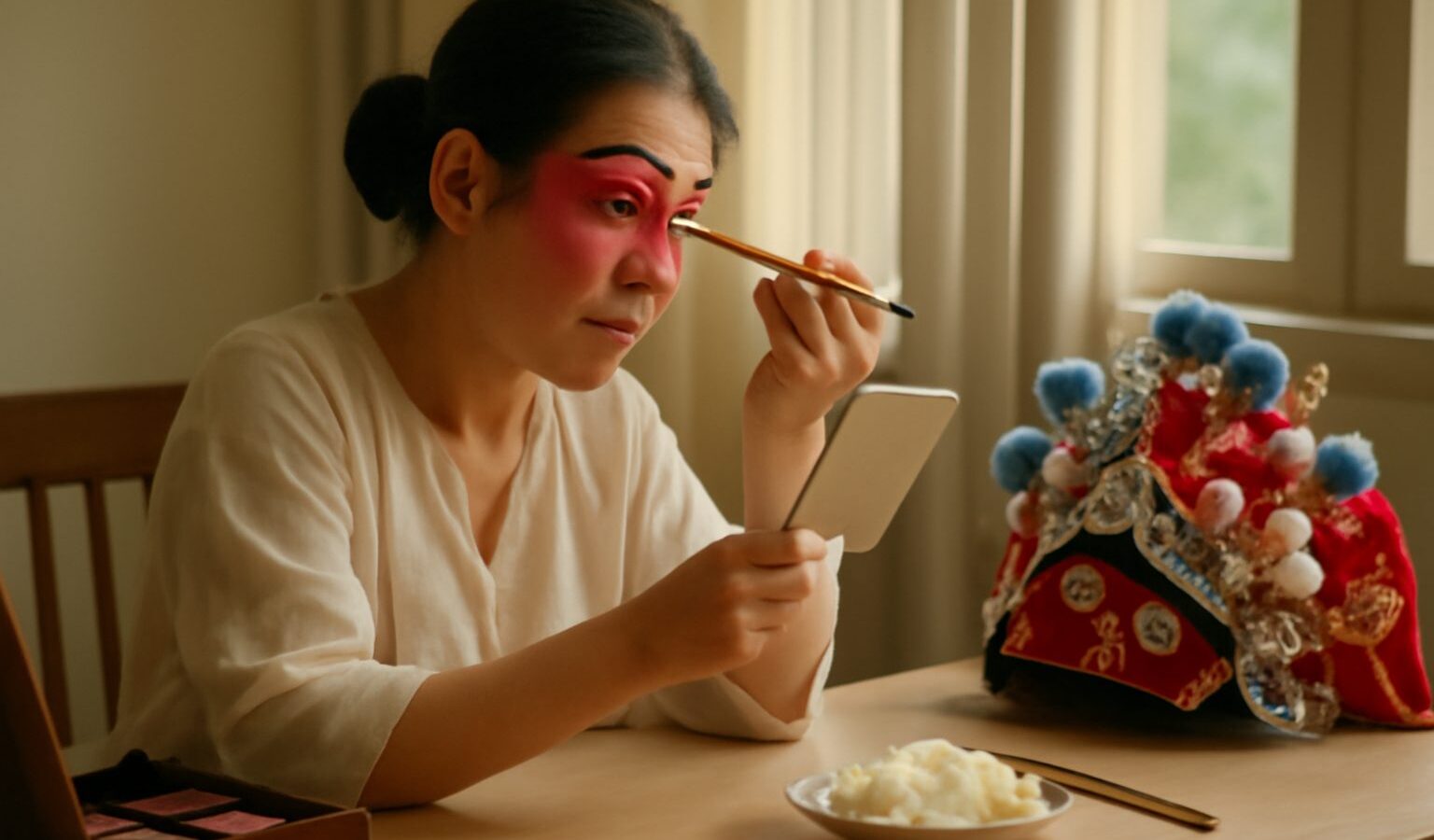
For generations of Singaporean families, teochew opera in Singapore was the sound of a temple festival: clashing cymbals, painted faces, and a plywood stage built overnight beside a wet market or a housing estate courtyard. Alongside it stands Hokkien opera, a related but distinct dialect form. Together these two traditions carried stories, music, and moral lessons through the dialect communities that shaped early Singapore.
Two dialect forms, not one
It is easy to lump all Chinese street opera together under the Hokkien word “wayang”, but Teochew and Hokkien opera are separate traditions with their own languages, music, and repertoire. Each grew from a specific region in southern China and travelled to Singapore with migrants who settled here from the nineteenth century onwards.
Teochew opera, known in Mandarin as chaoju, comes from the Chaoshan region of eastern Guangdong. Hokkien opera, often called gezai xi or koa-a-hi, has its roots in southern Fujian and Taiwan. Because the two communities spoke mutually unintelligible dialects, the operas were never interchangeable. A Teochew audience wanted to hear its own tongue on stage, and so did a Hokkien one.
The temple stage and its purpose
The most important thing to understand about dialect opera in Singapore is that it was rarely just entertainment. Performances were tied to the religious calendar. Troupes were engaged during the birthday celebrations of temple deities, during the seventh-month Hungry Ghost observances, and at other festival occasions when a community wanted to give thanks or seek blessings.
The stage faced the temple or the altar, because the first and most honoured audience was the deity. This is why you may notice rows of empty front seats at a getai or wayang show even when a crowd stands behind them. Those seats are understood, by custom, to be reserved for spirits and gods. The living watch from further back.
Because these performances served worship, the schedule followed the lunar calendar rather than a theatre season. A troupe might play several nights in one district and then move on to the next temple that had booked it.
What sets Teochew and Hokkien opera apart
While both forms share the broad grammar of Chinese opera, singing, stylised movement, symbolic costume, and role types, the details differ in ways a regular follower can hear and see.
| Feature | Teochew opera | Hokkien opera |
|---|---|---|
| Home region | Chaoshan, eastern Guangdong | Southern Fujian and Taiwan |
| Stage language | Teochew dialect | Hokkien dialect |
| Musical feel | Softer, more lyrical, refined melodies | Livelier, more colloquial, folk-flavoured |
| Signature strength | Delicate female and young-scholar roles | Everyday storytelling and comic timing |
| Common name here | Chaoju, “Teochew wayang” | Gezai xi, koa-a-hi |
The distinctions are not rigid, and skilled performers cross expectations, but longtime audiences often describe Teochew opera as the more polished and gentle of the two, and Hokkien opera as warmer and closer to common speech. Both use a small live orchestra of string, wind, and percussion instruments, with the percussion driving the pace of the action.
Painted faces, costume, and the language of gesture
Chinese opera communicates through a visual code, and dialect opera is no exception. Face paint signals character: a boldly patterned face marks a warrior or a supernatural figure, while a mostly natural face suggests a scholar or a gentle heroine. Costume colour and embroidery indicate rank and role.
Movement is equally coded. A flick of a long “water sleeve”, a particular walk, or a circling of the stage can express weeping, a long journey, or the crossing of a threshold. None of this needs literal scenery. A single table and two chairs can become a court, a mountain, or a bedchamber depending on how the performers use them. Audiences who grew up with the form read these signs instantly.
The roles
Both traditions organise their casts into familiar role types: the dignified older male, the young scholar or lover, the refined or spirited female, the painted-face strongman, and the clown. The clown is often the audience favourite, using improvisation and local references to make people laugh between the more solemn passages.
The stories on stage
The repertoire draws on shared Chinese sources: historical sagas, romances, court intrigues, tales of loyal generals and clever magistrates, and folk legends of love and sacrifice. Because many in the audience knew the plots already, enjoyment came from the singing, the skill, and the interpretation rather than from suspense.
These stories carried values. Filial piety, loyalty, honesty rewarded and treachery punished, all were dramatised in ways that a mixed crowd of grandparents and children could absorb together. For communities far from their ancestral homes, opera was also a way of keeping language and memory alive.
Decline, and quiet survival
As dialect use declined across Singapore, so did the natural audience for dialect opera. Fewer young people understood the sung Teochew or Hokkien, and troupes found it harder to recruit performers willing to train in a demanding art. Professional street-opera troupes today are far fewer than in their peak decades, and many performances now share the festival calendar with amplified getai variety shows.
Yet the tradition has not vanished. Amateur and community troupes continue to stage performances at temple events. Cultural groups and enthusiasts document scripts, music, and costume. During festival seasons, especially the seventh lunar month and major temple birthdays, you can still come across a lit-up stage in a heartland, cymbals ringing into the night.
How to watch respectfully
- Do not sit in the empty front rows near the stage, which are kept for the deities.
- Photography is usually fine from a respectful distance, but avoid using flash close to performers.
- Give way to worshippers making offerings at the adjacent temple or altar.
- If you do not follow the dialect, watch the movement, the face paint, and the percussion; much of the meaning is carried there.
Why it still matters
Teochew and Hokkien opera are living records of how Singapore’s dialect communities worshipped, gathered, and told their stories. They preserve languages that are fading from daily use and an art form that turns a bare stage into an entire world through voice and gesture. Whenever a festival stage rises in a heartland courtyard, it links today’s Singapore to the migrants who first brought these songs across the sea.
Explore more: Chinese opera and getai in Singapore · Traditional Chinese customs in Singapore · Singapore superstitions and taboos