
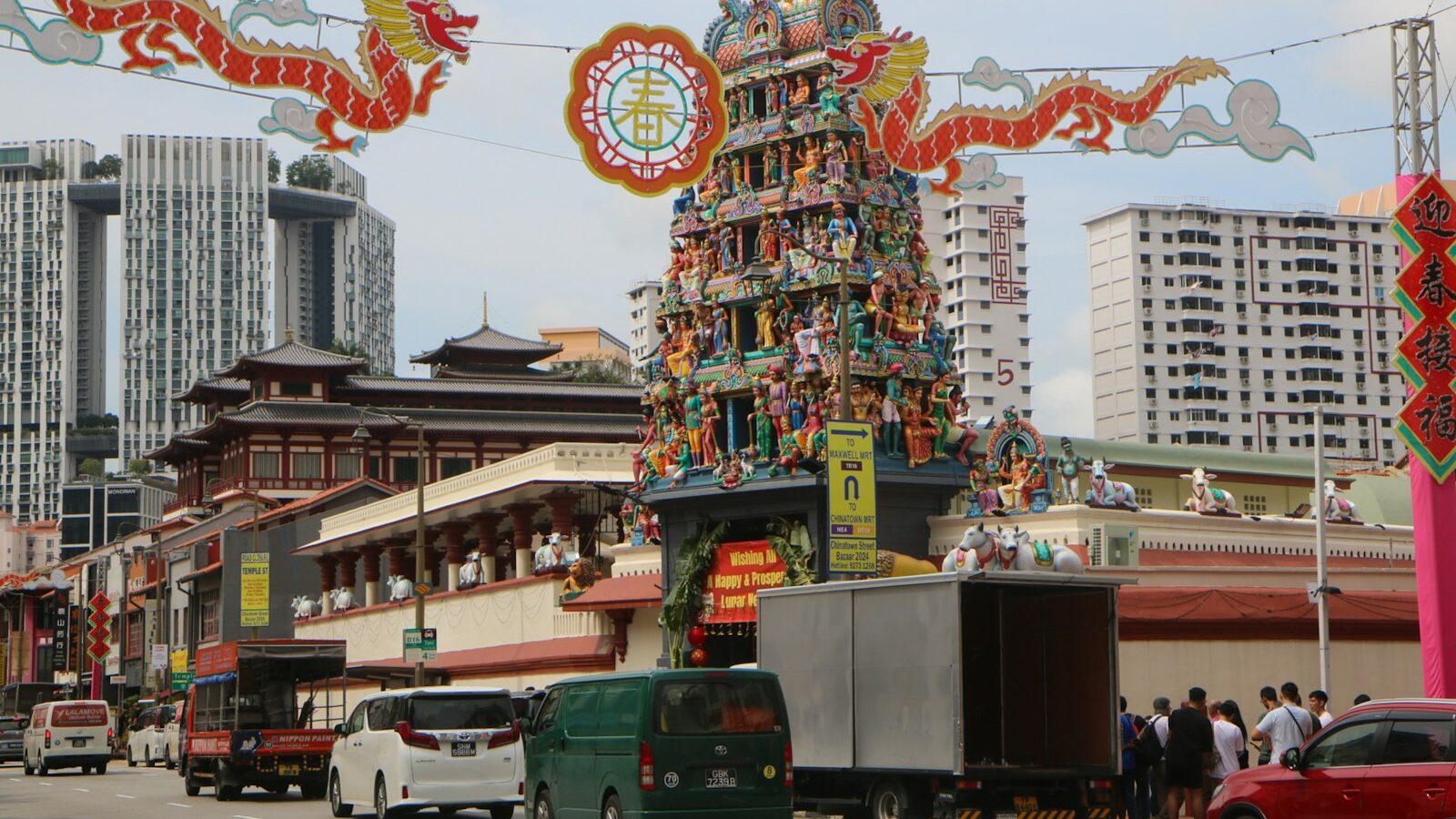
Tucked among the office towers of the Raffles Place financial district, Yueh Hai Ching Temple on Phillip Street is one of Singapore’s oldest and most historically important Chinese temples. Its name can be translated as Temple of the Calm Sea, a fitting title for a place founded by a seafaring community that crossed dangerous waters to reach these shores. Built and cherished by Teochew immigrants, the temple is a Taoist place of worship and a remarkable survival of nineteenth century craftsmanship amid the glass and steel of the modern city.
The temple serves the Chinese community, and in particular the Teochew, one of the major dialect groups among Singapore’s Chinese population. It was long associated with a leading Teochew clan organisation, which cared for the temple and used it as a focal point for community life. For a broader picture of this tradition, see our overview of Chinese temples and Taoism in Singapore.
History and Significance
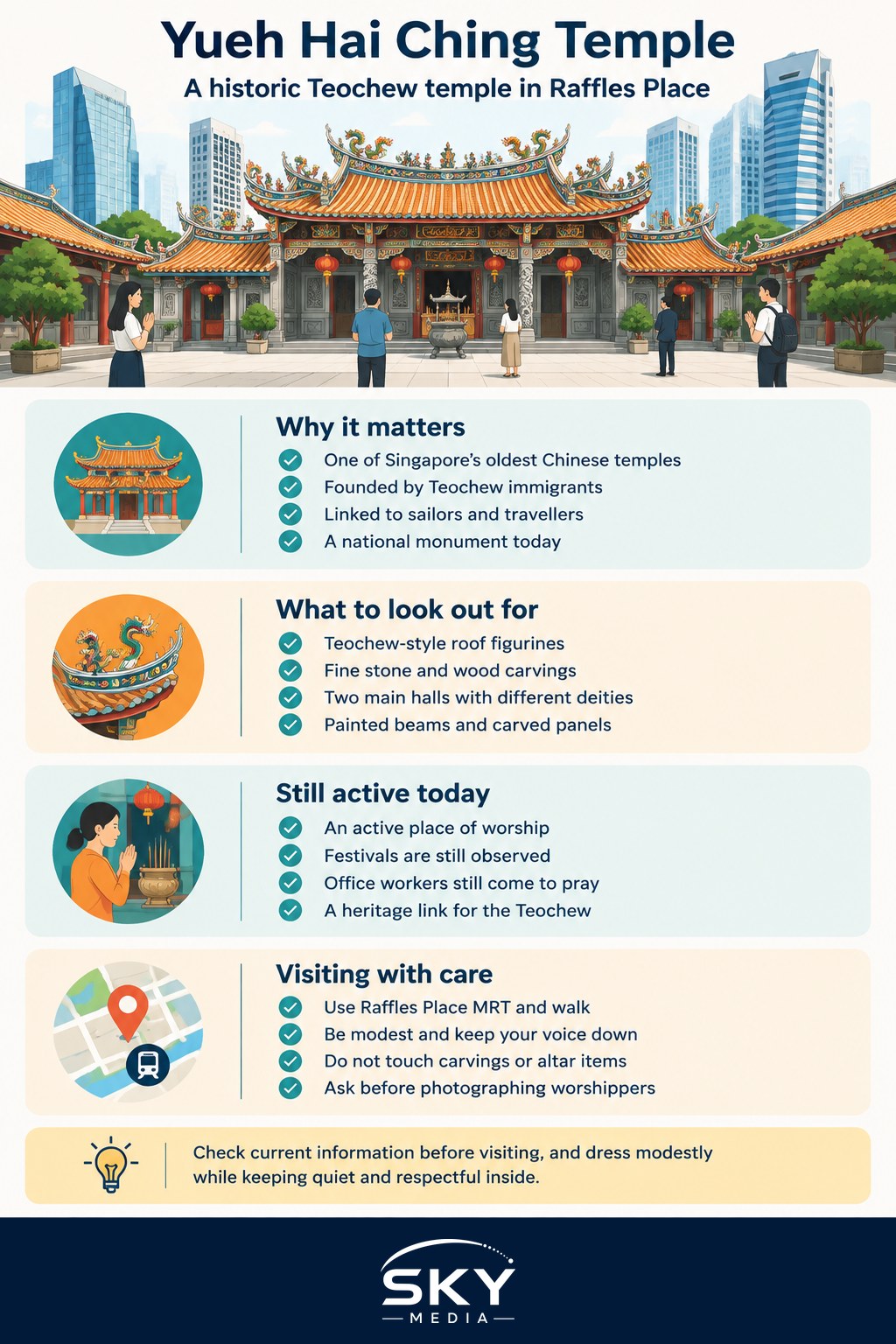
Yueh Hai Ching Temple dates from the middle of the nineteenth century, making it a contemporary of Singapore’s early growth as a trading port. For the Teochew immigrants who arrived by sea, safe passage was a matter of life and death, and so the temple was dedicated to deities associated with the protection of sailors and travellers. It became a place where newcomers gave thanks for their survival and prayed for good fortune in a strange new land.
Over time the temple grew into far more than a shrine. It served as a gathering place, a source of community support and a symbol of Teochew identity in Singapore. Its long history and cultural value have earned it recognition and protection as a national monument, ensuring that this precious building is preserved for future generations. A major restoration in recent decades returned much of its intricate ornamentation to its former glory, and the effort was widely praised for its care and authenticity. Because the temple remains active and its arrangements can change, especially around festivals, do check current information before visiting.
Architecture and Notable Features
The temple is celebrated for the richness and quality of its decorative craftsmanship. Its roofs are crowned with elaborate figurines depicting scenes from Chinese mythology and legend, sculpted in the distinctive Teochew style. These roof ornaments, together with finely carved stone and woodwork, make the temple a treasure house of traditional artistry that rewards close and patient looking.
Within the compound stand two main halls, each dedicated to different deities. One is associated with the protection of those who travel by sea, reflecting the temple’s origins, while another honours a deity connected with matters of the home, family and marriage. Devotees come to offer prayers, light joss sticks and seek blessings for safe journeys, harmonious relationships and good fortune. The interior spaces, though modest in size, are dense with detail, from painted beams to carved panels, and the atmosphere is quietly reverent.
The contrast between the temple’s low, ornate rooflines and the soaring skyscrapers that surround it is striking, and it makes the building all the more precious as a reminder of the world that existed here long before the financial district rose around it.
Its Role Today
Despite its location in a busy commercial area, Yueh Hai Ching Temple remains an active place of worship. Devotees, including office workers from the surrounding buildings, still come to pray, and the temple continues to observe festivals and religious occasions through the year. It stands as a link to the heritage of the Teochew community and to the broader story of how Chinese immigrants built their lives and institutions in Singapore.
The temple is also a point of interest for those exploring the heritage of the civic and financial districts, and it contributes to Singapore’s tapestry of faiths. Visitors interested in how different communities coexist may appreciate our reflections on interfaith harmony in Singapore.
How to Get There
Yueh Hai Ching Temple is on Phillip Street in the Raffles Place area. The nearest MRT station is Raffles Place, only a short walk away, and Telok Ayer and Clarke Quay stations are also within reach. The temple sits close to other heritage sites in the historic commercial core, so it is easy to combine a visit with a wider walk through this storied part of the city.
Respectful Visitor Etiquette
As with any active temple, visitors should behave with care and courtesy. Dress modestly, keep your voice down and move slowly and quietly, particularly when devotees are at prayer. Take care around burning joss sticks and candles, and do not touch the delicate carvings or altar items. Photography is often permitted for the architecture, but you should ask before photographing people at worship, and follow any signs that restrict pictures in certain areas.
If you wish to observe or take part in rituals, follow the example of the devotees around you and defer to the temple’s own guidance. Our guide to visiting Chinese temples and prayer etiquette offers helpful background for newcomers. Approached with respect, Yueh Hai Ching Temple offers a rare and moving encounter with Singapore’s maritime and immigrant past, still alive within the beating heart of the modern city.
Frequently Asked Questions
Who were the deities honoured at Yueh Hai Ching Temple? The temple has two main halls dedicated to different deities. One is associated with protecting those who travel by sea, reflecting the temple’s origins, and the other with home, family and marriage. Devotees pray for safe journeys and harmonious relationships.
Why is it called the Temple of the Calm Sea? The name reflects its founding by Teochew immigrants who crossed dangerous waters to reach Singapore. Safe passage was a matter of life and death, so the temple honoured deities protecting sailors and travellers, and newcomers gave thanks for surviving the voyage.
What should I look for in the temple’s decorations? Look up at the roofs, crowned with elaborate figurines showing Chinese mythology and legend in the distinctive Teochew style. Finely carved stone and woodwork, painted beams and carved panels reward patient looking. Do not touch the delicate carvings.
Is the temple a good stop during a lunch break in the CBD? Yes, it sits among the office towers of Raffles Place and office workers still come to pray. It is small, so a short visit is enough. Check current opening arrangements, as these can change, especially around festivals.
Can I join in the rituals as a visitor? You may observe, and if you wish to take part, follow the example of the devotees around you. Defer to the temple’s guidance, take care around burning joss sticks and candles, and ask before photographing people at worship.
Further reading: Hougang Heritage Guide: Strong Teochew Roots in the North East