
Thaipusam is one of the most striking religious festivals you can witness in Singapore. Devotees walk barefoot through the streets carrying milk pots and elaborate kavadi, often after weeks of prayer and fasting, while family and friends chant and walk beside them. Many non-Hindu residents and visitors come to watch, and they are generally welcome. Knowing a little Thaipusam Singapore etiquette before you go helps you enjoy the day as a respectful guest rather than a spectator who gets in the way.
This guide is written for first-timers who are not Hindu. It covers what to wear, how to behave along the route and at the temples, how to take photographs thoughtfully, and what the experience is actually like. For the religious meaning and history of the festival, start with Thaipusam Explained.
What You Will Actually See
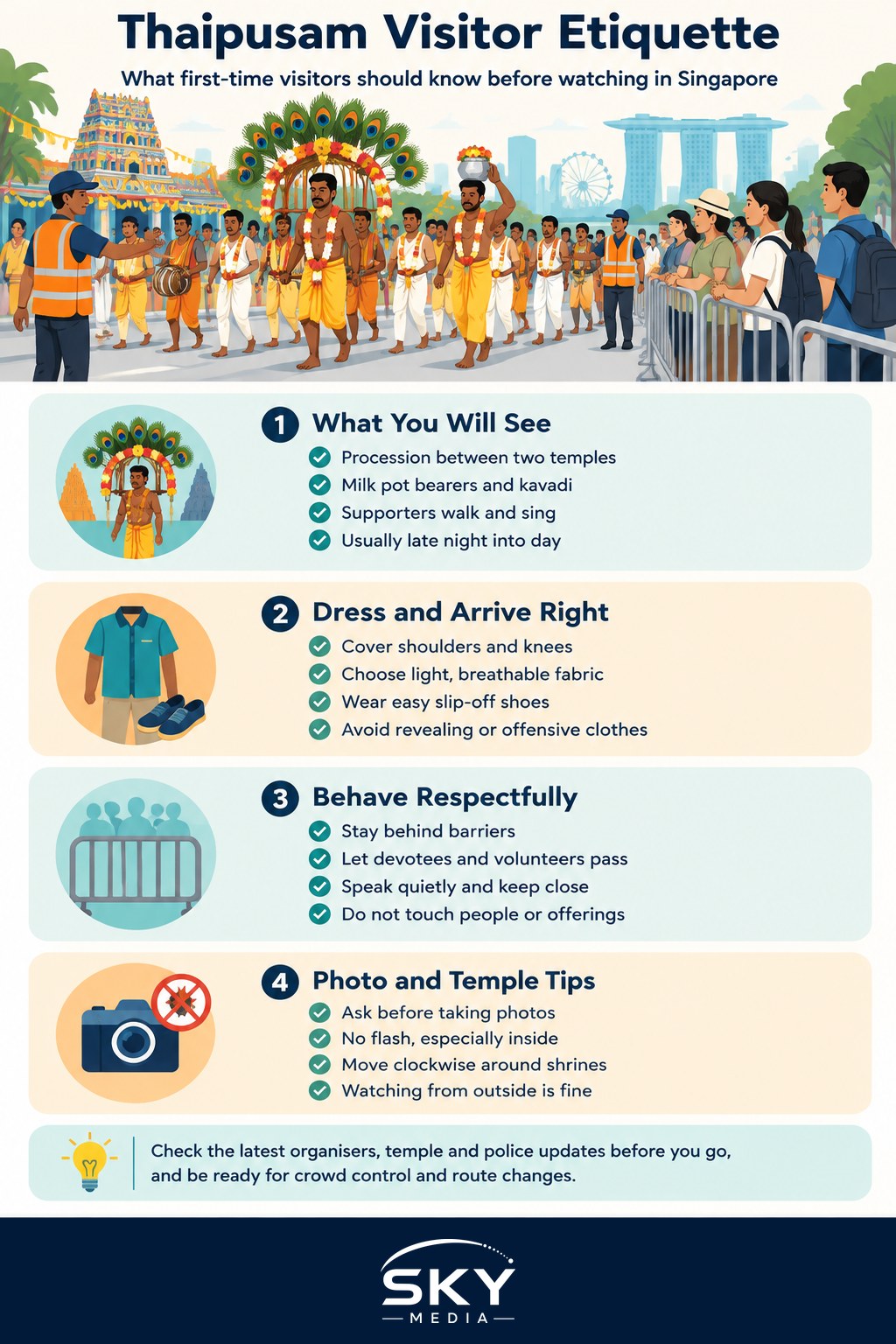
Thaipusam falls in the Tamil month of Thai, usually in January or February, and is observed in honour of Lord Murugan. In Singapore, the main procession runs between two Hindu temples: it begins at Sri Srinivasa Perumal Temple on Serangoon Road in Little India and ends at Sri Thendayuthapani Temple on Tank Road, a walk of a few kilometres. The procession usually starts late on the night before Thaipusam and continues through the day.
Along the route you will see:
- Paal kudam bearers carrying pots of milk, often on their heads, as an offering. This is the most common form of devotion, and you will see men, women and children doing it.
- Kavadi bearers carrying large decorated structures, some supported by hooks or skewers through the skin. Piercings are a vow of devotion and are done under the supervision of the temple and its helpers.
- Supporters who walk with each devotee, singing devotional songs, drumming where permitted, and offering encouragement and water.
The atmosphere is intense but focused. For devotees, this is a spiritual act, not a performance. Keeping that in mind is the foundation of good etiquette.
Dress Modestly and Comfortably
There is no strict dress code for spectators on the street, but modest clothing is a sign of respect, and it is expected if you plan to enter either temple. A simple guide:
- Cover your shoulders and knees. A T-shirt and long trousers, or a loose dress or skirt below the knee, works well.
- Choose light, breathable fabric. You may be standing in the sun or in a dense crowd for a long time.
- Wear shoes you can slip off easily. Footwear must be removed before entering a Hindu temple, and there may be a queue at shoe racks.
- Avoid clothing with offensive slogans or images, and skip anything very revealing.
Many local visitors wear light colours. Some devotees and their families wear yellow or orange, colours associated with Lord Murugan, but visitors are not expected to.
How to Behave Along the Route
The procession route is managed by the temple organisers, the Hindu Endowments Board and the police, with barriers and volunteers along much of the way. Your main job as a spectator is to stay out of the path and let devotees pass.
| Do | Don’t |
|---|---|
| Stand behind barriers or on the side of the pavement | Step into the procession path to get a better look |
| Give way to devotees, their supporters and volunteers | Touch a kavadi, a milk pot or a devotee’s body |
| Speak quietly and keep children close | Laugh, joke loudly or point at piercings |
| Ask a supporter or volunteer before approaching anyone | Offer food or drink to devotees unless volunteers invite you to |
| Follow instructions from police and marshals | Smoke, drink alcohol or vape near the route or temples |
A few further points are worth remembering:
- Many devotees are fasting and have prepared for days or weeks. Avoid eating noisily or waving snacks around right beside them.
- Do not interrupt a devotee to ask questions. If you are curious, family members and volunteers at the temples are often happy to explain, especially once things are quieter.
- Look out for the ground. Devotees walk barefoot, so never drop litter, cigarette ends or bottle caps along the route.
Photography: Ask, Be Brief, Avoid Flash
Thaipusam is visually dramatic, and photography is common. That does not mean every moment is a photo opportunity. Treat devotees as people in prayer, not as subjects.
- Keep a distance. Use a zoom lens or your phone’s zoom rather than pushing close to someone’s face.
- Ask when you can. If a devotee or their supporter is resting, a gesture towards your camera and a nod is often enough. If they shake their head or look away, respect it.
- Avoid flash, especially at night and inside the temples. It can startle devotees who are concentrating.
- Do not stop someone mid-walk for a better angle, and never ask them to pose.
- Check the temple’s rules before photographing inside. Some areas, especially near the shrine, may be off-limits for cameras.
- Think before you post. Close-up images of piercings, children or people in visible pain should be shared thoughtfully, if at all.
Visiting the Temples on Thaipusam
Both temples are busy places of worship on the day. If you want to go in:
- Remove your shoes at the entrance and leave them where indicated.
- Move clockwise around shrines, as worshippers do, and do not cut across people praying.
- Do not touch statues, offerings or the sacred ash and kumkum (red powder) set out for worshippers unless someone offers it to you.
- Accept offered food, such as blessed sweets or water, with your right hand if you take it. You may politely decline.
- Keep your visit short when it is crowded, and follow directions from temple volunteers.
If the temple is very crowded, watching from outside is completely acceptable and often more considerate.
Practical Tips for a Comfortable Visit
Thaipusam can be long, hot and crowded. A little planning helps:
- Go early or late. The procession runs for many hours. Early morning and evening tend to be cooler.
- Take public transport. Roads near the route are often closed or congested. Check the latest traffic and closure advisories from the police and LTA (Land Transport Authority) before you go.
- Bring water and stay hydrated, but drink discreetly.
- Keep children close and explain beforehand what they might see, especially the piercings, so they are not startled.
- Mind your belongings in thick crowds.
Thaipusam is not a public holiday in Singapore, so the procession takes place on what may be a working day. Arrangements, timings and route rules are set by the organisers each year and can change, so check the latest announcements from the Hindu Endowments Board and the temples before you plan your visit.
Being a Welcome Guest
Most people walking in the procession are glad that others are interested in their faith, as long as that interest is respectful. Watching quietly, giving way, asking before photographing and dressing modestly are usually all it takes. If you get the chance, a short conversation with a volunteer or family member afterwards can teach you far more than any guide.
If you are new to Singapore and want to understand how Thaipusam fits alongside other religious festivals, our newcomer’s guide to Thaipusam and Vesak Day is a good next read, and Thaipusam in Singapore, Explained covers the festival in more depth.