
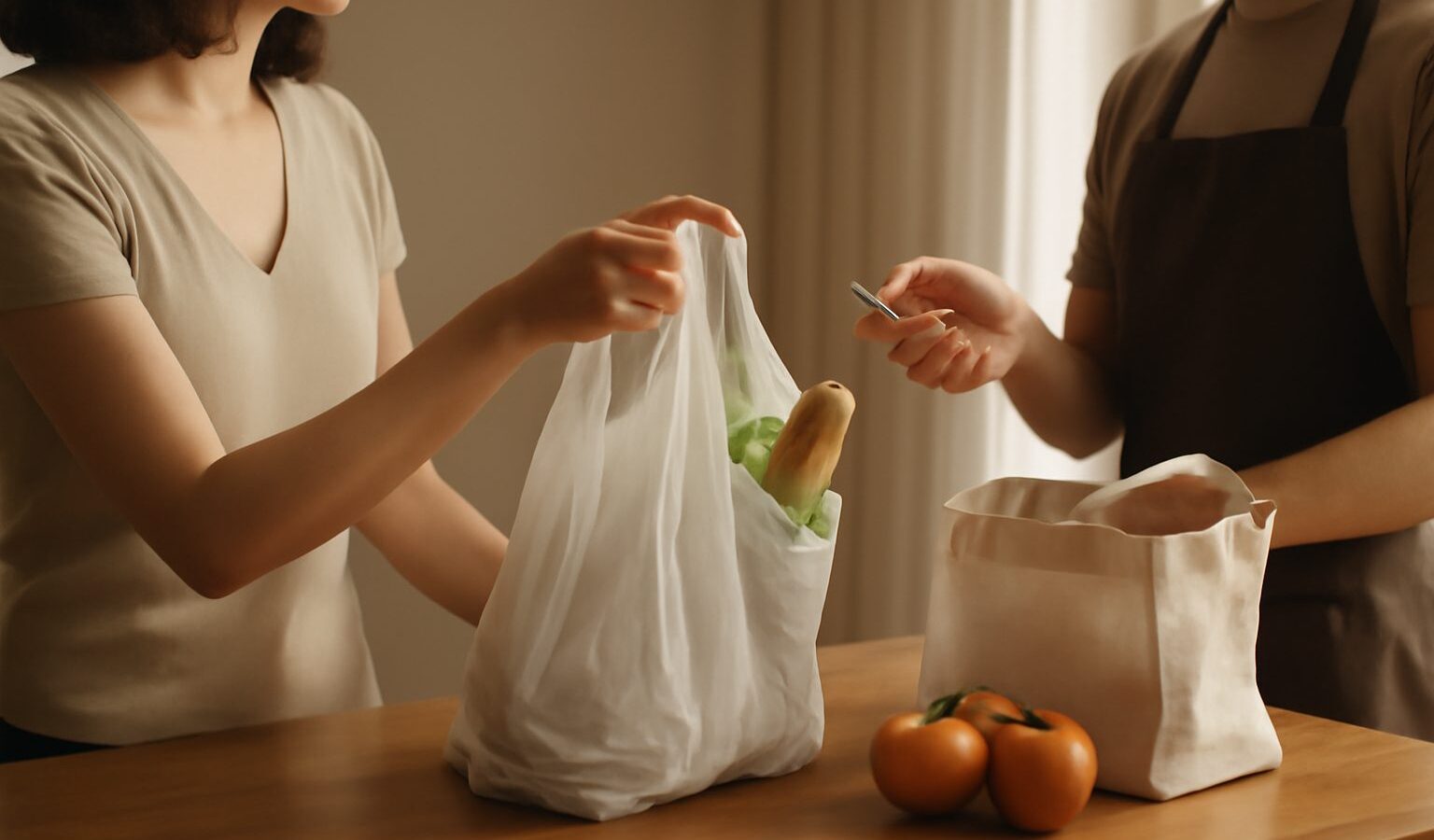
If you have done your groceries lately, you will have noticed a new line on the receipt: a small fee for each carrier bag. The disposable bag charge is one of the more visible sustainability nudges to reach everyday life in Singapore, and it has quietly changed how many of us shop. It is also widely misunderstood. Some shoppers think it is a money-grab, others assume it bans bags outright, and plenty of us are simply confused about where it applies and what to do instead.
This guide walks through what the disposable bag charge actually is, why it exists, and how to work it into your routine without stress. The aim is not to make you feel guilty at the till. It is to help you understand a policy that is here to stay, spend a little less on bags you do not need, and reduce the pile of single-use plastic heading to the incinerator.
What the Disposable Bag Charge Actually Is
The disposable bag charge is a mandatory fee that certain larger supermarket operators must apply to each disposable carrier bag they hand out, whether the bag is plastic, paper or another material. It is not a tax that supermarkets pocket as profit. Under the scheme set out by the National Environment Agency (NEA), operators are required to charge for bags and to be transparent about what happens to the money collected.
A few points are worth clearing up straight away:
- It applies to designated supermarket operators above a certain size, not to every shop, hawker stall or wet market stall in the country.
- The charge covers the carrier bags you use to take purchases home, not the smaller bags for loose produce or hygiene reasons where they are still provided.
- You are never forced to buy a bag. You can bring your own, carry items by hand, or use a box.
Because the exact fee, the list of covered operators and the finer rules can be updated over time, always check the current details on the NEA website rather than relying on what a friend told you last year. The principle, though, is simple and stable: bags that used to feel free now carry a visible cost, so we pause before taking one.
Why Singapore Introduced the Charge
Singapore uses a lot of disposable bags. In a hot, humid, convenience-driven city where many of us shop on the way home and reach for a bag out of habit, the numbers add up fast. Those bags do not biodegrade in any meaningful sense here. Almost all of our general waste is burned at waste-to-energy plants, and the ash is barged out to the offshore Semakau landfill, which has a finite lifespan. Every bag we skip is a small easing of that pressure.
There is a well-established behavioural reason for a charge rather than a ban. When something is free, we take it without thinking. Attaching even a small, visible price makes us pause and ask whether we really need it. Around the world, this kind of nudge has cut disposable bag use sharply, and early signs here point the same way. The goal is not the revenue. The goal is fewer bags in circulation and a shift in the default from take a bag to bring a bag.
The charge also sits within a bigger picture. It is one strand of the Singapore Green Plan and works alongside other measures such as Extended Producer Responsibility, which pushes producers to take more responsibility for packaging. Thinking about bags is a gentle entry point into thinking about single-use plastic more broadly.
Where the Charge Applies and Where It Does Not
One reason the scheme confuses people is that it does not cover every place you shop. Knowing where to expect a charge helps you plan and avoid the small annoyance of being caught out at the counter.
| Where you shop | Bag charge likely? | What to bring |
|---|---|---|
| Large chain supermarkets | Yes, per designated NEA rules | A reusable bag or two, or a foldable trolley |
| Wet markets and small provision shops | Usually not covered | Your own bag anyway, good habit |
| Hawker stalls and food courts | Not part of this scheme | A reusable container or bag for takeaway |
| Convenience stores and pharmacies | Varies, check at the counter | A small foldable bag in your daily carry |
| Online supermarket delivery | Depends on operator policy | Choose bagless or minimal-bag options where offered |
The practical takeaway is not to memorise every case. It is to always have a bag on you, so the answer to where does the charge apply stops mattering. If you are carrying a reusable bag, a charge somewhere simply becomes a fee you never pay.
How to Adjust Without the Hassle
The people who find the charge most irritating are usually the ones who keep getting caught without a bag. A little bit of system solves that almost entirely. Here are habits that make the disposable bag charge a non-event in your week:
- Keep foldable bags everywhere. Stash a couple in each work bag, in the car, by the front door and in your everyday tote. The lightweight ones that scrunch into a pouch are ideal for our climate and take up almost no space.
- Right-size your reusables. One big sturdy bag for a full grocery run, plus one small foldable for the unplanned top-up on the way home. You rarely need more.
- Reuse what you already have. You do not need to buy new eco bags. The bags you already own, old tote bags, even a clean box from a previous delivery, all work fine. Buying a stack of brand new reusable bags can defeat the purpose if you never use them enough.
- Wash them now and then. Bags that carry raw meat, seafood or leaky produce should be washed regularly. In our humidity this matters for hygiene, so give cloth bags a rinse and let them dry fully.
- If you do take a paper or plastic bag, use it more than once. A bag reused several times, then repurposed as a bin liner, has done far more work than one that goes straight in the rubbish.
If you forget your bag and face a charge, do not spiral into guilt. Pay the few cents, reuse the bag well, and set up your system so it happens less often. Sustainable habits are built through repetition, not perfection, and the odd slip is completely normal.
Bags Are One Piece of a Bigger Habit
It is easy to treat the disposable bag charge as the whole story, but bags are a small slice of household plastic. The same bring-your-own instinct extends naturally to other parts of daily life. Carrying a reusable container and cutlery helps you cut down on disposables when dining out, and being mindful of packaging feeds into reducing waste from food delivery, where single-use items pile up fast.
It also helps to understand where our rubbish goes. Knowing what happens to your recycling makes it clear why avoiding waste in the first place beats trying to recycle our way out of it. A disposable bag, even one labelled recyclable, is best avoided rather than relied upon to be recycled.
None of this requires a dramatic lifestyle overhaul. Bring a bag, reuse what you have, and let the small pause at the checkout do its quiet work. Over a year, one household skipping most of its disposable bags adds up to hundreds fewer bags, and across the island that becomes a genuine dent in single-use plastic. The disposable bag charge simply gives us the nudge to make that the new normal.