
For a generation of Singaporeans, some of the most memorable nights out were spent under the distinctive angled roof of the National Theatre. Built in the 1960s as a people’s venue for concerts, performances, and national events, the National Theatre in Singapore was a proud symbol of a young nation finding its cultural feet. It no longer stands, having been demolished, but its memory endures as one of the country’s best loved lost landmarks.
A people’s theatre for a new nation
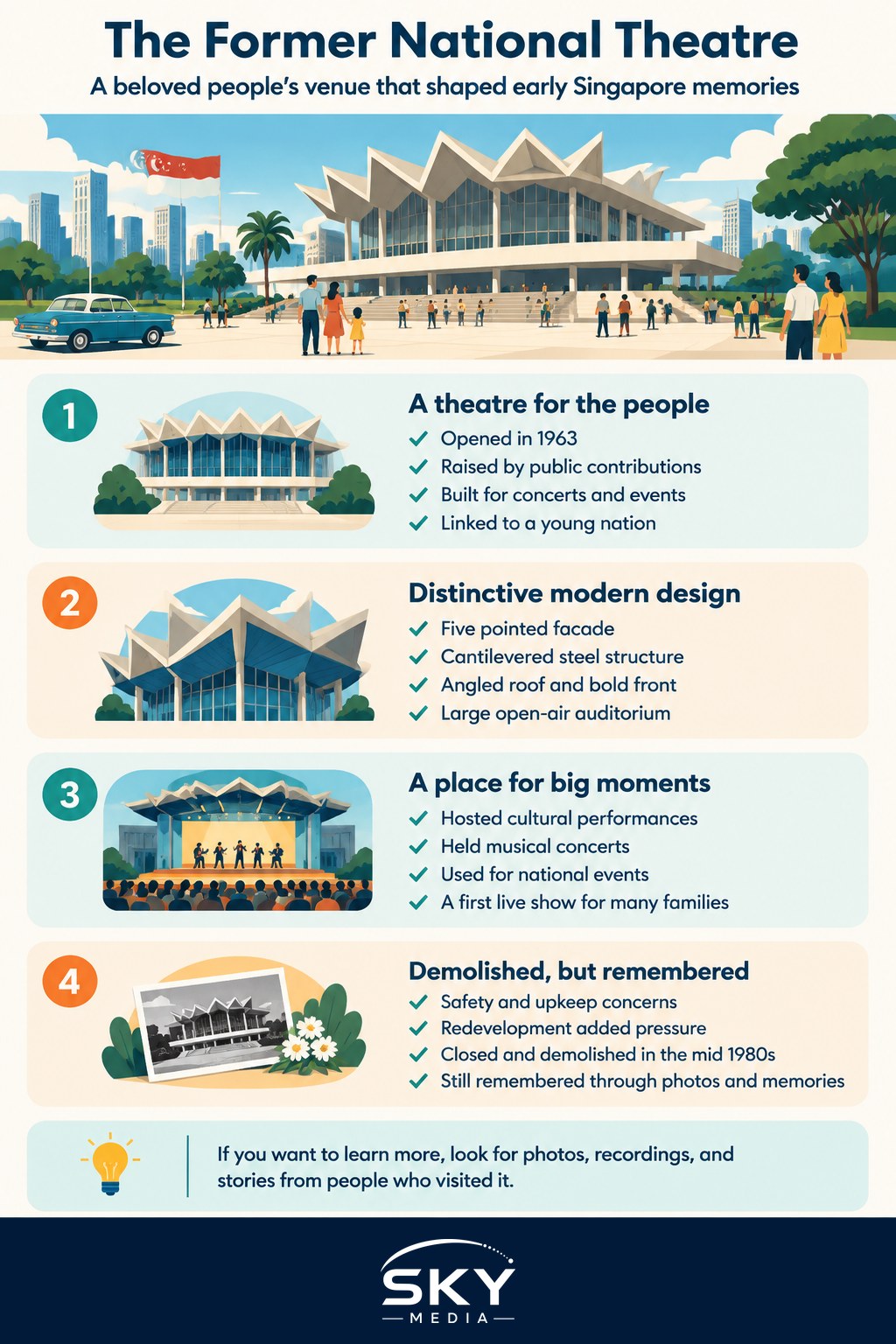
The National Theatre opened in 1963, in the period when Singapore was moving towards self government and then independence. It was conceived as a venue for the people, and in a striking gesture much of the funding was raised through public contributions, so that ordinary citizens felt a genuine sense of ownership over it. This spirit of shared effort was part of what made the building so beloved. It was not simply handed down from above. It was, in a real sense, built by the community for the community.
The design was unmistakable. The theatre was famous for its bold facade, made up of five soaring pointed sections that fanned out above the entrance, and for a cantilevered steel structure that gave the building a light, forward leaning drama. The five points were widely read as a reference to the five stars on the national flag, tying the building’s very form to the identity of the emerging nation. A large open air auditorium allowed it to host sizeable audiences, and a decorative fountain once played nearby. As a piece of modern architecture it was ambitious and optimistic, very much of a piece with the confident design thinking described in our Singapore architecture styles guide.
Over the years the theatre played host to a remarkable range of occasions. It staged cultural performances, musical concerts, and mass gatherings, and it served as a setting for important national events during the formative years of the republic. For many families it was the place where they first experienced live performance on a grand scale. That kind of shared, formative memory is exactly what our collection on old Singapore nostalgia tries to preserve, and the National Theatre sits close to the heart of it.
Demolition and lasting memory
Despite the deep affection it inspired, the National Theatre did not last. In time, concerns arose about the condition and structural safety of the building, and questions were raised about the cost and feasibility of keeping it in good order. Redevelopment of the surrounding area also placed pressure on the site. After a period of debate, the decision was taken to close and then demolish the theatre, and it was pulled down in the mid 1980s. Its removal was felt keenly by those who had grown up with it, and it has been mourned ever since as one of the more painful losses among the city’s vanished landmarks.
The story of the National Theatre is therefore a clear case of a building that was widely loved and yet still lost, and it belongs squarely within our wider record of Singapore’s lost buildings and landmarks. Its passing is often raised in discussions about how a fast developing city balances renewal against the value of the places its people cherish, a tension that runs through our piece on the conservation of heritage buildings in Singapore. Had the building come along a little later, when appreciation for post independence modernism had grown, its fate might have been different.
The status of the former National Theatre today is plain. It has been demolished, and the site has since been given over to other uses. What remains is the memory, kept alive through photographs, recordings of the events it hosted, and the recollections of those who were there. Its five pointed facade lives on as one of the enduring images of early independent Singapore, a shorthand for a hopeful moment in the national story. Following that story from its beginnings to the present, as we do in our Singapore history timeline, it is impossible to leave out the National Theatre, the theatre that the people built and then, in time, had to let go.
Frequently Asked Questions
Why did the National Theatre have five points on its facade? The five soaring pointed sections were widely read as a reference to the five stars on the national flag, tying the building’s very form to the identity of the emerging nation. A cantilevered steel structure gave it a light, forward leaning drama.
Who paid for the National Theatre to be built? Much of the funding was raised through public contributions, so ordinary citizens felt a real sense of ownership. That shared effort is a big part of why the theatre was so beloved, as it was built by the community for the community.
Why was the National Theatre demolished? Concerns arose about the building’s condition and structural safety, and questions were raised about the cost and feasibility of keeping it in good order. Redevelopment of the surrounding area also placed pressure on the site. After debate, it was closed and pulled down in the mid 1980s.
What was the open air auditorium used for? The large open air auditorium let the theatre host sizeable audiences for cultural performances, musical concerts and mass gatherings. It also served as a setting for important national events in the republic’s formative years, and many families had their first big live show there.
Can I still see anything of the National Theatre today? The building itself is gone and the site has been given over to other uses. What remains is memory, kept alive through photographs, recordings of events it hosted and the recollections of those who were there. Its five pointed facade endures as an image of early independent Singapore.