
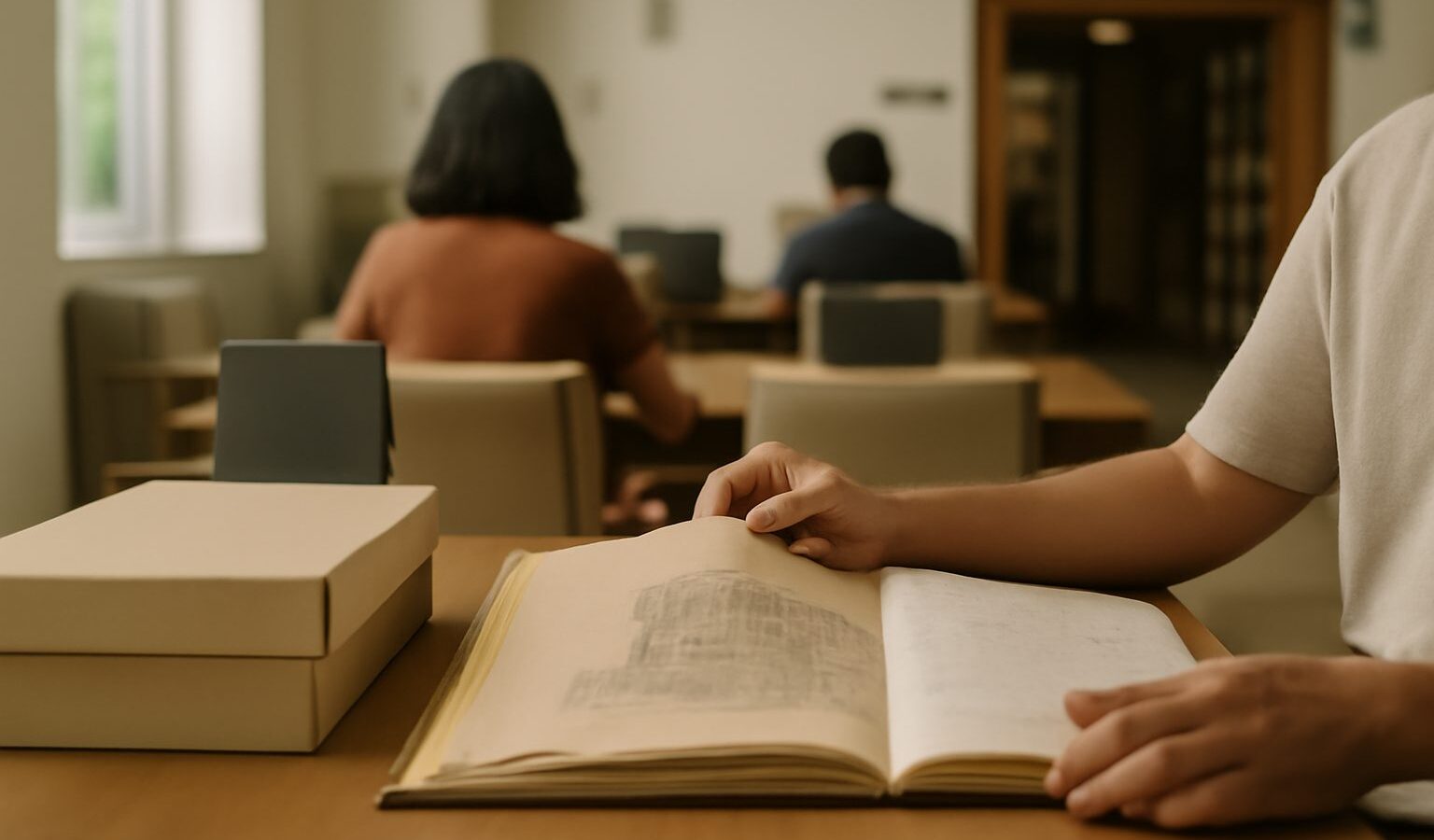
The National Archives of Singapore is the nation’s official keeper of records of enduring value. It gathers, preserves and makes available the documents, photographs, maps, recordings and other materials that together form the documentary memory of the country. This guide explains, in general terms, what the National Archives is, what it holds, and how members of the public can use it.
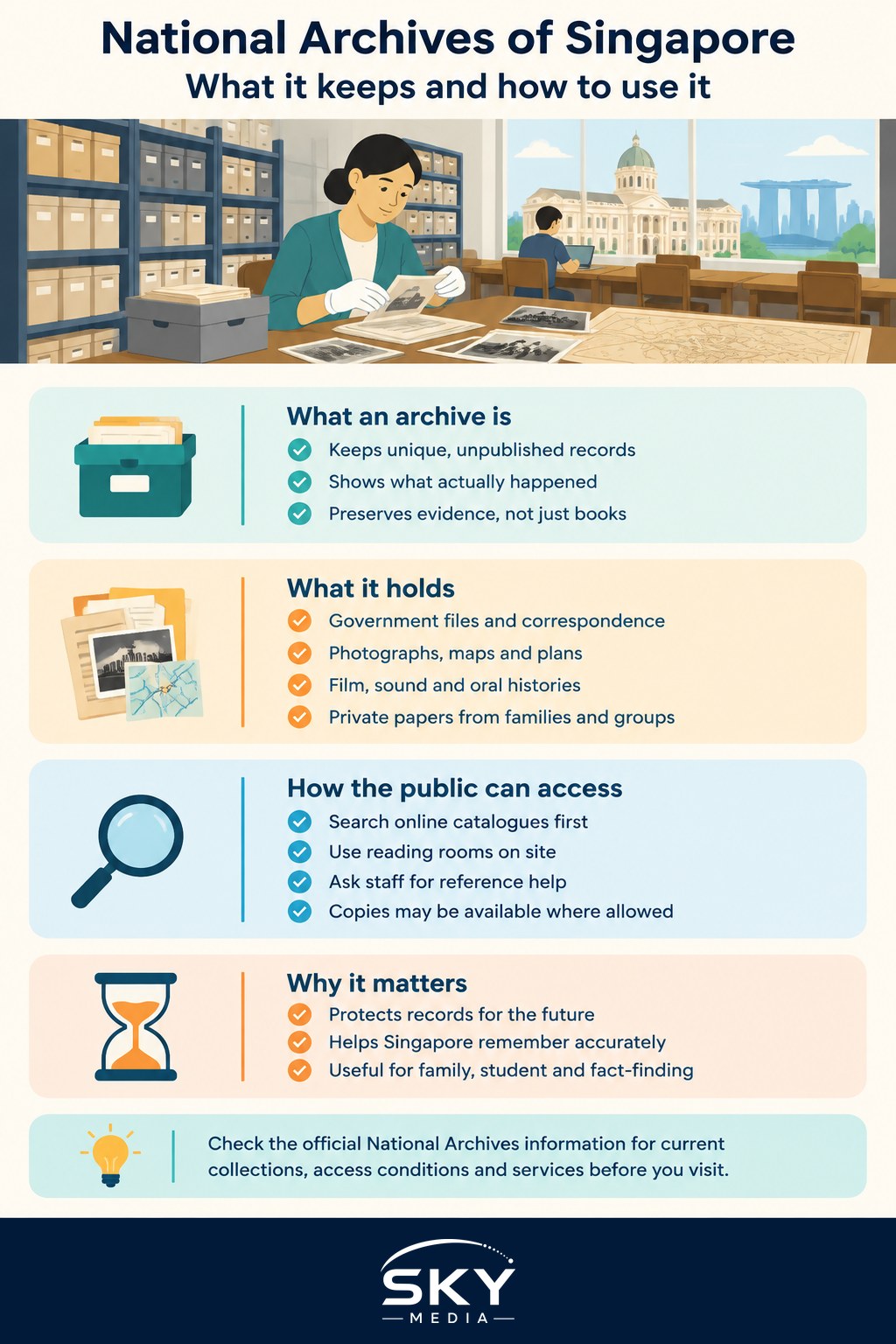
What the National Archives is
An archive is not the same as a library. A library collects published books and materials that exist in many copies. An archive keeps records, often unique and unpublished, that were created in the course of real activity: the paperwork of government, the photographs of an event, the recording of a person’s memories. The value of an archive lies in this authenticity. Its holdings are evidence of what actually happened.
The National Archives of Singapore serves as the central repository for such records at the national level. Its role is to make sure that materials of lasting significance are not lost, that they are preserved under proper conditions, and that they can be found and consulted by researchers, students, officials and ordinary citizens who want to understand the past.
The kinds of records it keeps
The collections of the National Archives are broad. While the exact scope is best confirmed from the institution’s own official information, the main categories are generally these.
Government and public records
A core function of any national archive is to keep the records of the state that have enduring value. These can include official files, correspondence and documents generated by public bodies over the years. Such records are essential for understanding how the country was governed and how decisions were made.
Photographs, maps and audiovisual materials
The Archives holds large visual collections. Photographs capture people, places and events across the decades. Maps and plans show how the island and its streets changed over time. Audiovisual materials, including film and sound recordings, preserve moving images and voices that written records alone cannot convey.
Oral history
One especially valued part of the Archives is its oral history work, in which people are interviewed and their recollections recorded. These interviews capture the memories of individuals across many walks of life, from ordinary residents to those who took part in significant events. Oral history is precious because it preserves experiences and perspectives that were never written down, and because the people who lived through earlier times will not always be here to tell their stories.
Private and community records
Alongside official material, an archive often accepts records donated by families, associations, businesses and community groups. These private papers, photographs and documents add texture to the national story, showing history from the point of view of individuals and communities rather than only the state.
How the public can access records
A key point about the National Archives is that it is not a closed vault. A central part of its mission is to make records available to the public. There are several ways people commonly access archival materials, though exact procedures, opening hours and any conditions should always be checked from official sources.
- Online search. Many archives, including this one, provide online catalogues and digitised materials that can be searched from home. This is usually the best starting point, letting a researcher find out what exists before visiting in person.
- Reading rooms. For materials that must be consulted on site, an archive typically offers a reading room or search facility where visitors can examine records under supervision that protects fragile originals.
- Reference help. Archives staff can often guide members of the public on how to search, what may be available on a topic, and how to request materials.
- Reproductions. Where allowed, copies or reproductions of records may be obtained, subject to the archive’s rules and any restrictions.
It is worth noting that not every record is freely open. Some materials may carry access conditions for reasons such as privacy, or because they are still within a restricted period. The archive’s own guidance explains what applies.
Comparing an archive with a library and a museum
People sometimes confuse the roles of archives, libraries and museums. Each preserves the past, but each does so differently. The table below sets out the general distinction.
| Institution | Mainly keeps | Typical use |
|---|---|---|
| Archive | Unique records, documents and recordings | Research and evidence about the past |
| Library | Published books and materials in many copies | Reading, reference and learning |
| Museum | Objects and artefacts, often on display | Exhibition and public education |
Understanding this difference makes the National Archives easier to use. A person tracing a family history, a student researching a topic, or a writer checking a fact will find in the Archives a kind of source that neither a library nor a museum can fully replace.
Why the National Archives matters
The value of a national archive is easy to overlook until it is needed. Records preserved today are what allow the country to remember accurately tomorrow. Without careful keeping, documents are lost, photographs fade, and the memories captured in oral history vanish with the people who held them.
For Singapore, a young nation that changed rapidly, this work of remembering is especially important. So much was built, cleared and rebuilt within living memory that the documentary record is often the only reliable link to how things once were. The National Archives helps ensure that the story of the country rests on evidence rather than on fading recollection alone.
Making use of it
For anyone curious about the past, the National Archives of Singapore is a resource worth knowing. A family researcher can look for traces of relatives and old neighbourhoods. A student can find primary sources for a project. A community group can deposit and protect its own records for the future. The first step is simply to explore what is available, ideally through the institution’s own official channels, where current details on collections, access and services are kept up to date.
An archive is, in the end, a promise across time: that what mattered will be kept, and that those who come later will be able to find it.
Explore more: Museums and heritage centres in Singapore · A Singapore history timeline · Samsui women and migrant history
Frequently Asked Questions
Can you donate family photos or papers to the National Archives? Archives often accept records donated by families, associations, businesses and community groups, and these private papers add texture to the national story. Not everything is accepted, so contact the National Archives through its official channels to ask what it collects and how to offer material.
Is the National Archives useful for tracing family history? It can be, since a family researcher may find traces of relatives and old neighbourhoods in photographs, maps, oral history and other records. Start with the online catalogue to see what exists, and remember that not every record is open, as some carry access conditions.
Why can some archive records not be viewed by the public? Some materials carry access conditions for reasons such as privacy, or because they are still within a restricted period. The archive’s own guidance explains what applies to each collection, so check before planning a visit or requesting a record.
What is oral history and why does the Archives record it? Oral history means interviewing people and recording their recollections, from ordinary residents to those involved in significant events. It preserves experiences that were never written down, and the people who lived through earlier times will not always be here to tell their stories.
Can students use National Archives material for a school project? Yes, a student can find primary sources such as photographs, maps and documents for a project. Begin with the online search, note the reference details for citations, and ask the reference staff for help if you are unsure how to search or request materials.