
For anyone who grew up in Singapore in the second half of the twentieth century, the words “the library” often meant one place and one place only. The old National Library at Stamford Road, with its warm red-brick walls and its long stone staircase, was more than a building that held books. It was a shared memory, a meeting point, a quiet refuge from the heat, and for many families the first door into a wider world of reading. When the old National Library Singapore closed and was later taken down, the loss was felt far beyond the pages that once lined its shelves.
What It Was and How It Came to Be
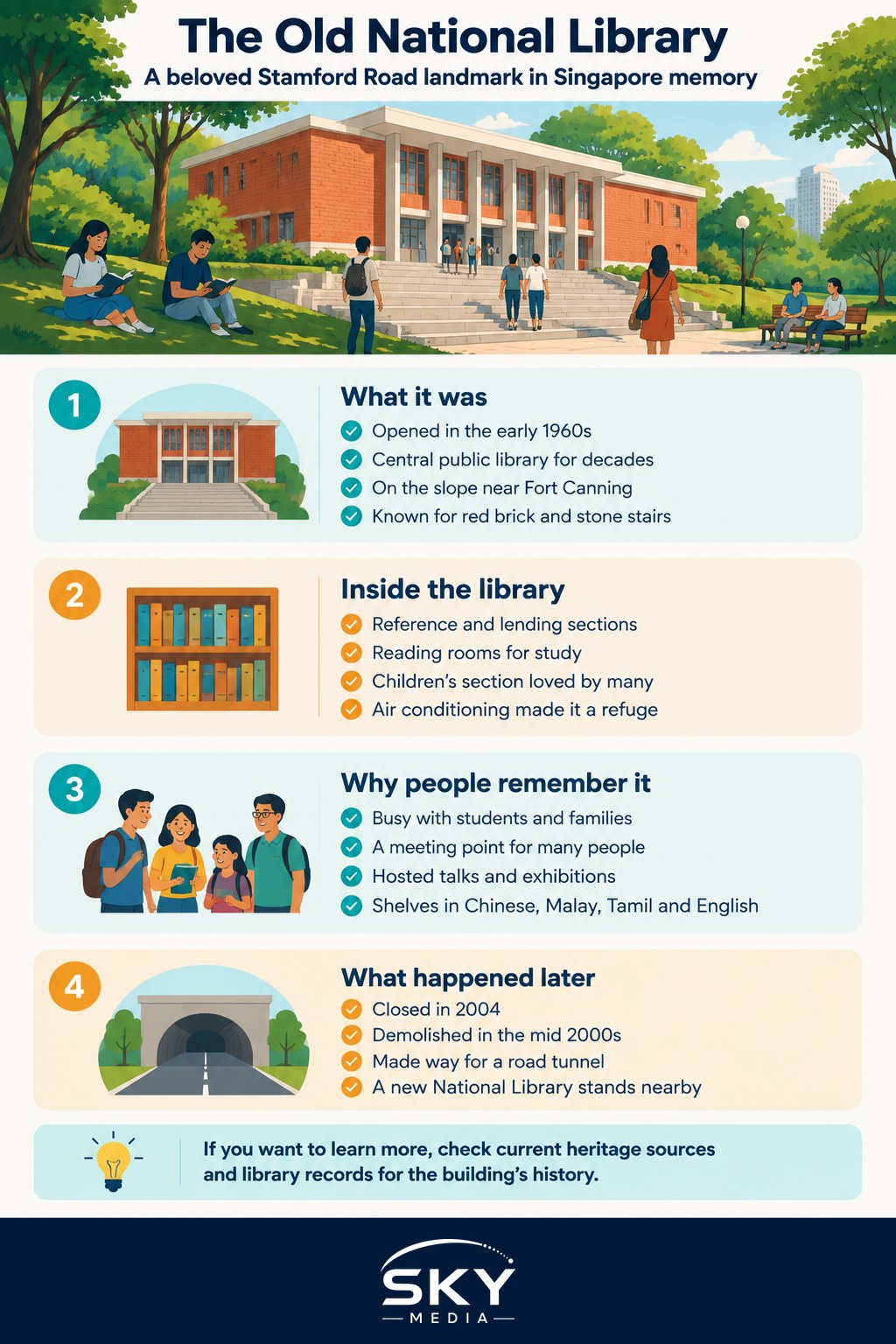
The Stamford Road building opened in the early 1960s and served as the country’s central public library for more than four decades. It stood on the slope near Fort Canning, close to the Singapore heart of the old civic and cultural district. The distinctive red brick gave it a character quite unlike the pale stone and glass of many buildings around it, and generations of Singaporeans came to know it simply by that colour and that staircase.
The library grew out of an older institution. Singapore had run public reading rooms and a Raffles Library long before independence, and the Stamford Road building was the modern home meant to serve a young and rapidly changing nation. Part of the funding for the building is widely associated with the generosity of a well known philanthropist, and this spirit of giving to the public good was very much in keeping with the mood of the era. Rather than repeat figures that are easy to get wrong, it is enough to say that the library was built as a gift to ordinary people, and ordinary people repaid it with decades of devoted use.
Inside, the layout was practical and unfussy. There were reference sections, a lending library, reading rooms where students bent over notes for hours, and a children’s section that many adults still remember with real affection. Air conditioning, still something of a luxury in early Singapore, made the library a treasured place to sit and think on a sweltering afternoon.
Its Heyday, Its Memories and Its Social Role
At its peak the old National Library was one of the busiest public spaces in the city. School pupils came to borrow storybooks and to research projects. University students queued for reference material before examinations. Job seekers, hobbyists, new immigrants and retirees all passed through its doors. For a small island building a modern society, the library was a great equaliser, a place where knowledge cost nothing but a borrower’s card and a little patience.
The memories people carry are often small and personal. The particular smell of old paper and cool air. The clunk of the date stamp on a borrowing slip. The nervous walk to the counter with an armful of books. Meeting a friend, or a first crush, on the front steps. Sheltering there when a sudden downpour swept across the city. These are the ordinary moments that turned a public building into a private landmark for millions.
The library also played a quiet civic role. It hosted talks, exhibitions and reading programmes, and it helped nurture a habit of reading across languages and communities. In a nation with several mother tongues, a well stocked public library was a bridge between them, offering shelves in Chinese, Malay, Tamil and English under one roof. You can trace this same spirit of shared public space in other chapters of the city’s past, from the amusement parks to the busy streets captured in old Singapore nostalgia.
What Happened to It and What Stands There Now
The old National Library at Stamford Road was demolished in the mid 2000s, closing its doors in 2004, to make way for a road tunnel linking the civic district with the areas beyond Fort Canning. The decision was deeply controversial. Many Singaporeans, heritage advocates and former users campaigned to save the building, arguing that its emotional value could not be measured against traffic flow. The campaign did not succeed, and the red-brick landmark came down, joining a long list of much loved structures lost to development. For a wider view of these losses, see our look at Singapore lost buildings and landmarks.
The nation did not abandon libraries, of course. A large modern National Library rose nearby on Victoria Street, a striking tower of glass and greenery that carries the institution proudly into the present day. It is a fine building, busy and admired, and it holds the collections that matter. Yet for those who remember the original, the new tower and the old red brick are not quite the same thing. One is where the books live now. The other is where a childhood happened.
Some fragments of the old library were preserved and displayed, small physical links to a place that lives mostly in memory. Perhaps that is fitting. The old National Library Singapore was always about more than mortar and shelves. It was about a young country deciding that reading mattered, and about the millions of quiet afternoons that decision made possible. The staircase is gone, but the habit of curiosity it helped build endures, which is exactly what any library would wish for. To place it within the larger arc of the island’s development, our Singapore history timeline sets the scene.
Frequently Asked Questions
Why was the old National Library demolished? It was taken down to make way for a road tunnel linking the civic district with the areas beyond Fort Canning. The decision was deeply controversial, and many Singaporeans, heritage advocates and former users campaigned to save it, arguing emotional value could not be weighed against traffic flow.
Where did the National Library move to after Stamford Road? A large modern National Library rose nearby on Victoria Street, a tower of glass and greenery that carries the institution into the present day. It holds the collections that matter, though many who remember the original feel it is not quite the same thing.
What languages could you borrow books in at the old library? It offered shelves in Chinese, Malay, Tamil and English under one roof. In a nation with several mother tongues, a well stocked public library worked as a bridge between communities and helped nurture a habit of reading across languages.
What could you do at the old library besides borrow books? There were reference sections, reading rooms where students studied for hours, and a children’s section many adults remember fondly. It also hosted talks, exhibitions and reading programmes. Air conditioning made it a treasured place to sit and think on a sweltering afternoon.
Was any part of the old library kept? Yes, some fragments were preserved and displayed, small physical links to a place that lives mostly in memory. The building and its red-brick walls and staircase are gone, but the habit of curiosity it helped build is what many people say endures.
Further reading: The Singapore National Library Building and Its Cultural Role · The Former National Theatre · The National Archives of Singapore