
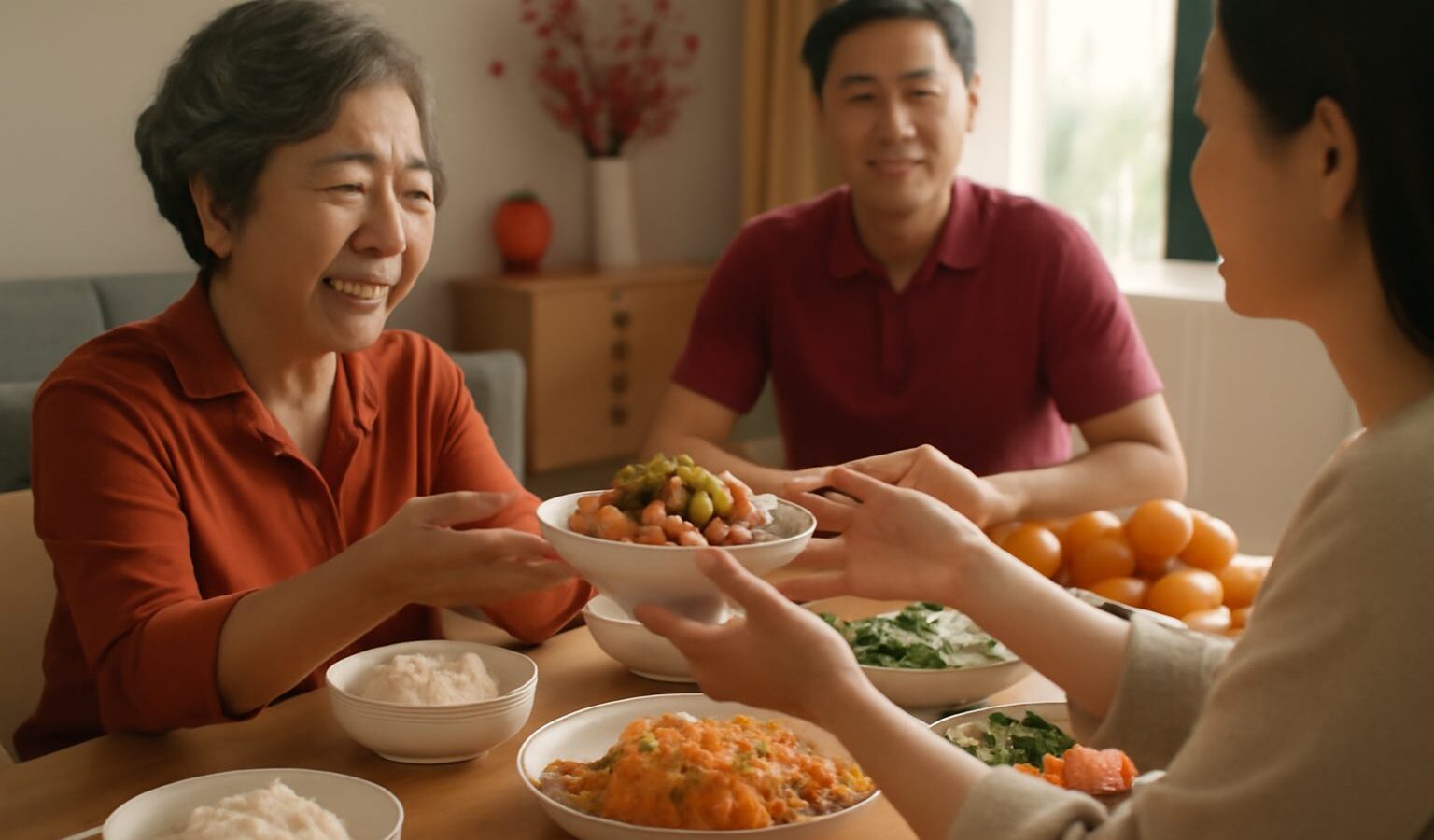
The reunion dinner Singapore families gather for on the eve of Chinese New Year is, for many, the single most important meal of the year. It is the moment when relatives travel back from wherever life has taken them to sit at one table, share food heavy with meaning, and close the old year together before the new one begins.
What the reunion dinner is
Held on the eve of the first day of the Lunar New Year, the reunion dinner marks the gathering of the family. The Mandarin term, tuan yuan fan, literally carries the idea of coming together in a full circle. The meal is less about elaborate cooking than about presence: being at the table matters more than any single dish.
Traditionally the meal is hosted at the home of the eldest generation, often the paternal grandparents, though many families now book restaurants for practicality. An empty seat may be kept, or a family may wait, for a member who is delayed, because the point is completeness.
Why the timing matters
The eve of the new year is a hinge between two years. By sharing this meal, the family gives thanks for the year that is ending and expresses hope for the one arriving. In the past, the meal was followed by staying up late, a practice linked to wishing elders long life. Even where that custom has relaxed, the sense that this night is different from ordinary nights remains strong.
Married couples in particular often navigate the delicate question of whose family to join on the eve, sometimes alternating year by year, because both sides value the same gathering.
The food and its symbolism
Almost every dish on a reunion table carries a wish, usually through a pun in Chinese or through the shape and colour of the food. Practices vary by dialect group and by family, so no single menu is “correct”, but several dishes appear again and again.
| Dish | The wish it carries |
|---|---|
| Fish, often served whole | Surplus and abundance year after year |
| Dumplings, shaped like old ingots | Wealth and prosperity |
| Whole chicken | Family togetherness and a good start |
| Longevity noodles, uncut | Long life |
| Leafy greens | Freshness and new beginnings |
| Mandarin oranges | Gold, luck, and good fortune |
| Yusheng, the raw fish salad | Rising abundance and good luck |
The fish is often left partly uneaten, so that the “surplus” carries into the next year. Longevity noodles are meant to be eaten without being bitten through, to avoid cutting short the long life they symbolise.
Yusheng and the lo hei ritual
A dish especially associated with Singapore and the region is yusheng, the colourful raw fish salad. Families and friends gather around it, add ingredients while calling out auspicious phrases, and then toss the salad high with their chopsticks. The higher the toss, the greater the hoped-for good fortune. Lo hei has become a shared social ritual well beyond the reunion dinner itself, appearing at gatherings throughout the festive period.
The steamboat table
Many Singaporean households favour a steamboat, or hotpot, for the reunion meal. A simmering communal pot suits the occasion perfectly: everyone cooks together at one table, the meal stretches across a relaxed evening, and the round pot echoes the theme of the family circle.
Regional and dialect variations
What appears on the table reflects a family’s dialect heritage. A Teochew family may favour particular braised dishes and a delicate style, while Hokkien, Cantonese, Hakka, and Hainanese families each bring their own signatures. Peranakan families may include Nonya dishes that are found on few other tables. None of these is more authentic than another; they are simply the many faces of the same tradition.
How the tradition is evolving
Singapore’s reunion dinner is not frozen in time. Several shifts are visible across recent generations.
- Dining out. With smaller kitchens and busier lives, more families book restaurant set menus or order in, rather than cooking a full spread at home.
- Convenience options. Ready-to-cook reunion sets, pre-tossed yusheng, and delivery have made the meal easier to host.
- Blended families and dietary needs. Menus increasingly accommodate vegetarian, halal-friendly, or health-conscious guests, and mixed-heritage families weave in dishes from more than one culture.
- Distance and technology. When members cannot fly home, video calls now let absent relatives join the table for at least part of the evening.
What has not changed is the underlying intent. Whether the meal is a home-cooked feast or a restaurant booking, the aim is to gather the family and mark the turning of the year together.
Quiet etiquette at the table
- Wait for the elders to begin before starting to eat.
- Serve older relatives first as a mark of respect.
- Keep the tone warm; avoid quarrels and unlucky talk on this night.
- Where lo hei is served, join in the tossing and the calling of good wishes.
Making the most of the evening
For younger Singaporeans, the reunion dinner is a rare fixed point in a fast-moving year, a chance to hear elders’ stories and to learn the dishes before the knowledge fades. Offering to help prepare a dish, learning why the fish is left whole, or simply asking a grandparent about reunion dinners of their childhood can turn an ordinary meal into a thread of memory passed down.
A meal about belonging
Strip away the individual dishes and the reunion dinner comes down to one idea: that no matter how far apart a family scatters during the year, this one night draws it back into a circle. That is why the tradition endures across changing menus and changing homes. The reunion dinner in Singapore is, in the end, less about what is served and more about who is there to share it.
Explore more: Lunar New Year in Singapore · Traditional Chinese customs in Singapore · Mandarin oranges and CNY gifting