
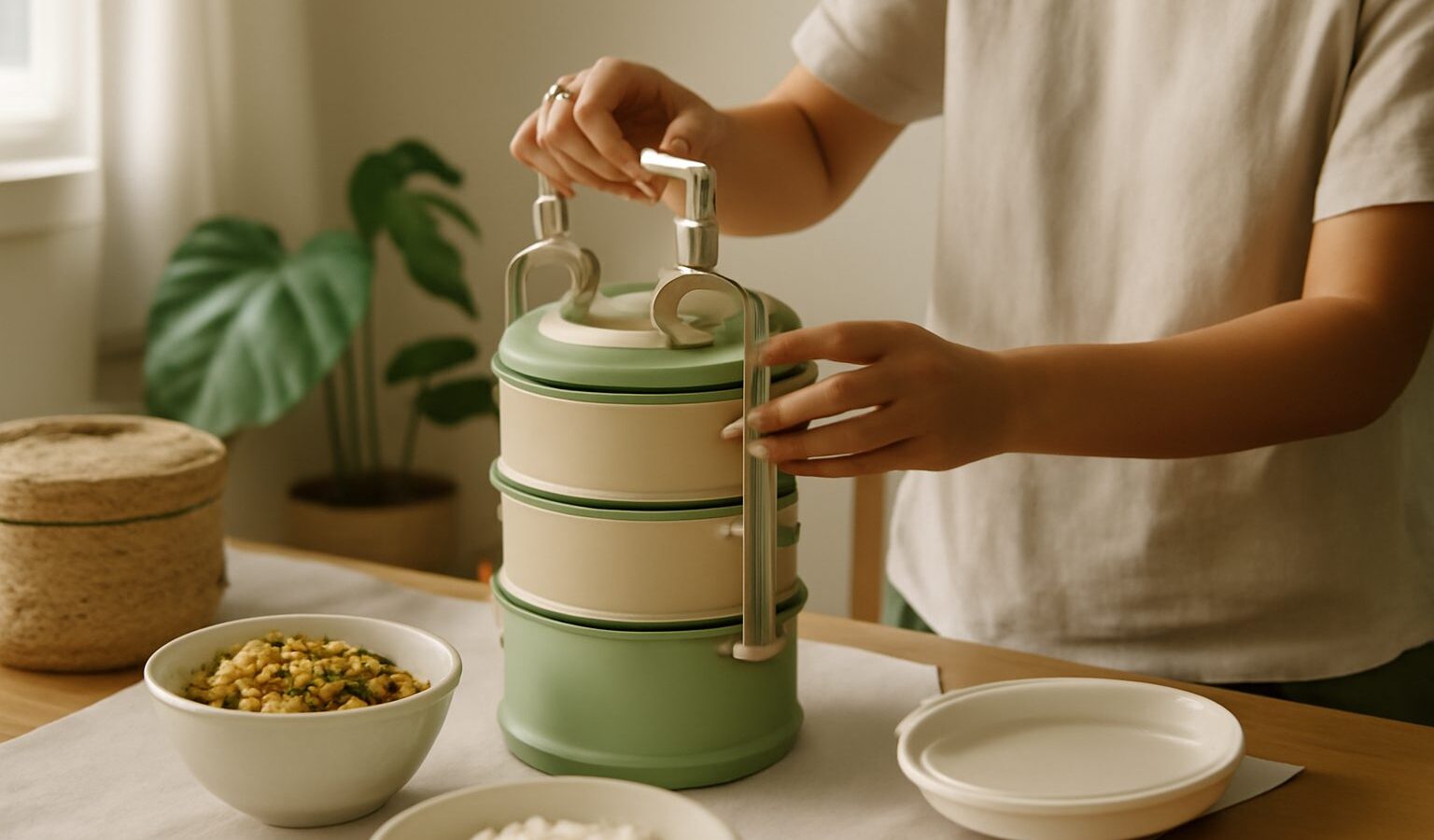
The tingkat tiffin carrier is one of those everyday objects that carries a whole way of life within its stacked tiers. Before takeaway boxes and food-delivery apps, these gleaming metal containers moved warm, home-cooked meals across Singapore, linking kitchens to workplaces and families to one another.
What Is a Tingkat
A tingkat is a set of round metal containers that stack one on top of the other, held together by a frame and a single handle. The word tingkat means “level” or “storey” in Malay, which describes the design perfectly. Each tier holds a different dish, so rice sits in one, a curry or vegetable in another, and soup or a treat in a third.
The wider term “tiffin carrier” comes from the colonial-era word tiffin, a light midday meal. Across the region these carriers took slightly different forms, but the idea was the same: keep a full meal warm, portable, and neatly separated until the moment it is eaten.
A Carrier That Fed a Working City
In the decades when Singapore was growing into a busy port and trading centre, the tingkat solved a daily problem. Workers left home early and could not easily return for lunch. Instead, a home-cooked meal was packed into a tingkat and sent to them, warm and ready.
This gave rise to a quiet trade of tiffin runners and delivery hands, who ferried carriers from households to shops, offices, and dockside workplaces. A meal cooked by a wife, mother, or family cook could reach a worker across town, still tasting of home. For many families it was also a matter of thrift and trust, since home cooking was cheaper and its cleanliness was known.
Why Households Relied on It
- Warmth and separation: tiers kept gravy from soaking the rice and helped dishes stay hot.
- Portability: one handle carried an entire meal with no spills.
- Reuse: sturdy metal lasted for years and produced no waste.
- Care from home: eating from the family tingkat was a daily reminder of those cooking back at home.
Anatomy of the Classic Tingkat
Most traditional carriers were made of tin-plated steel, stainless steel, or enamelled metal. A good tingkat balanced weight against durability, since it had to survive daily journeys yet stay light enough to carry.
| Feature | Traditional tingkat | Typical modern container |
|---|---|---|
| Material | Stainless or enamelled metal | Plastic or paper board |
| Lifespan | Years, often decades | Single use or short use |
| Dish separation | Multiple stacked tiers | One or two compartments |
| Waste produced | None, fully reusable | Frequent disposable waste |
| Heat retention | Good with metal walls | Varies, often poor |
More Than a Container
Over time the tingkat became a small carrier of relationships. Sending a meal in one was an act of care, and returning it clean was a courtesy understood by all. Neighbours borrowed and lent them, and a well-kept set could be handed down as part of a household’s belongings.
The carrier also reflected Singapore’s mixed kitchens. Whatever the family cooked, whether a Chinese stir-fry, a Malay curry, or an Indian dhal, the tingkat held it without prejudice. In that sense it was a neutral vessel that quietly showcased the diversity of our tables.
The Decline and the Revival
As lifestyles changed, disposable packaging and canteen meals grew common, and the daily tingkat run faded from view. For a time these carriers were tucked away in cupboards, remembered mostly by older Singaporeans as part of an earlier rhythm of life.
Recently the tingkat has enjoyed a genuine revival. Two forces drive it. The first is a renewed appetite for wholesome, home-style cooking, met by tingkat meal-delivery services that send balanced dishes to homes and offices in reusable or well-portioned sets. The second is the push against single-use waste, which has made the reusable metal carrier feel modern again rather than old-fashioned.
The Tingkat Today
- Subscription meal services deliver rotating menus of home-style dishes to busy households.
- Zero-waste enthusiasts carry personal tingkat to hawker stalls to avoid disposable boxes.
- Heritage collectors restore vintage enamel carriers as keepsakes and display pieces.
- Families rediscover them for picnics, gatherings, and packed meals.
Caring for a Tingkat
If you own one, a little care keeps it serving for years. Wash and dry each tier well to prevent rust on tin-plated types, and store the tiers loosely rather than clamped tight so trapped moisture can escape. Enamelled carriers should be handled gently, as knocks can chip the coating. A vintage set found at a flea market often needs only a good clean to return to daily use.
The Tingkat in Family Memory
For older Singaporeans, the tingkat is bound up with vivid memories of childhood and home. Many recall the sound of the carrier’s frame clinking as it was lifted, the smell of a favourite curry rising when the lid came off, and the ritual of unstacking each tier at the table. It was, in its way, a daily reunion in metal form.
The carrier also taught small lessons in responsibility. Children were often sent to collect or return a tingkat, learning to walk carefully so nothing spilled and to hand it back clean. Whole neighbourhoods kept an informal etiquette around these exchanges, and a lost or dented carrier was a matter of real concern.
These memories explain why the tingkat stirs such affection today. When a family unearths an old set from a cupboard, they are not just finding a container but recovering a piece of their shared past. Passing it on, still usable, links one generation’s meals to the next.
A Quiet Symbol Worth Keeping
The tingkat tiffin carrier endures because its logic never truly aged. It kept meals warm, cut waste, and carried a message of care from one hand to another. In an era rediscovering slow food and sustainability, this stacked metal carrier feels less like a relic and more like a sensible companion. To use one is to join a long line of Singaporeans who understood that a good meal, sent with care, is worth carrying properly.
Explore more: Kampong Days in Singapore · Old Singapore Nostalgia · Peranakan Culture in Singapore