
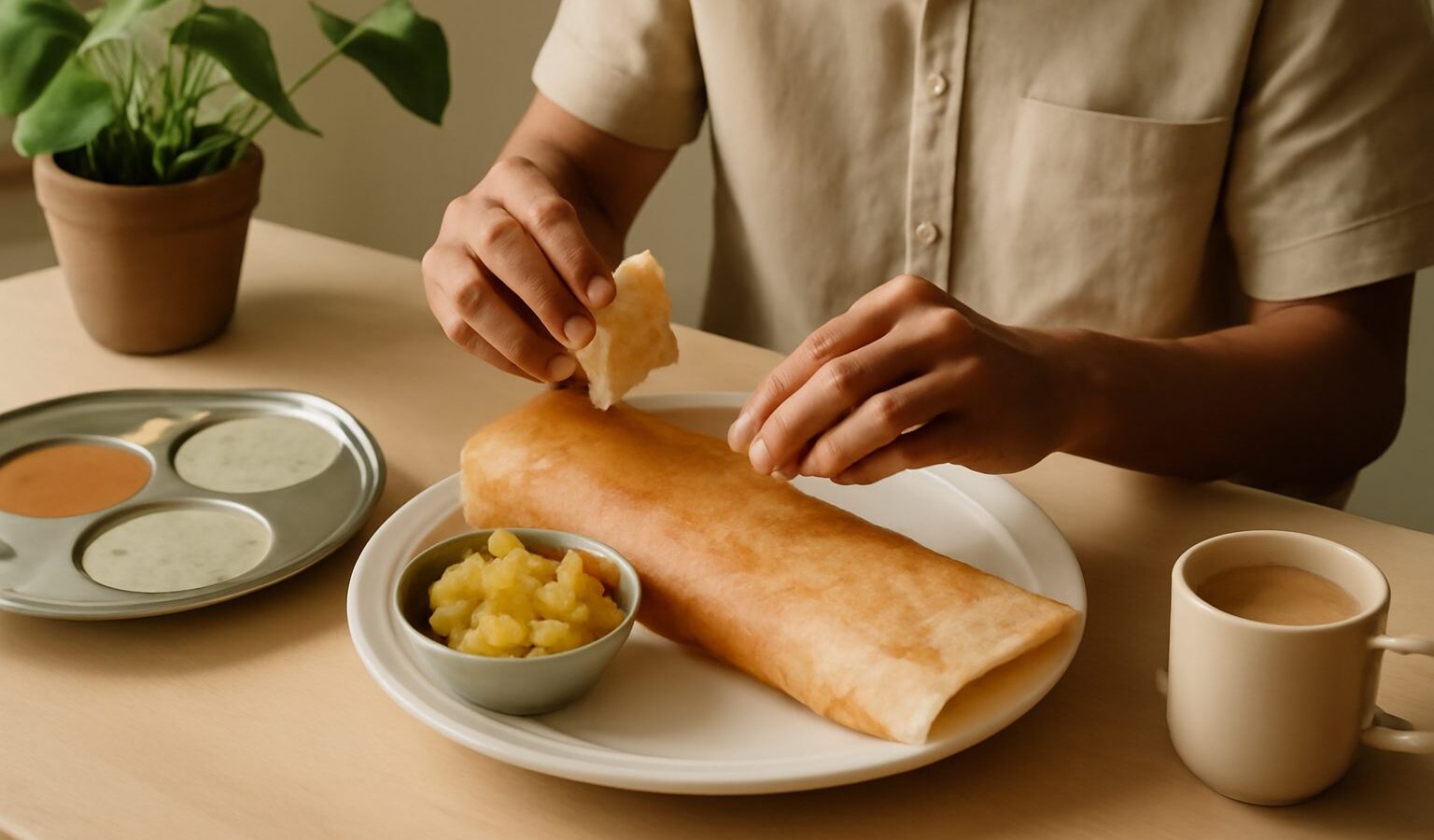
Few breakfasts feel as satisfying as a hot thosai fresh off the griddle, its edges lacy and crisp, its centre soft and faintly sour, ready to scoop up a small bowl of sambar. This thosai guide is for the curious eater who wants to know what the dish really is, why the name shifts from thosai to dosai depending on who you ask, and what to order when the menu runs to a dozen versions. It is one of Singapore’s great everyday pleasures, found from early-morning Indian stalls to sit-down South Indian restaurants, and it rewards a little knowing.
At its heart the thosai is a thin, savoury pancake made from a fermented batter of rice and split lentils, cooked on a flat griddle until golden. Simple in idea, it is endlessly variable in practice, and once you understand the basics you can walk up to any stall and order with confidence.
What A Thosai Actually Is
The batter is the whole story. Raw rice and skinned black gram, known as urad dal, are soaked separately, ground to a smooth paste, combined and then left to ferment overnight. Wild yeasts and friendly bacteria do the work, giving the batter its gentle tang and its ability to bubble and crisp on the griddle. A little fenugreek is often added for aroma and colour, and salt goes in at the end.
When the batter hits a hot, lightly oiled griddle it is spread outward in a spiral with the base of a ladle, thinner at the edges than in the middle. The result is a pancake that is crisp and brittle where it is thin and tender where it is thick. It is naturally free of dairy and, in its plain form, suits many diets, though you should always ask about ghee, butter or shared cooking surfaces if you have allergies or specific dietary needs.
The flavour is savoury and lightly sour rather than sweet, which is why thosai is almost never eaten on its own. It arrives with an ensemble of accompaniments, and half the joy is in the dipping and scooping.
Thosai Or Dosai: Same Dish, Different Name
Newcomers are often puzzled to see thosai on one signboard and dosai, or dosa, on another. They refer to the same family of dish. Thosai is the spelling and pronunciation common in Singapore and Malaysia, reflecting Tamil roots, while dosa is more widely used across much of India and on many modern menus. Dosai sits comfortably in between. There is no meaningful difference in the food itself.
What does vary is regional style. A thin, very large, crisp version is associated with certain South Indian traditions, while softer, spongier or thicker styles come from other regions. Singapore’s Indian food scene draws heavily on Tamil heritage, so the everyday thosai here tends to be the thinner, crispier sort, but you will find many regional variations as South Indian restaurants have grown more ambitious.
Types Worth Ordering
The plain version is the place to start, but the range is where the fun lies. Here is a quick guide to the styles you are most likely to meet, so you can match one to your appetite.
| Type | What it is | Best for |
|---|---|---|
| Plain thosai | The classic thin, crisp pancake, nothing added | Tasting the batter and the accompaniments |
| Masala thosai | Wrapped around spiced mashed potato with onion | A more filling, savoury meal |
| Paper thosai | Extra thin and very large, shatteringly crisp | Sharing and for the theatre of it |
| Rava thosai | Made with semolina for a lacy, crunchy texture | A crisper, grainier bite |
| Egg thosai | An egg cracked and spread onto the cooking pancake | A protein-rich breakfast |
| Ghee thosai | Cooked with ghee for extra richness and aroma | When you want something indulgent |
Beyond these you may see onion thosai, cheese versions aimed at younger eaters, and set thosai, which are smaller, softer and served in a stack. Many stalls also offer podi thosai, dusted with a spiced lentil powder that adds warmth and a little heat.
How To Enjoy It
Thosai is meant to be eaten by hand, torn into pieces and used to scoop up the accompaniments, though nobody will mind if you reach for a spoon. The usual companions are sambar, a soupy lentil and vegetable stew with tamarind, and a set of chutneys.
- Sambar: tangy, savoury and mildly spiced, poured over or served in a bowl for dipping.
- Coconut chutney: cooling, creamy and gently flavoured with green chilli and ginger.
- Tomato or onion chutney: sharper and more robust, adding contrast.
- Podi: a dry spiced powder, often mixed with a little oil, for those who like more punch.
Tear a piece, load it with potato or drag it through chutney, and alternate mouthfuls with sips of the sambar. Eat it while it is hot, because a thosai loses its crispness quickly once it cools. If you are ordering for the table, a paper thosai in the middle for sharing plus a masala thosai each makes a generous, varied spread.
You will find good thosai across the island, from busy Indian breakfast stalls in the heartlands to dedicated South Indian restaurants and the vegetarian eateries clustered in the city’s Indian quarter. A coffeeshop stall may keep to plain and masala versions, while a sit-down restaurant may run to a long list. Details, opening hours and offerings change often, so it is worth checking current information before you make a special trip.
A Few Tips For First Timers
If you are new to thosai, keep a few things in mind. Order one to share before committing to a stack, so you can gauge the size, which can be surprising. Ask how spicy the chutneys and sambar are if you are sensitive to heat, as it varies from kitchen to kitchen. If you keep to a particular diet, ask whether ghee or butter is used, since plain thosai is often dairy free but not always. And do not be shy about eating with your hands, which is both traditional and, honestly, the most enjoyable way to do it.
Master the plain thosai and its accompaniments and the rest of the menu opens up naturally. It is a dish that repays return visits, because there is always another style to try and another chutney to fall for.
Explore more
If you enjoy the savoury, snackable side of South Indian food, our vadai and Indian fritters guide is a natural next read. For a fuller sit-down meal, see our banana leaf rice guide, and for a late-night favourite try our Maggi goreng and mamak classics.