
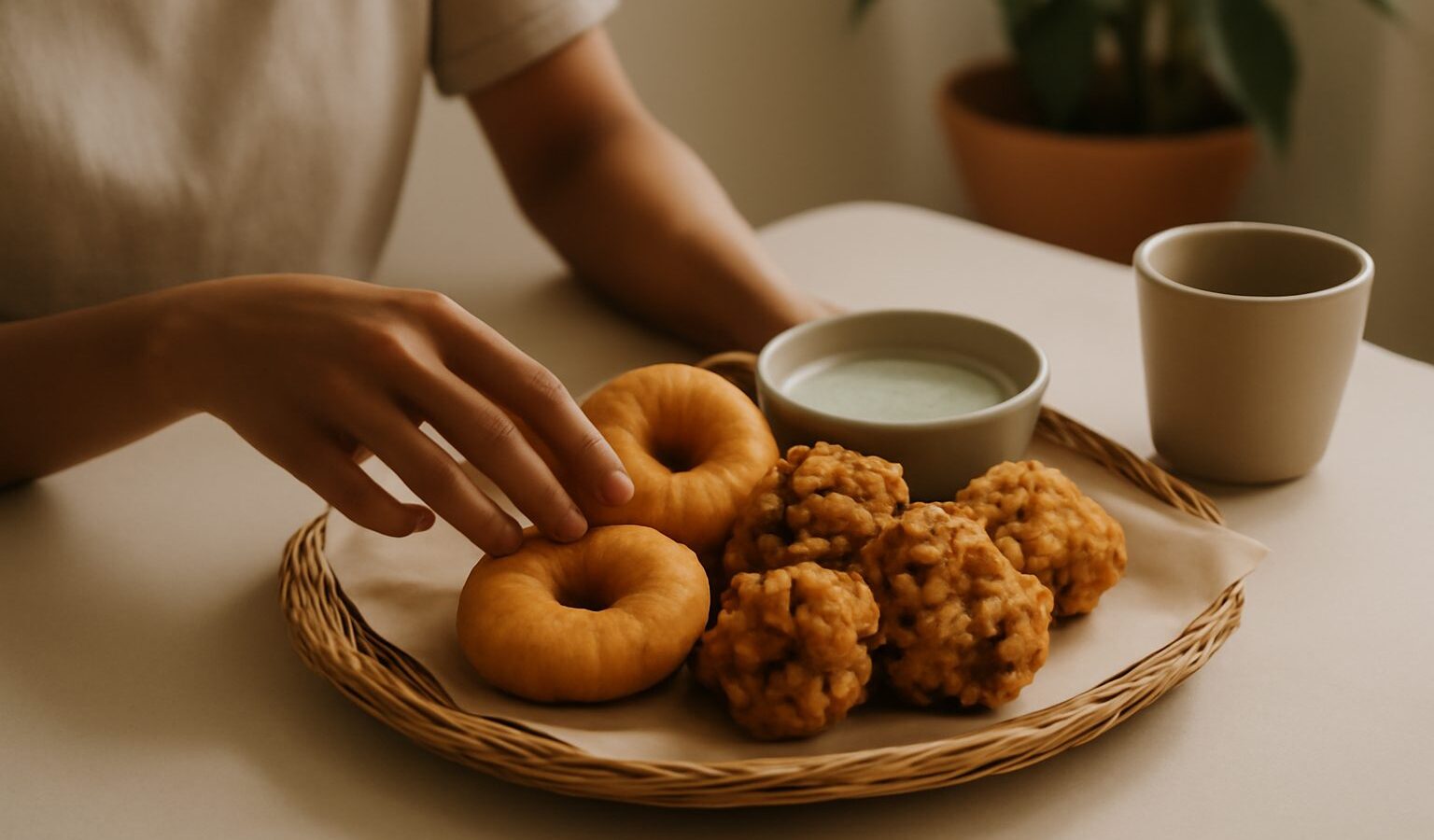
Golden, crunchy and deeply savoury, vadai is the snack that turns an ordinary afternoon into something worth pausing for. This vadai Singapore guide walks the curious eater through the crisp lentil and flour fritters you will spot at Indian stalls across the island, from the ring-shaped medu vadai stacked in glass cases to the lacy, spice-flecked masala vadai sold by the handful. They are humble, affordable and enormously satisfying, and knowing a few of them by name makes ordering far more fun.
Vadai belongs to a wider family of South Indian fritters that are fried to order or kept warm for tea time. Some are soft inside and shatteringly crisp outside, others are dense and studded with whole lentils. All of them reward eating fresh, ideally still warm, with a chutney to dip into.
What Makes A Vadai A Vadai
Most vadai start with a base of ground lentils or, in some cases, a spiced gram flour batter. The most classic style uses skinned black gram, urad dal, soaked and ground to a fluffy, aerated paste, seasoned with pepper, curry leaves, green chilli and ginger, then shaped and deep fried. The trick is in the batter: whipped enough to hold air, it fries up light and hollow rather than heavy and greasy.
Other vadai lean on chana dal, split chickpeas, which are coarsely ground so the finished fritter keeps a nubbly, textured bite. Frying is done in hot oil until the outside is a deep, even gold. Done well, a good vadai is crisp at the edge, tender within and never oily, which is why fresh from the fryer always beats one that has sat too long.
Because these are fried snacks, treat them as an occasional pleasure rather than an everyday staple, and if you have allergies do ask about the oil and whether nuts, dairy or other ingredients share the kitchen.
The Fritters Worth Knowing
The word vadai covers several distinct snacks, and a few close cousins often sit in the same display. Here is a quick comparison to help you tell them apart and choose well.
| Fritter | What it is | Texture |
|---|---|---|
| Medu vadai | Ring-shaped urad dal fritter, the classic | Crisp outside, soft and fluffy inside |
| Masala vadai | Coarsely ground chana dal, spiced, flat | Crunchy and nubbly throughout |
| Ulundu vadai | Another name for the urad dal doughnut style | Light and airy in the centre |
| Bonda | Battered, deep-fried potato or lentil ball | Soft and pillowy inside a crisp shell |
| Bajji | Sliced vegetable dipped in gram batter and fried | Crisp coating, tender vegetable within |
| Pakora | Mixed vegetables bound in spiced batter, fried | Craggy, crunchy and irregular |
Medu vadai is the one most people picture first, the savoury doughnut with a hole in the middle. Masala vadai, sometimes called paruppu vadai, is the flatter, coarser fritter that is wonderful with tea. Bonda, bajji and pakora are strictly speaking fritters rather than true vadai, but they keep such close company at the same stalls that any fritter guide would be incomplete without them.
How To Enjoy Them
Vadai is best eaten warm, within an hour or so of frying, when the contrast between the crisp shell and the soft interior is at its peak. They are usually served with the same accompaniments as thosai and other South Indian snacks.
- Coconut chutney: cooling and creamy, the classic partner for medu vadai.
- Sambar: a soupy lentil stew you can dunk the whole fritter into.
- Tomato or mint chutney: sharper and brighter, good with the spicier fritters.
- A cup of tea: masala vadai and a strong, milky teh is a much loved pairing.
One popular way to eat medu vadai is to soak it briefly in warm sambar so it turns soft and savoury throughout, a preparation many stalls will do on request. Others prefer it crisp, dipped piece by piece into chutney. There is no wrong answer, though everyone has a firm opinion.
Where To Find Them In Singapore
Vadai turns up all over Singapore’s food scene. Indian breakfast and tea stalls in the heartlands often fry them through the day, and dedicated South Indian restaurants list several styles alongside thosai and idli. The vegetarian eateries in the city’s Indian quarter are a reliable hunting ground, and you will also spot vadai at Indian sweet and snack shops, at festival bazaars and, in the form of spiced prawn or fish fritters, at some coffeeshop stalls.
A few pointers for buying well:
- Look for a busy fryer. High turnover means the vadai are fresh rather than sitting under a warmer.
- Order a mix. A soft medu vadai and a crunchy masala vadai give you both textures in one go.
- Eat them soon. If you dabao a batch, reheat briefly in an oven or air fryer to bring the crispness back rather than the microwave, which softens them.
- Ask about spice. Heat levels vary, so check if you are sensitive.
Because stalls open, close and change their offerings often, and prices move over time, it is always worth confirming current details before making a special trip for a particular style.
Bringing It All Together
The pleasure of vadai lies in its simplicity: a handful of lentils, a few spices, hot oil and good timing. Once you can tell a medu vadai from a masala vadai and know which chutney you like with each, a whole corner of Singapore’s Indian food scene opens up. Start with a fresh, warm medu vadai and coconut chutney, work your way through the fritters at your own pace, and let curiosity, and your appetite, lead you on.
Explore more
If the crisp, savoury pancake is calling too, read our thosai and dosai guide next. For a satisfying sit-down meal, see our banana leaf rice guide, and for a late-night bite our Maggi goreng and mamak classics hits the spot.