
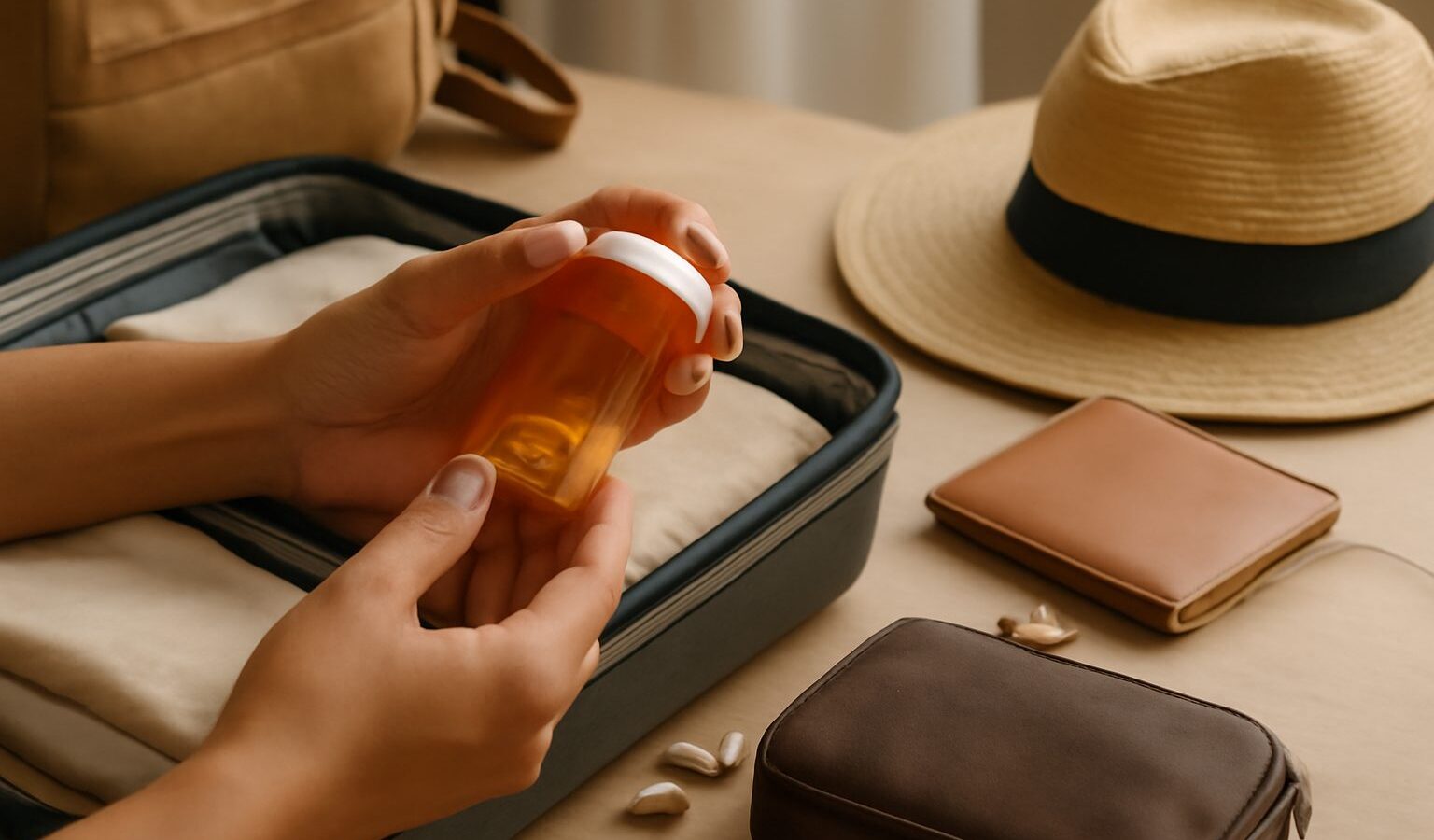
If you take regular medicine, travelling with medication abroad needs a little planning so your treatment is not interrupted and you do not run into trouble at a border. The essentials are simple: carry enough, keep it properly documented, check the rules of each country you enter, and work out your dosing across time zones. This is general information to help you prepare, not medical advice, so speak to your doctor or pharmacist about your specific medicines before you travel.
Pack it in your carry-on
Keep your medication in your hand luggage, not your checked bag. Checked bags can be delayed, lost or exposed to extreme hold temperatures, and you cannot access them mid-flight. Your carry-on keeps essential medicine with you the whole way.
A few sensible habits:
- Bring more than the trip length, with a buffer in case of delays or a longer stay.
- Split a backup supply into a second bag where possible, so a lost bag does not leave you with none.
- Mind temperature-sensitive medicines such as those needing refrigeration, and ask your pharmacist about travel cool packs and how long the medicine tolerates being out of the fridge.
Liquids, gels and medical devices are usually allowed through security in reasonable, medically necessary quantities, but declare them and carry documentation.
Keep original packaging and paperwork
Travelling with medicine goes far more smoothly when it is clearly identifiable and documented.
- Keep medicines in their original, labelled packaging with your name and the pharmacy or prescription details visible. Do not decant everything into a single unlabelled organiser for a border crossing, though a daily pill box for the day itself is fine.
- Carry a copy of the prescription for each medicine.
- Ask your doctor for a letter listing your conditions, the medicines by their generic (active ingredient) names, the dosages and why you need them. Generic names help because brand names differ between countries.
Keep these documents with the medication in your carry-on, and consider a photo or digital copy as backup.
Controlled drugs vary from country to country
This is the part that catches travellers out. Medicines that are perfectly legal and routine in Singapore may be restricted, require a permit, or even be banned in another country. This commonly affects strong painkillers, certain sleep and anxiety medicines, some stimulant medicines, and specific cold or allergy remedies containing ingredients that are controlled elsewhere.
Rules cut both ways: there are conditions on taking certain medicines out of Singapore, and separate rules on bringing them into your destination.
Because of this, you need to check two things for every trip:
- Leaving Singapore: check the Health Sciences Authority (HSA) guidance on personal medicines, as some medicines have conditions or limits when taken out of the country.
- Entering your destination: check the destination country’s embassy, high commission or health authority for their rules on bringing that medicine in, including any permit, quantity limit or required documentation.
Do this well before departure, because a permit can take time to arrange. Never assume a medicine is fine simply because you were prescribed it at home.
Comparison: carry-on vs checked baggage for medicine
| Factor | Carry-on (recommended) | Checked baggage |
|---|---|---|
| Access during the journey | Always with you | None until arrival |
| Risk if bag is delayed or lost | You still have your medicine | You may be left without it |
| Temperature exposure | Cabin, more stable | Hold can be very hot or cold |
| Security documentation | Declare and show papers | Not inspected with you |
| Best use | All essential daily medicines | Bulky spares only, if at all |
Managing dosing across time zones
Crossing time zones raises a practical question: when do you take the next dose? For many everyday medicines a small shift causes no problem, and you can simply move to local times over a day or two. For medicines where precise timing matters, such as some treatments taken at fixed intervals, plan ahead rather than guessing.
Helpful steps:
- Ask your doctor or pharmacist before you go how to handle dosing on the travel day and how to shift to local time, especially for time-critical medicines.
- Keep taking doses on your home time on the plane if advised, then transition to local time once you land.
- Set alarms on your phone so a busy travel day does not cause a missed or doubled dose.
- Write down your plan for the outbound flight day and the return, since the time change reverses on the way home.
A quick pre-trip checklist
- Enough medication for the trip plus a buffer, in your carry-on.
- A backup supply split into another bag where possible.
- Original labelled packaging, prescription copies and a doctor’s letter using generic names.
- HSA guidance checked for taking your medicines out of Singapore.
- Destination embassy or health authority checked for bringing them in.
- A dosing plan for time zones, agreed with your doctor or pharmacist.
- Digital copies of all documents stored on your phone.
Sorting this alongside your other admin is easy if you use a pre-travel checklist for Singapore and keep your travel documents checklist together in one place.
Travel prepared, not anxious
Travelling with medication abroad is routine for millions of people, and a bit of preparation removes almost all the risk. Carry your medicines with you, keep them documented and in their original packaging, check both the HSA rules for leaving Singapore and the destination’s rules for entering, and plan your dosing around the time change. Because rules and medical needs differ from person to person and country to country, always confirm the details with HSA, the destination’s authority, and your own doctor or pharmacist before you fly. Do that, and your health stays on track wherever you go.
Explore more: Travel health and vaccinations for Singapore · Pre-travel checklist for Singapore · Travel documents checklist for Singapore