
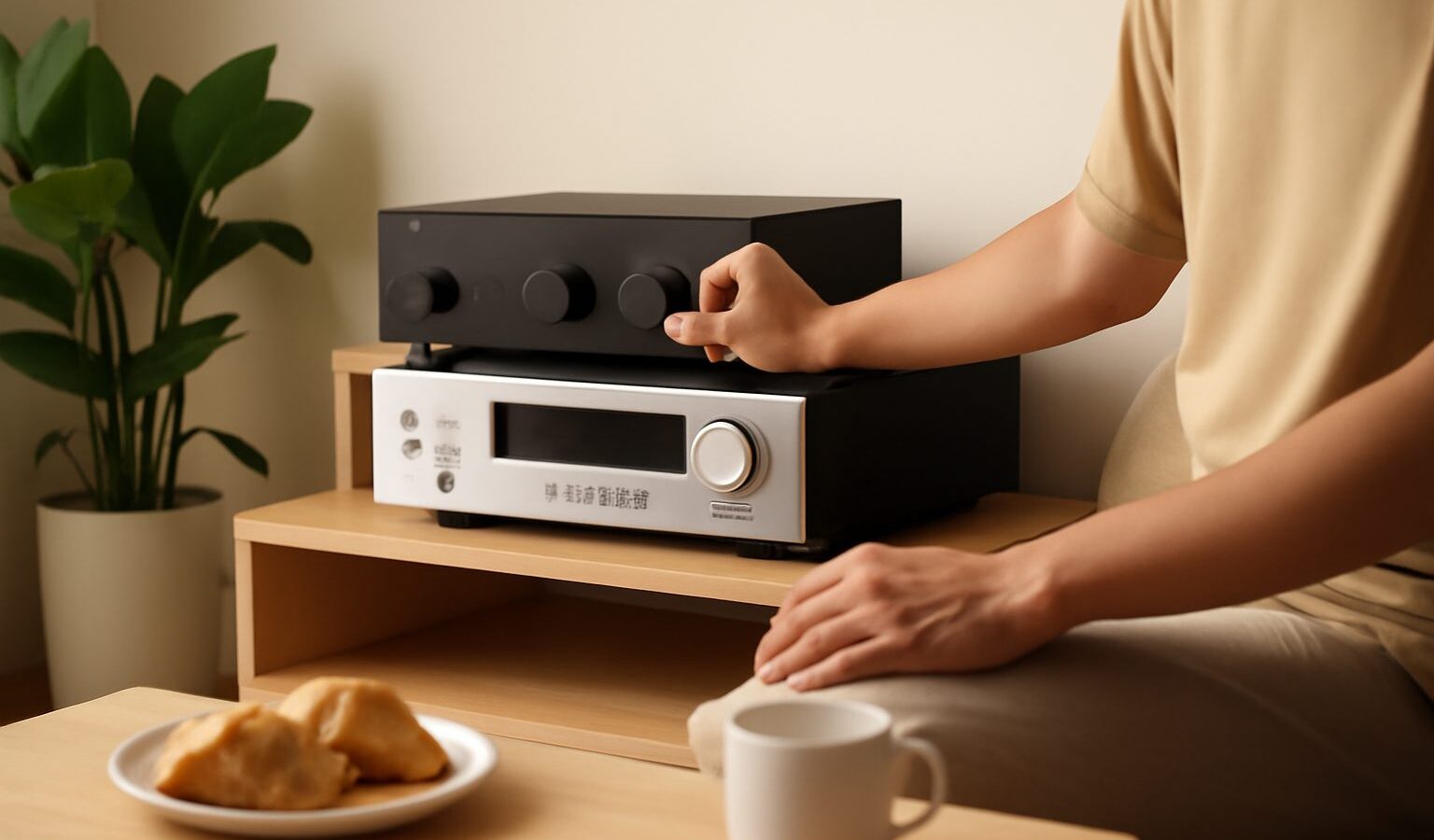
If speakers are the voice of a hi-fi system, amplifiers and receivers are the lungs. They take a delicate source signal and give it the muscle to move a speaker cone. Once you understand what these boxes actually do, the shopping jargon stops sounding intimidating and starts making sense.
What an amplifier actually does
Every source, whether a streamer, a turntable’s phono stage or a CD player, produces a signal that is far too weak to drive a loudspeaker directly. An amplifier’s job is to raise that signal to a useful level without changing its character. In practice there are two stages hidden inside most amps. The preamplifier selects the input, handles volume and does gentle shaping. The power amplifier does the heavy lifting, supplying current to the speakers.
You will meet these stages sold three ways: bundled together, split apart, or wrapped up with a radio tuner and video switching.
Integrated, pre and power, or AV receiver
An integrated amplifier puts the preamp and power amp in one chassis. For most people listening to music at home, this is the sensible starting point. It is tidy, cheaper than buying separates, and modern integrateds often include a digital-to-analogue converter and a phono input, so you can plug in a turntable or a laptop without extra boxes.
A pre and power setup splits those two jobs into separate units. The appeal is control and isolation: the noisy, power-hungry amplifier lives in its own case away from the sensitive preamp circuits. This is the enthusiast’s route, and it rewards patience more than it rewards a first-time buyer.
An AV receiver is a different animal. It is built for home cinema, so it decodes surround sound, switches HDMI video, drives five or more speakers and includes a radio tuner. It is a marvel of convenience, but the trade-off is that its budget is spread across many features rather than concentrated on two channels of clean music.
| Type | Best for | Strengths | Trade-offs |
|---|---|---|---|
| Integrated amplifier | Music-first stereo listening | Simple, affordable, often has DAC and phono | Fixed feature set |
| Pre and power separates | Enthusiasts chasing refinement | Isolation, flexibility, upgrade path | Costlier, more cables and space |
| AV receiver | Films and multi-channel setups | Surround decoding, HDMI, many channels | Budget spread thin for pure music |
Reading the power figures
The number everyone quotes is watts per channel, but it means little on its own. A watt figure is only meaningful alongside the impedance it was measured at, whether it was measured with both channels driven, and across what frequency range. A modest, honestly rated amplifier that delivers clean power at low distortion across the full band will comfortably outperform a bigger number measured under kinder conditions.
More watts do not simply mean louder. Doubling perceived loudness takes roughly ten times the power, so the jump from a budget-tier amp to a premium one is more about grip, control and headroom than raw volume. Headroom is the reserve an amplifier calls on during sudden loud passages, and it is what keeps big moments sounding effortless rather than strained.
Impedance and why matching matters
Speakers present an electrical load measured in ohms, most commonly a nominal 8 ohms or 4 ohms. A lower impedance asks the amplifier to supply more current, which can stress a design that was not built for it. Before pairing anything, check that your amplifier is happy driving your speakers’ impedance. Most will list a supported range on the back panel or in the manual.
The other half of matching is sensitivity, a speaker specification that tells you how loud a speaker plays for a given input. A sensitive speaker needs less power to reach satisfying levels, so it can be a smart partner for a lower-powered amplifier. A power-hungry, less sensitive speaker in a large room is where extra amplifier muscle earns its keep.
A simple way to think about matching
- Work out your room size and how loud you actually listen.
- Note your speakers’ impedance and sensitivity.
- Choose an amplifier that comfortably drives that impedance with headroom to spare.
- Leave a little margin rather than buying exactly enough.
The goal is a comfortable partnership, not a wrestling match. An amplifier running well within its limits sounds relaxed and clean, while one pushed to its edge starts to sound hard and tired.
Features worth having
Beyond the core amplification, a few features genuinely add value. A built-in DAC lets you connect a computer or streamer digitally, which is handy if you keep your music as files or subscribe to a streaming service. A phono stage is essential if you own a turntable, since a record player’s signal needs special boosting and correction before a normal input can use it. Preamp outputs are useful too, because they leave room to add a power amplifier or a subwoofer later.
Bluetooth is convenient for casual listening, though it is rarely the path to the best sound. Treat it as a bonus rather than a reason to buy.
Getting the setup right
Placement and cabling matter more than most newcomers expect. Give the amplifier air, because these units generate heat and dislike being boxed into a sealed cabinet. Use decent but sensibly priced speaker cable of an adequate gauge for the run, and make sure the polarity is consistent on both speakers so they push and pull in step. Keep power leads and signal cables from bunching together to reduce hum.
If you hear a persistent buzz, especially with a turntable, check your grounding first before blaming any component. Most mystery noises trace back to a loose ground wire or a cable run that sits too close to a power supply.
Where to start
If you are building your first system, an honest integrated amplifier with a phono stage and a digital input covers almost every base and leaves your budget for speakers, which shape the sound far more than the amplifier does. As your taste sharpens, separates and dedicated components give you somewhere to grow. Start simple, match carefully, and let your ears rather than the spec sheet lead the way.
Explore more: Building a Hi-Fi System on a Budget · Bookshelf vs Floorstanding Speakers · Understanding Headphone Amps and DACs