
You cannot see most of them, but they are almost certainly around you right now. Microplastics are tiny plastic fragments, and learning a little about microplastics in Singapore helps make sense of a topic that can otherwise feel abstract or alarming. The good news is that once you understand where these particles come from, a few calm and practical habits at home can genuinely reduce how much plastic you create and shed in the first place.
What microplastics actually are
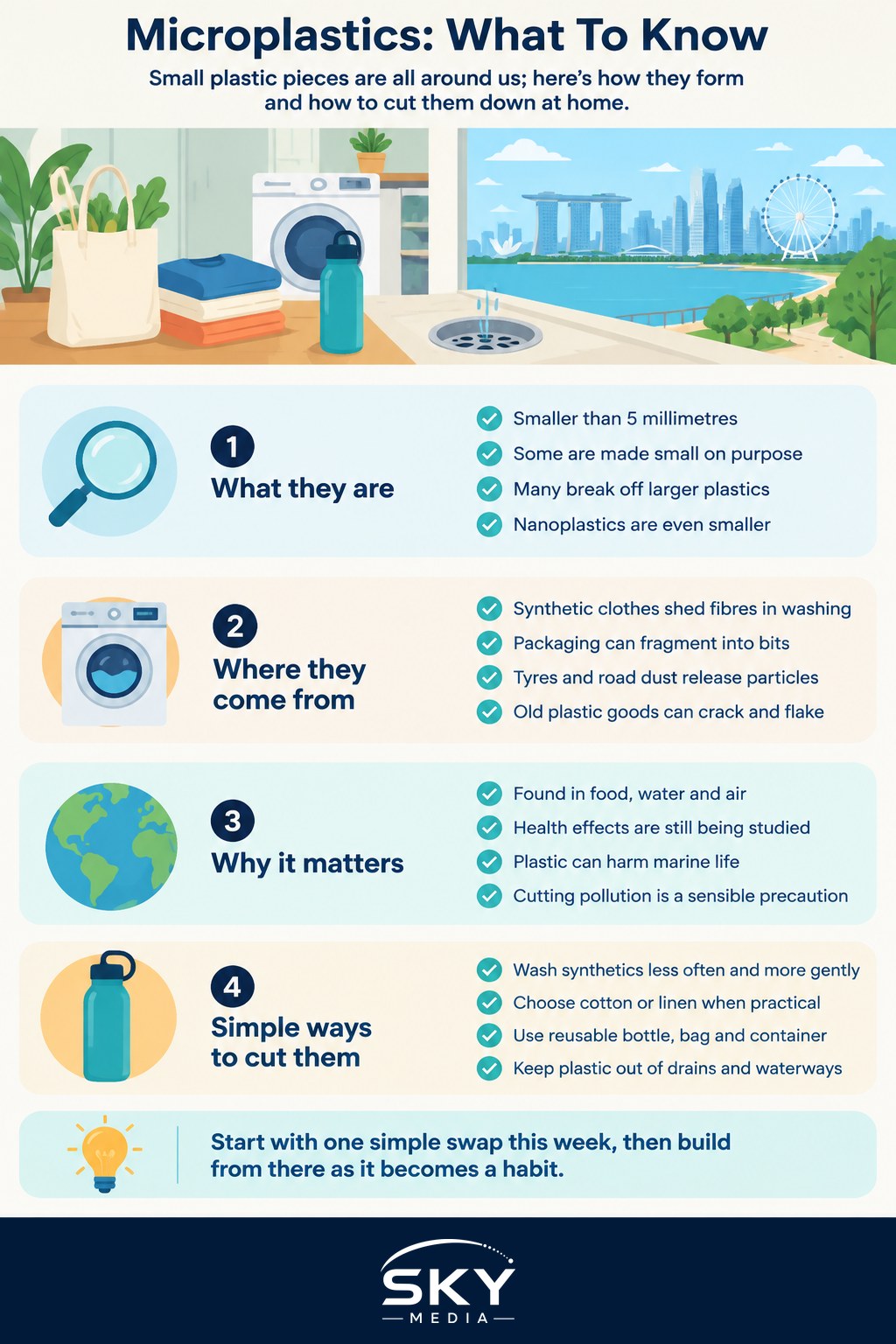
Microplastics are simply pieces of plastic smaller than five millimetres across, roughly the size of a sesame seed or finer. Some are manufactured small on purpose, such as the tiny beads once common in certain scrubs. Far more of them are what scientists call secondary microplastics: fragments that break off larger items as plastic weathers in sunlight, heat, and water. A bottle left in the sun, a frayed rope, a worn tyre, or a synthetic shirt in the wash all slowly shed material. Because plastic does not biodegrade the way a leaf does, it just keeps fragmenting into ever smaller pieces.
There is also a even finer category called nanoplastics, which are smaller still. Researchers around the world are actively studying both, and it is honest to say the science is young. What is clear is that these particles are now found widely across the environment, from soil to rivers to the sea, and in the bodies of many animals.
In our humid tropical climate, plastic outdoors is exposed to strong sun and warm rain most of the year, which can speed up how quickly larger items become brittle and start to break apart. That is one reason keeping plastic out of drains, parks, and the sea matters so much locally.
Where they come from in daily life
It helps to know the everyday sources, because that is where you have influence. Common contributors include:
- Synthetic textiles. Polyester, nylon, and acrylic clothing release fibres every time they are washed.
- Single-use packaging. Bags, wrappers, cutlery, and takeaway containers that fragment if they escape into the environment.
- Tyres and road dust. Vehicle tyres wear down and shed particles as we drive.
- Household items. Cheap plastic goods that crack and flake with age and heat.
Singapore manages its rubbish carefully, and most of what goes into the general waste stream is incinerated rather than left to litter the landscape. That is a real strength of the local system. Even so, litter that slips into drains and canals can be carried out to sea, and the plastic we buy still has to be made, shipped, and eventually disposed of. Reducing what we use upstream is the most reliable lever we have.
Why they matter, honestly
It is fair to feel unsure about the health angle, and it is better to be truthful than dramatic. Microplastics have been detected in food, water, and the air, and researchers are still working to understand what levels of exposure mean for human health over the long term. Nobody should panic, and equally nobody should pretend the question is settled. For the environment, the concerns are clearer: particles can be eaten by fish and other creatures, and plastic waste harms marine life through entanglement and ingestion. Cutting plastic pollution is a sensible precaution that helps ecosystems regardless of how the human health research eventually lands.
Simple ways to reduce plastic and shedding
You do not need to overhaul your life. A handful of steady habits add up:
- Wash synthetic clothes less often, on cooler and gentler cycles, and only when full. Air drying is kind to fabrics too.
- Choose natural fibres like cotton or linen when it is practical, and buy fewer, better pieces so they last.
- Carry a reusable bottle, bag, and container so you sidestep disposables. Our guide to reusable swaps for everyday life has easy starting points.
- Cut down on single-use plastics where you can, one habit at a time. See reducing single-use plastics in Singapore for realistic ideas.
- Recycle correctly so clean plastics stay in the loop rather than becoming litter. A quick read of how to recycle correctly in Singapore helps you avoid common mistakes.
- Keep plastic out of drains and waterways, and join the occasional clean-up if that appeals to you.
For food and drink, favouring glass, stainless steel, or ceramic for hot items and storage is a gentle swap many people are happy with, and it reduces the plastic in your kitchen over time.
Keeping it in perspective
Microplastics are a genuinely tricky, global issue, and no single household can solve it alone. That is not a reason to feel helpless. Every reusable you carry, every synthetic wash you skip, and every piece of litter that never reaches a drain is a small, real contribution. Living in a compact, well-managed city gives us a head start, and the aim is not perfection but steady, doable progress. Start with one change this week, let it become a habit, and add the next when you are ready.