
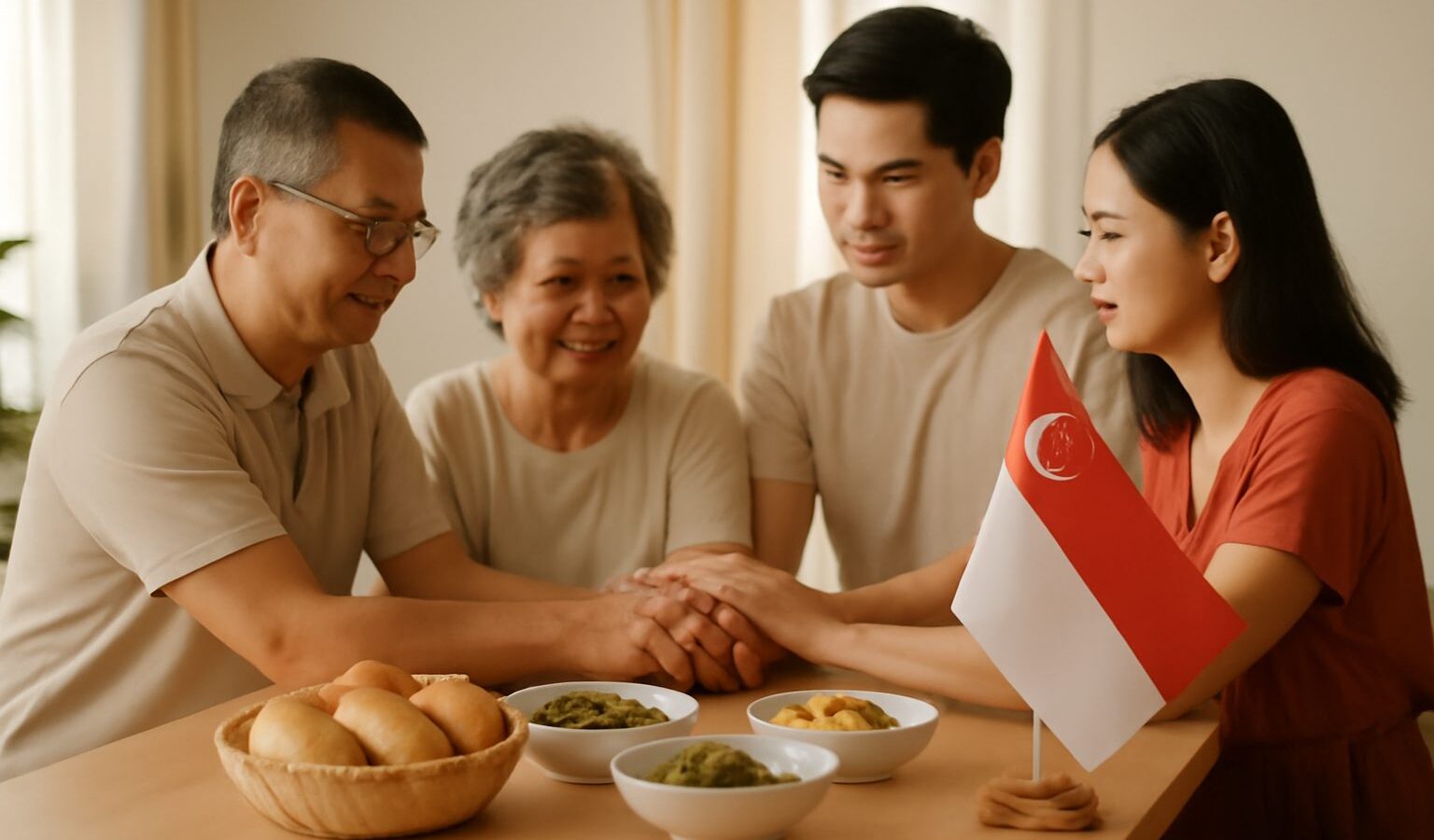
The Singapore Shared Values are five principles adopted as a common ethical framework for a young, multiracial and multireligious nation. They were set out to describe a set of ideas that Singaporeans of every background could agree on, regardless of race, language or religion. This guide explains what the five values are, how they came to be framed, and why they still shape public conversation here.
What the Shared Values are
The Shared Values are stated as five principles. Read together, they move from the individual outward to the nation, and back again to the person:
- Nation before community and society above self
- Family as the basic unit of society
- Community support and respect for the individual
- Consensus, not conflict
- Racial and religious harmony
Each line is deliberately short. They are not laws and they carry no legal penalty. They were intended as a shared reference point, a way of putting into words the habits and attitudes that many people already recognised in Singapore life.
Why a national ideology was framed
To understand the Shared Values, it helps to understand the setting in which they were discussed. Singapore is a small country with no single majority culture that could be treated as the national culture. Its population draws on Chinese, Malay, Indian and other roots, and on several major religions. There was a concern that, as the country modernised and grew more prosperous, younger generations might absorb values from elsewhere without a clear sense of what held the society together.
The idea behind a set of Shared Values was to identify common ground. Rather than pick the traditions of one community and impose them on the rest, the aim was to find principles that people from different communities could each recognise from within their own heritage. A Malay Muslim family, a Chinese family and an Indian family might all, for example, place a high value on the family unit, even if the customs around it differ. The Shared Values tried to name that overlap.
The values were discussed publicly and refined before they were formally set out. That process of consultation was itself meant to reflect one of the values, consensus rather than conflict.
Looking at each value
Nation before community and society above self
This first value speaks to putting the wider good ahead of narrower loyalties. In a country made up of several communities, it asks citizens to think of themselves as Singaporeans first, and to weigh the needs of society against purely personal interests. It does not ask people to abandon their community or their family, but to keep the health of the whole nation in view.
Family as the basic unit of society
The second value treats the family, rather than the isolated individual, as the building block of a stable society. It reflects a belief, common across the country’s communities, that strong families support their members, raise children well, and reduce the burden that would otherwise fall on the state alone.
Community support and respect for the individual
The third value balances the group and the person. It recognises that people need the support of the community around them, while also insisting that the individual be treated with respect and not simply absorbed into the collective. It is a reminder that valuing society does not mean ignoring personal dignity.
Consensus, not conflict
The fourth value points to how differences should be handled. In a diverse society, disagreements are unavoidable. This value expresses a preference for resolving them through discussion and accommodation rather than confrontation, so that competing interests can be worked out without tearing the fabric of society.
Racial and religious harmony
The fifth value names directly what many see as the foundation of the others. In a place where race and religion could easily become fault lines, the commitment to harmony asks every community to give others the space to practise their faith and culture, and to avoid words or acts that inflame tension.
How the values relate to daily life
The Shared Values are broad principles, not a rulebook. In practice, their spirit surfaces in familiar features of Singapore life: the care taken during religious festivals so that celebrations do not offend neighbours of other faiths, the emphasis on family in public policy, and the general expectation that public disagreements be handled with restraint. Many of the ideas in the values also connect to the way Singapore describes its society through the Chinese, Malay, Indian and Others framework.
Here is a simple summary of the five values and the everyday idea behind each.
| Shared Value | Everyday idea it points to |
|---|---|
| Nation before community and society above self | Think of Singapore as a whole, not only your own group |
| Family as the basic unit of society | Strong families are the foundation of a stable country |
| Community support and respect for the individual | Support one another, while respecting each person |
| Consensus, not conflict | Settle differences by discussion, not confrontation |
| Racial and religious harmony | Give every race and faith room, and keep the peace |
Common misunderstandings
A few points are worth clarifying. The Shared Values are not a religion and they do not replace anyone’s faith. They are not meant to erase the distinct cultures of Singapore’s communities; the aim is the opposite, to protect a common space in which those cultures can each flourish. They are also not fixed slogans to be recited, but principles to be understood and applied with judgement.
It is fair to say that people can and do debate how the values apply in specific cases. That, in a sense, is consistent with the value of working through differences by consensus. The values set a direction rather than settle every question.
Why they still matter
Singapore remains a small, diverse society in a changing world. The reasons the Shared Values were framed, the need for common ground among different communities and the wish to keep social peace, have not gone away. Whether or not one can recite all five from memory, their underlying idea, that a diverse nation needs values it can hold in common, continues to shape how Singaporeans talk about who they are.
Understanding the Shared Values is really about understanding a choice that a young country made: to look for what unites rather than what divides, and to write it down plainly enough that everyone could see it.
Explore more: Understanding Singapore’s multiracial society · The CMIO model and racial harmony · National symbols of Singapore