

If you play competitively at home and wonder whether you can do it with a team behind you, your campus is one of the best places to start. University esports in Singapore runs mostly through student-led clubs and interest groups at universities and polytechnics, with some institutions also fielding representative teams for inter-school or regional competitions. This guide explains how those campus pathways work, how to find them, and how to prepare for trials without letting your grades slide.
If you are new to competitive gaming in general, start with our beginner’s guide to esports, then come back here for the campus side.
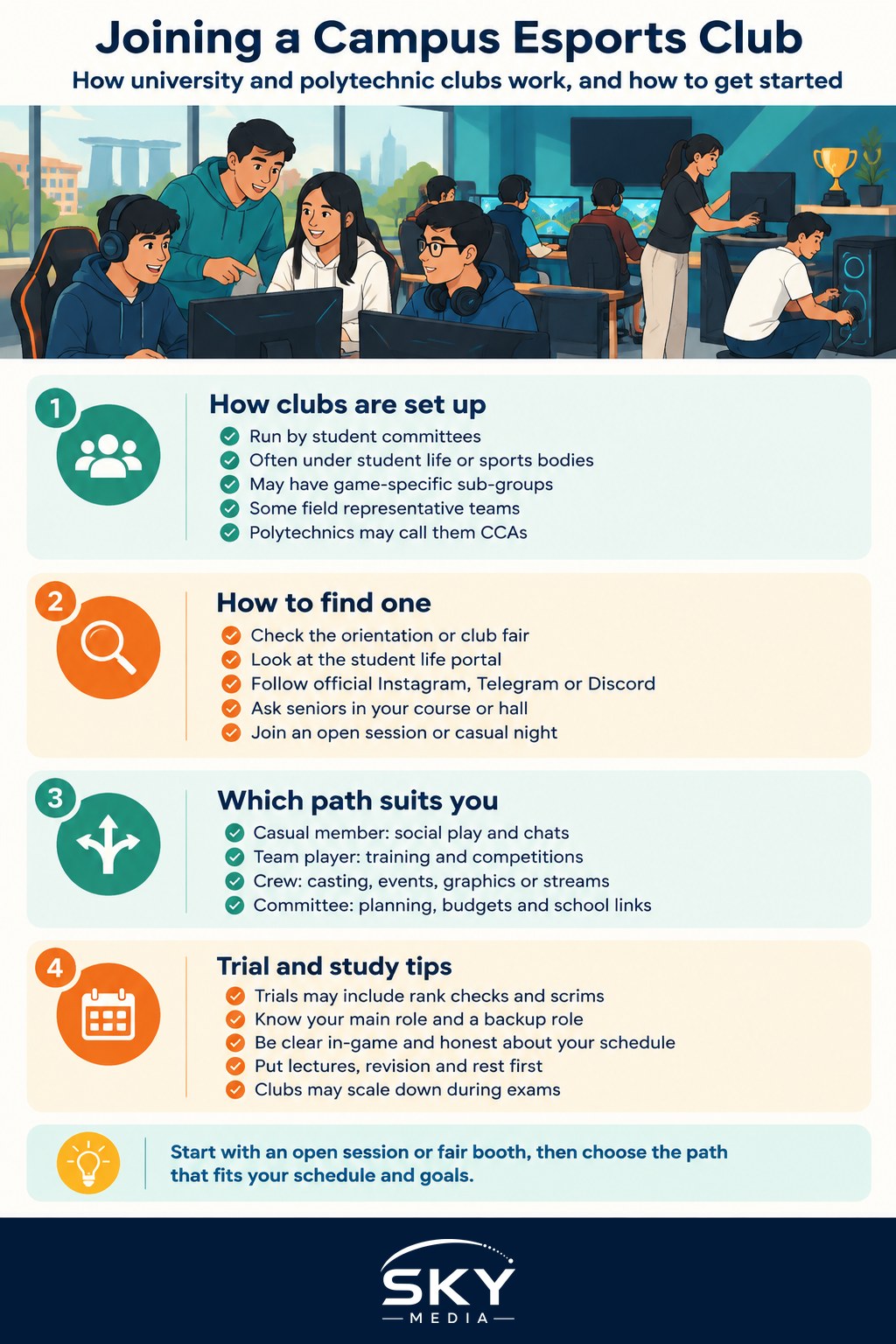
How Campus Esports Is Usually Organised
Every institution does things its own way, and arrangements change from year to year as committees turn over. Broadly, you will see some combination of the following:
- A student club or interest group. Run by a student committee, usually under the student union, student life office or a sports or recreation body. This is where most casual and semi-competitive play happens.
- Game-specific divisions. Larger clubs often split into sub-groups for individual titles, each with its own captain or coordinator.
- Representative or competitive teams. A smaller group selected through trials to compete against other schools or in open tournaments.
- Supporting roles. Shoutcasting, event production, graphics, social media, coaching and team management. These are real ways to be involved even if you are not a top player.
In polytechnics and ITE, esports may be organised as a CCA (co-curricular activity) or interest group. Universities more often call them clubs or societies. The labels differ, but the structure is similar.
Finding the Right Club on Your Campus
Clubs are easiest to find at the start of the academic year, but you can usually join later too.
- Visit the orientation or club fair. Most campuses run a fair where clubs set up booths and collect sign-ups. Esports booths are often the ones with a screen and a queue.
- Check the student life portal. Your institution’s student life or CCA page usually lists registered clubs and contact details.
- Search official social channels. Clubs commonly post on Instagram, Telegram and Discord. Make sure the account is the official club, not an unofficial fan group.
- Ask seniors. Seniors in your course or hall often know which clubs are active and how competitive their trials are.
- Attend an open session. Many clubs run casual nights or open tournaments for new members before formal trials.
If your campus does not have an active club for your game, ask the committee whether you can start a sub-group. Student life offices generally have a process for new interest groups.
Casual Member, Team Player or Crew: Which Path Fits
Not everyone joins to compete, and that is fine. Here is how the main paths compare.
| Path | What you do | Time commitment | Good for |
|---|---|---|---|
| Casual member | Join social nights, in-house tournaments and community chats | Light, flexible | Making friends and playing without pressure |
| Competitive team player | Train with a selected roster, scrim other teams, enter competitions | Regular fixed practice slots | Strong players who want structured competition |
| Production or casting crew | Shoutcast, run streams, produce events, design graphics | Spikes around events | Students interested in media, events or communications |
| Committee member | Plan activities, manage budgets, liaise with the school | Steady, plus admin | Leadership experience and organising skills |
Many students move between these over their time on campus, starting casual and taking on more as they settle in.
Preparing for Team Trials
Competitive teams usually hold trials once or twice a year. The format depends on the game and the club, but common elements include an in-game rank check, scrims with current members, role-specific tests and a short chat about commitment.
To prepare:
- Know your role. Be clear about the position or role you play best, and have a backup role you can fill.
- Show your history. Rank, past tournaments or team experience help, but committees also look for attitude and communication.
- Communicate clearly in-game. Short, calm, useful calls stand out more than raw mechanical skill.
- Be honest about your schedule. If you have heavy lab hours or a part-time job, say so upfront.
- Check your setup. For online trials, test your connection, headset and microphone before the session.
If you are not selected, ask for feedback and stay involved. Many players make the team on a second attempt after scrimming with the club. Our article on esports coaching explains how structured feedback can speed up improvement.
Balancing Esports With Your Studies
Campus competition can be intense, especially around tournaments that clash with assessment periods. A few habits help:
- Put your timetable first. Block lectures, tutorials, project meetings and revision before practice slots.
- Plan around exam periods. Most clubs scale down during exams. If yours does not, talk to your captain early.
- Look after your body. Long sessions take a toll on wrists, eyes, back and sleep. Take breaks, stretch and keep a regular bedtime.
- Keep the social side healthy. Team dynamics can get heated. Clubs usually have a code of conduct; read it, and speak to the committee or your student support office if something feels wrong.
- Watch the money. You do not need top-tier equipment to join. Clubs often have shared facilities or will advise on reasonable setups.
If you find gaming is pushing out sleep, meals or study, your campus counselling service is a confidential place to talk it through.
What Campus Esports Can Lead To
For most students, a university or polytechnic club is about friendship and fun. For some, it is a first step into the wider scene. Experience in competitive play, casting, production or team management can lead to open tournaments, community events and roles in the gaming industry. Our overview of the esports scene in Singapore explains how the local ecosystem fits together.
Even if you never go pro, being part of a club teaches teamwork, communication and event organisation, skills you can describe on a CV and talk about at interviews.
Getting Started This Semester
- Find your club through the fair, student portal or official socials.
- Join a casual session before trials to meet people.
- Decide which path suits you: casual, competitive, crew or committee.
- Prepare for trials with a clear role and honest schedule.
- Protect your studies, sleep and health as you go.
University esports in Singapore is driven by students, so the more you put in, the more you shape it. Show up, be a good teammate, and enjoy the game.
Further reading: How to Join a Valorant Team in Singapore · How to Start an Esports CCA in a Singapore School