

Plenty of students try to get better at games by watching videos and grinding ranked matches alone. That works up to a point, but if you want structure, feedback and people to train with, an esports course in Singapore can fill the gap. The catch is that “esports course” covers very different things, from a weekend workshop for 12 year olds to a full-time diploma that leads to industry jobs.
This guide maps out the main types of structured learning available locally, who each one suits, and what to check before you sign up or pay a deposit.
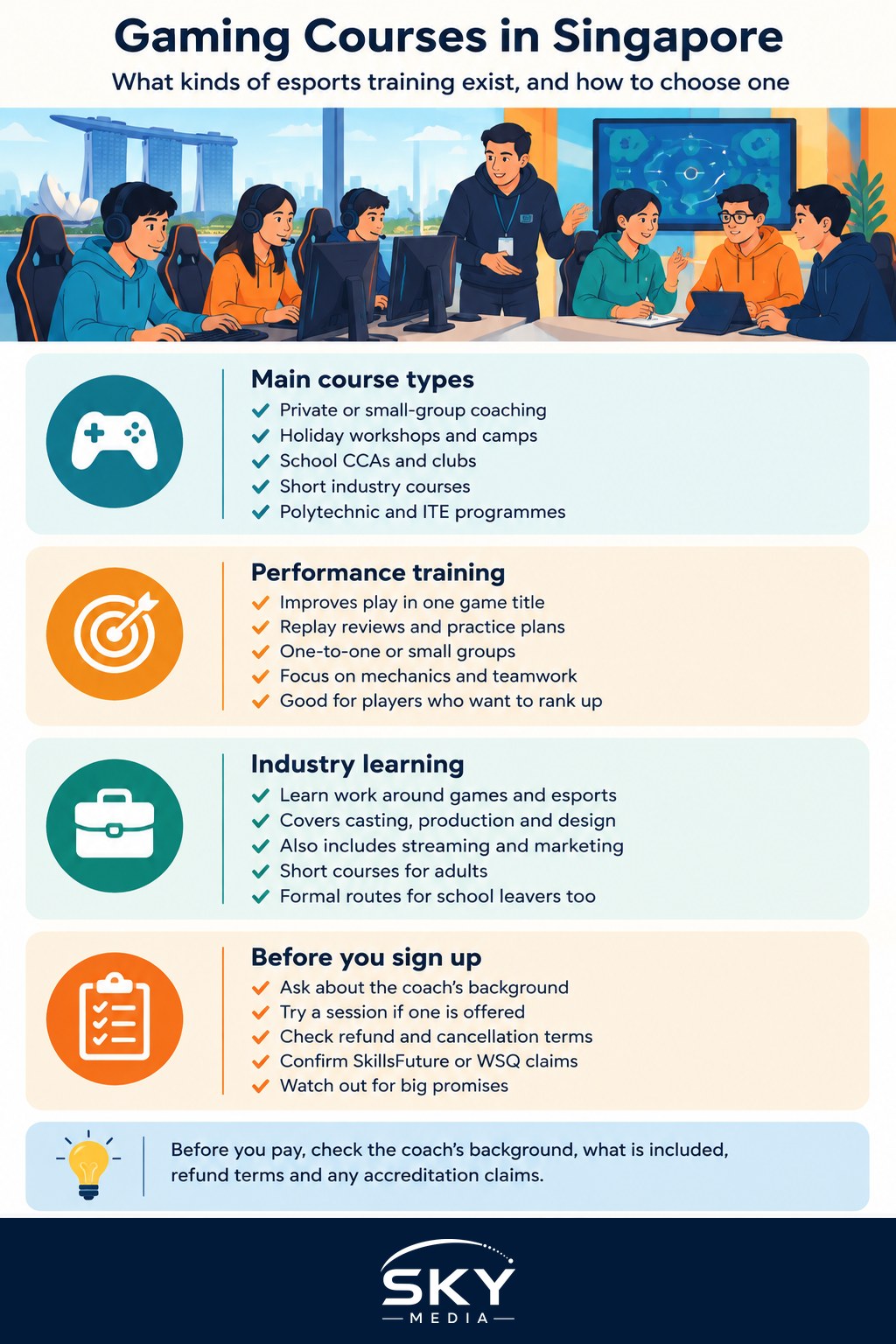
What Counts as an Esports Course
The phrase gets used loosely, so it helps to split the options into two broad groups.
Performance training is about playing better. Think coaching classes for a specific title, team bootcamps, or review sessions where a coach watches your replays and points out mistakes in positioning, communication and decision making.
Industry learning is about working around games rather than only playing them. This includes courses in event production, shoutcasting, content creation, game design, team management and marketing. Many people who build a career in this space never compete professionally. If that side interests you, our piece on exploring a career in gaming and esports in Singapore covers the roles in more detail.
Knowing which group you want saves a lot of time, because the providers, costs and commitments are quite different.
The Main Types of Structured Learning
Here is how the common options compare. Formats and fees vary between providers and change over time, so treat this as a starting map rather than a price list.
| Option | Best for | Typical format | What you come away with |
|---|---|---|---|
| Private or small-group coaching | Players who want to rank up in one title | Weekly sessions, online or in person, with replay reviews | Personal feedback and a practice plan |
| Holiday workshops and camps | Primary and secondary students trying esports out | A few days during school holidays, often team based | Teamwork, basic game sense, a taste of competition |
| School CCAs and interest groups | Students who want to play with classmates | Regular sessions during term, sometimes with inter-school events | A team, a routine and school support |
| Short industry courses | Adults and older students exploring jobs | Part-time classes over several weeks | Skills in casting, production, streaming or design |
| Polytechnic and ITE programmes | School leavers aiming at the games industry | Full-time over several years | A recognised qualification and internships |
Coaching classes
Coaching is the closest thing to tuition for gamers. A coach usually specialises in one or two titles, such as a popular MOBA or tactical shooter, and works on mechanics, map awareness and communication. Sessions can be one-to-one or in small groups. Good coaches set homework, like reviewing your own replays or practising specific drills, rather than simply playing alongside you. Our guide to understanding esports coaching explains what a coaching session should look like.
Holiday workshops for younger students
During the June and year-end school holidays, community clubs, enrichment centres and gaming venues sometimes run esports camps. These tend to mix game time with lessons on teamwork, sportsmanship and healthy screen habits. They suit younger students who are curious but not yet committed. Parents should check the age guidance and ratings of the games used.
School CCAs and student clubs
Some secondary schools, junior colleges, polytechnics and universities have esports clubs or interest groups. These are often the cheapest way to get regular team practice, and they give access to inter-school tournaments. Availability varies widely by school, so ask your school’s CCA coordinator or student life office directly.
Formal Qualifications and Upskilling
If you are thinking long term, formal education is worth a look.
- Polytechnic diplomas. Several polytechnics offer diplomas in game design, game development, digital media or related fields, and some include esports or event modules. Course names and content are updated regularly, so check each polytechnic’s current course list. Our guide on choosing a polytechnic course walks through how to compare them.
- ITE programmes. ITE has courses in areas like games and digital media that can lead into further study or entry-level roles.
- University modules. Some universities offer game design or interactive media modules within broader degrees.
- Short accredited courses for adults. Working adults can look for short courses in areas like video production, live streaming, event management and digital marketing. Some are WSQ (Workforce Skills Qualifications) courses, which follow a national training framework, and may be eligible for SkillsFuture Credit or course fee subsidies. Always confirm eligibility on the official SkillsFuture website before enrolling, since rules and subsidy levels can change.
A formal course will not turn you into a professional player, but it can open doors to the jobs that keep the esports scene running.
How to Choose a Coach or Course
Because esports training is a young and loosely regulated field, quality varies a lot. Before you commit, run through these checks.
- Ask about the coach’s background. Competitive rank or tournament history is useful, but so is teaching experience. A great player is not always a great teacher.
- Request a trial session. Many coaches offer a shorter first session. Use it to see whether they explain things clearly and adapt to your level.
- Check what is included. Does the fee cover replay reviews, written feedback, or access to a practice group? Is equipment provided at in-person sessions?
- Read the cancellation and refund terms. Package deals are common. Find out what happens if you miss sessions or want to stop.
- Look for safeguarding practices. For students under 18, ask how the provider handles online communication, voice chat and supervision. Reputable providers will have clear rules.
- Confirm accreditation claims. If a course says it is SkillsFuture claimable or WSQ accredited, verify this on the official portal rather than relying on marketing material.
- Be wary of promises. Nobody can guarantee you a pro contract, a rank, or a job. Treat such claims as a red flag.
Getting the Most Out of Training
Paying for a course is only the start. Students who improve fastest usually do a few things consistently.
- Set a specific goal. “Get better” is vague. “Improve my early-game decisions” or “learn to shoutcast a full match” gives you and your coach something to work towards.
- Review your own play. Recording and watching your matches is uncomfortable but effective. Coaches can only help with what they can see.
- Protect your health. Take breaks, stretch, sleep properly and keep up some physical activity. Long sessions without rest hurt performance and wellbeing.
- Balance it with school. For students, esports should sit alongside studies rather than replace them. If a parent is unsure, our guide on guiding your teen on gaming and esports offers ways to have that conversation.
- Join the community. Local tournaments, watch parties and online groups are where you meet teammates, mentors and future collaborators.
Questions to Ask Before You Sign Up
Before you hand over any money, it helps to write down a few questions and send them to the provider.
- Which games and skill levels do you teach?
- How big are the groups, and how much individual feedback will I get?
- Is the course online, in person, or a mix?
- What will I be able to do by the end that I cannot do now?
- Are there any extra costs, such as equipment, game purchases or tournament fees?
Clear, direct answers are a good sign. Vague replies or pressure to pay quickly are not.
Whether you are a secondary student testing the waters or a school leaver eyeing a diploma, the right esports course in Singapore is the one that matches your goal, your budget and the time you can realistically give. Start small, check the details, and build from there.
Frequently Asked Questions
Can a parent sign a child up for esports coaching, and is it worth it? Yes, many coaches and workshops take younger students, but it is worth it only if your child is keen and has a clear goal. Ask for a trial session, check the supervision and voice-chat rules, and make sure it does not crowd out schoolwork.
Can I use SkillsFuture credit for an esports course? Possibly, but only for courses approved for it. Short industry courses in areas like video production or digital marketing may be eligible, while private gaming coaching usually is not. Confirm eligibility and current subsidy rules on the SkillsFuture website before paying.
Do I need my own gaming PC to join an esports class? Not always. Some providers supply equipment at in-person sessions, while online coaching needs your own device and internet. Ask the provider what is included and which game and specifications they expect before you sign up.
Is esports a realistic career or just a hobby? For most people it is a hobby or a path into related jobs rather than a guaranteed career as a pro player. Roles in event production, content, game design and team management are more widely available. Treat any promise of a pro contract as a red flag.
How do I tell if an esports coach is genuine before paying? Ask for the coach’s teaching experience and results, request a trial session and read recent reviews. Be careful with large upfront payments, and check refund terms in writing. A good coach explains clearly and sets practice tasks, not just plays alongside you.
Further reading: Esports Careers Beyond Playing in Singapore · How to Explain Esports to Non-Gamer Parents · A Parent’s Guide to Esports Scholarships in Singapore