

If you want to eat the way Singaporean families do on a casual night out, you want zi char. Pronounced roughly “zee char” and sometimes written tze char or dai chow, it refers to the affordable, home-style Chinese cooked-to-order dishes served at neighbourhood coffee shops and casual eateries across the island. You gather around a table, order a spread of dishes to share over rice, and enjoy a feast that feels like a home-cooked meal scaled up for a crowd. This guide explains what zi char is, the dishes to order, how to order for a group, and why it holds such a special place in local dining.
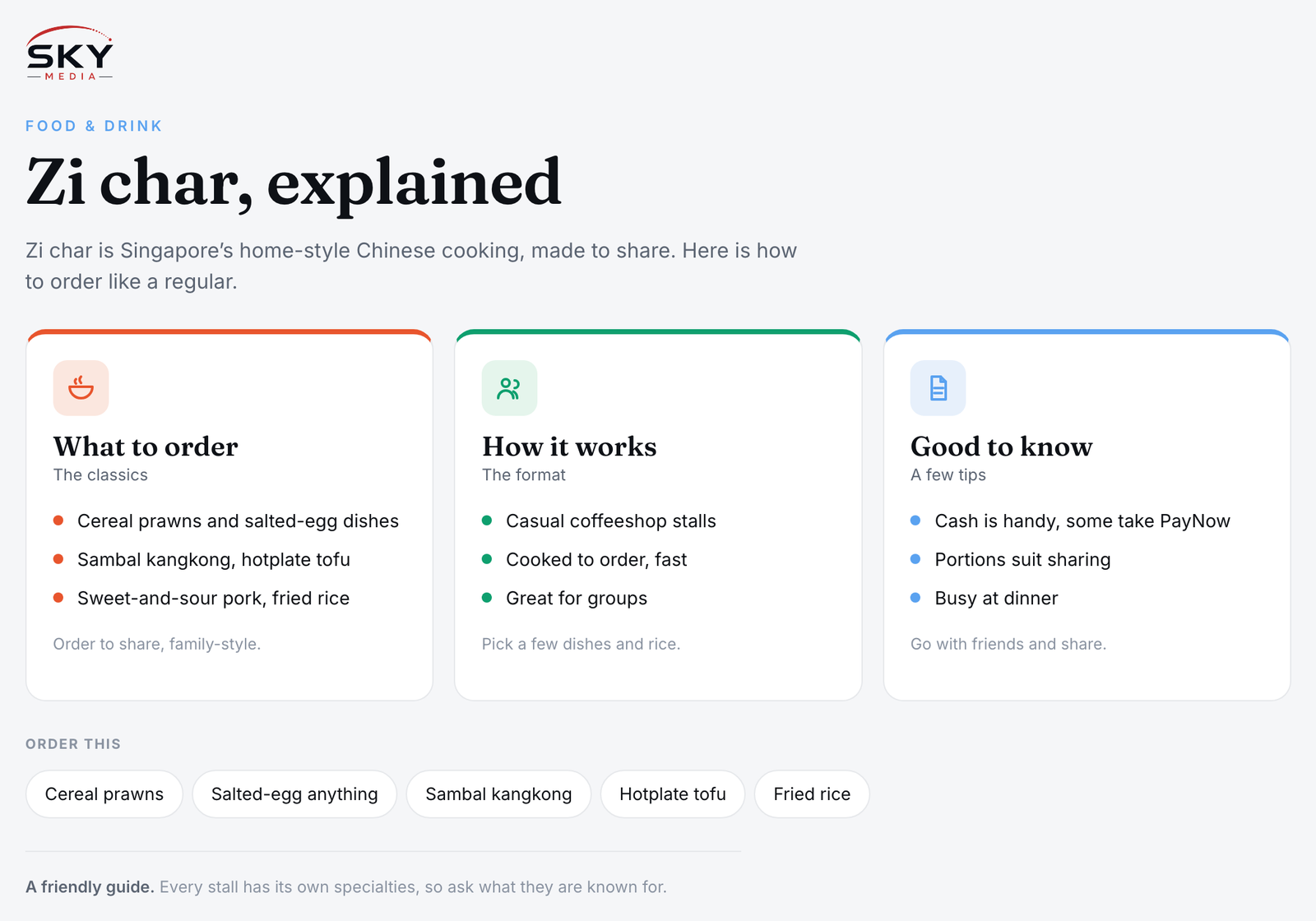
What is zi char
Zi char literally refers to cooking and frying, and in practice it means a stall or eatery that whips up a wide range of Chinese dishes to order, from stir-fries to soups to seafood, all served family style. Unlike a single-dish hawker stall, a zi char place offers a broad menu, and the idea is to order several dishes for the table to share over steamed rice. It is the everyday, unpretentious Chinese cooking that locals grew up with, executed with the speed and wok skill of a busy kitchen.
The setting is usually casual: plastic stools, round tables, a coffee shop or a no-frills eatery, often buzzing in the evenings with families and groups of friends.
The joy of sharing
The heart of zi char is sharing. You do not order a plate each; instead the table orders a selection of dishes to enjoy together, balancing meat, seafood, vegetables and perhaps a soup, all eaten with rice. This communal style is a big part of the appeal, turning a meal into a relaxed, sociable occasion. It is how many families eat out on a weeknight, and how friends gather for an affordable feast.
The unwritten rule of zi char: order for the table, not for yourself. Aim for a balanced spread of meat, seafood and vegetables to share, and everyone gets a bit of everything.
Must-order dishes
Menus can be long, but certain dishes are classics you will find almost everywhere:
- Cereal prawns. Prawns coated in a fragrant, buttery cereal mixture, sweet, savoury and addictive.
- Sweet and sour pork. A crowd-pleasing balance of tangy and sweet with crispy pork.
- Sambal or stir-fried vegetables. Greens such as kangkong (water spinach) cooked with sambal, a garlicky, spicy favourite.
- Salted egg dishes. Rich, savoury salted egg coating on prawns, chicken or crab.
- Claypot tofu. Silky tofu braised with vegetables and a savoury sauce in a hot claypot.
- Steamed or fried fish. Fresh fish prepared simply to let its flavour shine.
- Hor fun or fried noodles. A noodle dish, such as beef hor fun in a savoury gravy, to round out the spread.
Many places are also known for seafood such as chilli or black pepper crab, and for a comforting soup to share.
How to order for a group
Ordering zi char well is a small art, but easy to grasp:
- Match dishes to your group size. A rough guide is to order roughly one dish per person, plus rice, adjusting for appetites.
- Balance the spread. Aim for a mix: a meat dish, a seafood dish, a vegetable, and perhaps a soup or a noodle, so the meal feels complete.
- Consider spice levels. Include at least one milder dish if your group has varied tolerances.
- Do not over-order. It is easy to get carried away; you can always order more.
- Ask for recommendations. Many stalls have signature dishes worth trying.
Quick ordering guide
- Order to share, roughly a dish per person plus rice.
- Balance meat, seafood, vegetables and a soup or noodle.
- Include a milder option for varied spice tolerances.
- Ask what the stall is known for.
- Start modestly and top up if needed.
Why locals love it
Zi char occupies a sweet spot in local dining: more variety and a more sociable, sit-down feel than a single hawker dish, yet far more affordable and casual than a restaurant. It is where families celebrate small occasions, where friends catch up over a shared table, and where you get comforting, well-cooked Chinese food without ceremony. The dishes taste of home, the atmosphere is relaxed, and the bill is friendly, which is exactly why it endures across generations.
For newcomers, zi char is one of the best ways to experience how Singaporeans actually eat and socialise. Gather a few people, order a shared spread, and you get both a delicious meal and a window into local dining culture.
When zi char is the perfect choice
Part of knowing zi char is knowing when to reach for it. It is ideal when you have a group and want variety without the formality or cost of a restaurant, making it a natural pick for family dinners, casual birthday gatherings, or a relaxed catch-up with friends. It also shines when appetites and tastes differ, since a shared spread means everyone finds something they like. On a weeknight when you want a proper cooked meal but do not feel like cooking, a nearby zi char place delivers home-style comfort with no effort. It is less suited to a quick solo bite, where a single hawker dish makes more sense, and to occasions calling for a smart setting. Understanding this helps you use zi char for what it does best: feeding a group well, affordably and without fuss.
Finding a good zi char place
Zi char eateries are found in coffee shops and casual restaurants across residential neighbourhoods, so your own area likely has a few. As with all local food, a steady crowd is a good sign, and many zi char places build strong reputations for particular signature dishes over the years. Prices are very reasonable for the amount of food, making it excellent value for groups, though treat any prices as a rough guide since they change. Neighbourhood coffee shops in the evenings are a natural place to start.
Zi char is the delicious, unpretentious heart of everyday Chinese dining in Singapore: a shared table of home-style dishes, enjoyed casually with family and friends. Order a balanced spread, embrace the communal style, and you will understand why it is such a cherished part of local life. As always with casual dining, let the busy stalls and your own taste guide you, and treat any specifics as a rough guide.
Explore more: Seafood guide in Singapore, Steamboat and hotpot in Singapore, Must-try hawker food in Singapore