

A camera that suddenly shows an error code, a lens that grinds when it zooms, or a viewfinder with a haze you cannot wipe away usually needs more than a blower and a microfibre cloth. This guide to camera repair Singapore owners can rely on explains the two main routes, authorised service centres and independent repairers, how to decide between them, and what to do before you hand your gear over. It focuses on proper repair and servicing rather than the DIY cleaning you can already do at home.
Prices, turnaround times and warranty terms vary by brand and by shop, and they change over time, so treat this as a framework for asking the right questions rather than a price list.
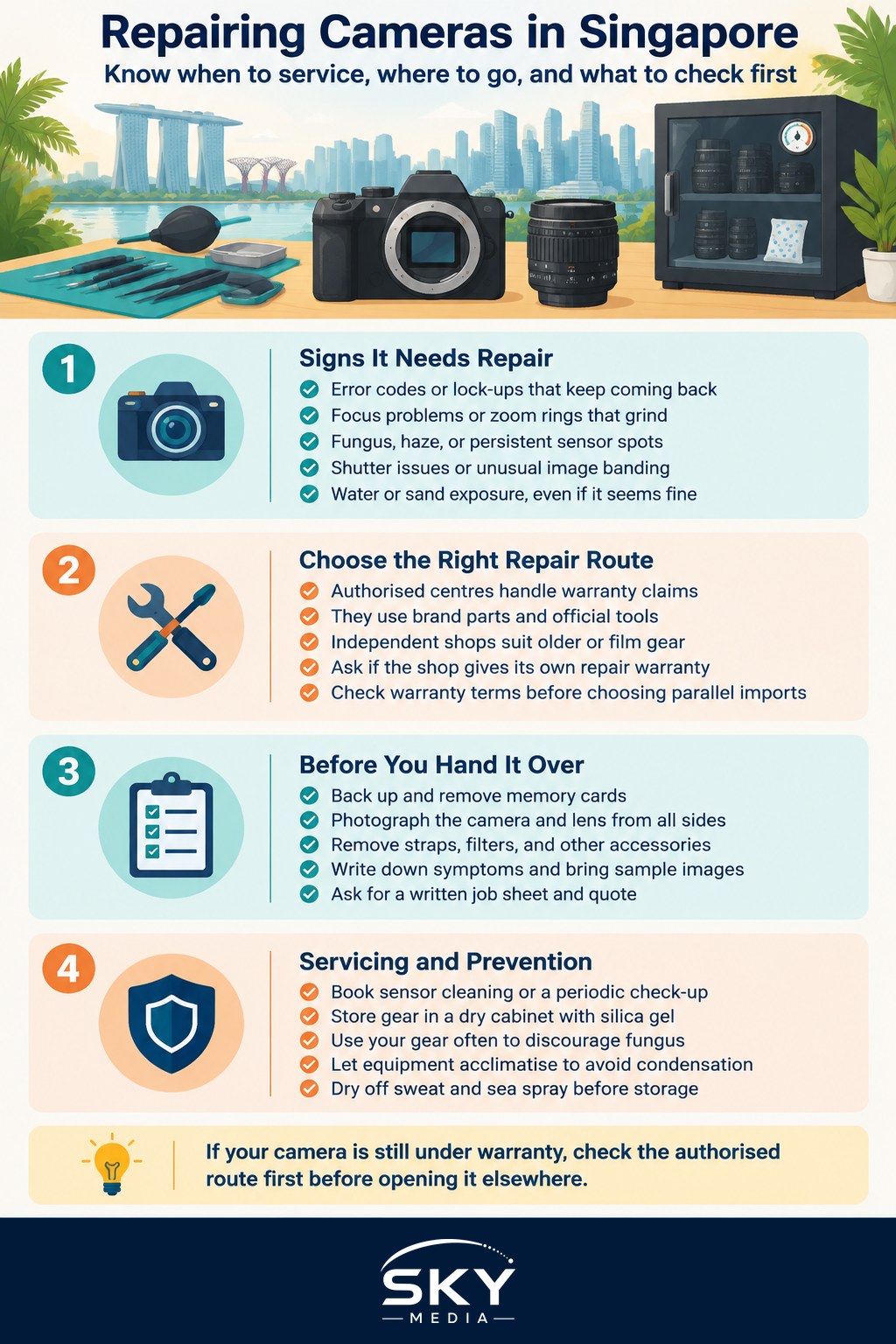
When a Camera Needs a Professional, Not a Cleaning Cloth
Some problems are worth sorting yourself. Dust on the outside of a lens, a smudged rear screen or a dirty eyecup are routine. Other symptoms point to an internal fault that needs trained hands and proper tools:
- Error codes or lock-ups that persist after you remove the battery and reset the camera.
- Autofocus hunting or a lens that will not focus at infinity, which can point to a decentred element or a failing focus motor.
- Grinding, sticking or loose zoom and focus rings.
- Fungus or haze inside the lens, which often looks like a faint spider-web pattern when you shine a torch through it. Singapore’s year-round humidity makes this one of the most common local problems.
- Shutter failures, banding in images or a shutter that sounds different from usual.
- Water or sand exposure, even if the camera seems fine afterwards. Corrosion can develop slowly.
- Persistent sensor spots that a gentle blower does not remove.
If you are unsure, take a few test shots at a small aperture against a plain sky or white wall and bring them along. A technician can read a lot from a test image.
Authorised Service Centres: What They Offer
Most major camera brands support Singapore customers through an authorised service centre, either run directly by the brand or by an appointed local partner. Check the brand’s official Singapore website for the current address, booking system and opening hours, because these do move.
The main reasons to choose an authorised centre:
- Warranty work. If your camera is still under the manufacturer’s warranty, the authorised channel is usually the only way to claim it. Bring your proof of purchase and the warranty card if one came with the camera.
- Genuine parts and official tools. Authorised technicians have access to brand-specific parts, firmware and calibration equipment.
- Records. Many brands log repairs against the serial number, which can help with resale.
- Membership or professional services. Some brands run programmes for registered users or working professionals, which may include sensor cleaning or priority repair. Check whether you qualify.
The trade-offs are that out-of-warranty repairs can be expensive, some faults are sent overseas for repair, which lengthens turnaround, and older or discontinued models may no longer be supported once parts run out.
One important point for parallel imports: a camera bought overseas or from a grey-market seller may carry a different warranty to a locally sold unit, and a Singapore centre may treat it as out of warranty. Read the warranty terms on your receipt or the seller’s site before assuming coverage.
Independent Camera Repairers: When They Make Sense
Singapore also has independent repairers, often long-established workshops in older shopping centres that specialise in cameras and lenses. They can be a sensible choice when:
- The camera is out of warranty and the authorised quote is close to the cost of a replacement.
- You own film cameras, vintage lenses or discontinued models that the brand no longer services.
- You want a cleaning, fungus treatment or lens adjustment rather than a part replacement.
- You need a second opinion on a diagnosis.
Independent work quality varies more widely than authorised work, so ask questions. Does the shop specialise in your brand or format? Does it offer a warranty on the repair itself, and for how long? Will it use original parts, compatible parts or salvaged parts? A good repairer will explain the options plainly.
Be aware that opening a camera at an independent shop may affect any remaining manufacturer’s warranty. If your camera is still covered, go to the authorised centre first.
Authorised Centre vs Independent Repairer at a Glance
| Factor | Authorised service centre | Independent repairer |
|---|---|---|
| Warranty claims | Usually the only route for manufacturer warranty | Cannot process brand warranty claims |
| Parts | Genuine parts from the brand | Original, compatible or salvaged, ask which |
| Older or film cameras | Often unsupported once parts run out | Frequently the better option |
| Cost for out-of-warranty work | Can be higher | Often lower, but varies by shop |
| Turnaround | Can be longer if sent overseas | Often quicker for simple jobs |
| Repair guarantee | Usually stated on the job sheet | Varies, ask before agreeing |
Getting a Quote and Handing Over Your Gear
Whichever route you choose, the hand-over process matters. Before you go:
- Back up and remove your memory cards. Do not leave cards in the camera.
- Note the serial number and photograph the camera and lens from all sides. This records existing scratches and condition.
- Remove accessories such as straps, filters and L-brackets unless they relate to the fault.
- Write down the symptoms, including when they started and any error codes. Bring sample images.
At the counter, ask for a written job sheet listing the serial number, the fault described, accessories handed over and the shop’s terms. Many places charge an inspection or diagnosis fee, and some waive it if you proceed with the repair. Ask:
- Is there an inspection fee, and is it deducted from the repair cost?
- Will you call me with a quote before doing any work?
- What is the estimated turnaround, and will parts come from overseas?
- What warranty covers this repair?
- How long will you store the item if I do not collect it?
Never agree to an open-ended repair without a quote. If the quote is high, it is normal to decline, pay the inspection fee and collect your camera.
Routine Servicing and Prevention in a Humid Climate
Servicing is not only for broken gear. Many photographers book a periodic check-up or sensor cleaning, especially before a big trip or a paid shoot. Professional sensor cleaning reduces the risk of scratching the sensor or its filter stack, which is an expensive mistake to make at home.
Prevention matters even more here. Fungus thrives in warm, humid, dark conditions, so:
- Store cameras and lenses in a dry cabinet or a sealed box with fresh silica gel, and check the humidity reading regularly.
- Use your gear often. Light and airflow discourage fungus.
- Let gear acclimatise when moving from an air-conditioned room to the outdoors to reduce condensation. Keeping it in a closed bag for a while helps.
- Wipe off sweat and sea spray after shoots and dry the camera before storing it.
If a problem is caught early, such as light haze, a cleaning may be enough. Left too long, fungus can etch lens coatings permanently.
Is It Worth Repairing?
Compare the repair quote with the current used price of the same model. For a mid-range body several generations old, a large repair may not make financial sense, and upgrading could be better value. For high-end lenses, which tend to hold their value, repair is often worthwhile. If you are thinking of replacing, our guide to choosing your first camera covers the basics. For broader context on fixing rather than replacing electronics, see understanding the right to repair and our guide to getting your phone or laptop repaired.
If a repair goes wrong or a shop refuses to honour its stated repair warranty, keep your job sheet and receipts. You can seek advice from the Consumers Association of Singapore (CASE) on your options.
Frequently Asked Questions
Should I remove my lens and memory card before sending a camera for repair? Back up and take out your memory cards, and remove accessories such as straps, filters and L-brackets unless they relate to the fault. Hand over the lens only if it is part of the problem. Photograph all sides of your gear first to record its condition.
Is it worth repairing an older camera body? Compare the repair quote with the current used price of the same model. For a mid-range body several generations old, a big repair may cost more than it is worth, and upgrading could be better value. High-end lenses hold their value, so repairing them is often worthwhile.
Does a repair at an independent shop void my warranty? It can affect any remaining manufacturer’s warranty, because opening the camera may breach the terms. If your camera is still covered, go to the authorised service centre first. Independent repairers cannot process brand warranty claims.
How can I protect my camera and lenses from fungus in humid weather? Store gear in a dry cabinet or sealed box with fresh silica gel, and check the humidity reading regularly. Use your equipment often, because light and airflow discourage fungus. Wipe off sweat and sea spray after shoots and let gear acclimatise when leaving an air-conditioned room.
What can I do if a repair shop does not honour its repair warranty? Keep your job sheet and receipts as proof of what was agreed. You can then seek advice from the Consumers Association of Singapore (CASE) on your options. Asking for a written job sheet before handing over your gear makes any dispute easier to settle.
Further reading: Buying a Camera Overseas vs in Singapore: Warranty, GST and Grey Imports