

If you have just moved from mainland China, one of the quiet comforts of Singapore is how easy it is to keep reading in Chinese. Bookshops stock simplified Chinese titles, the public libraries hold large Chinese collections, and several times a year there are book fairs and book events where you can browse thousands of titles in one place. This guide explains what a typical Chinese book fair Singapore readers attend looks like, how to find one, and how to get the most out of a visit, whether you are buying for yourself or for your children.
We will not list fixed dates or named organisers here, because events change from year to year. Instead, you will learn the types of events to watch for and where to check the current schedule.
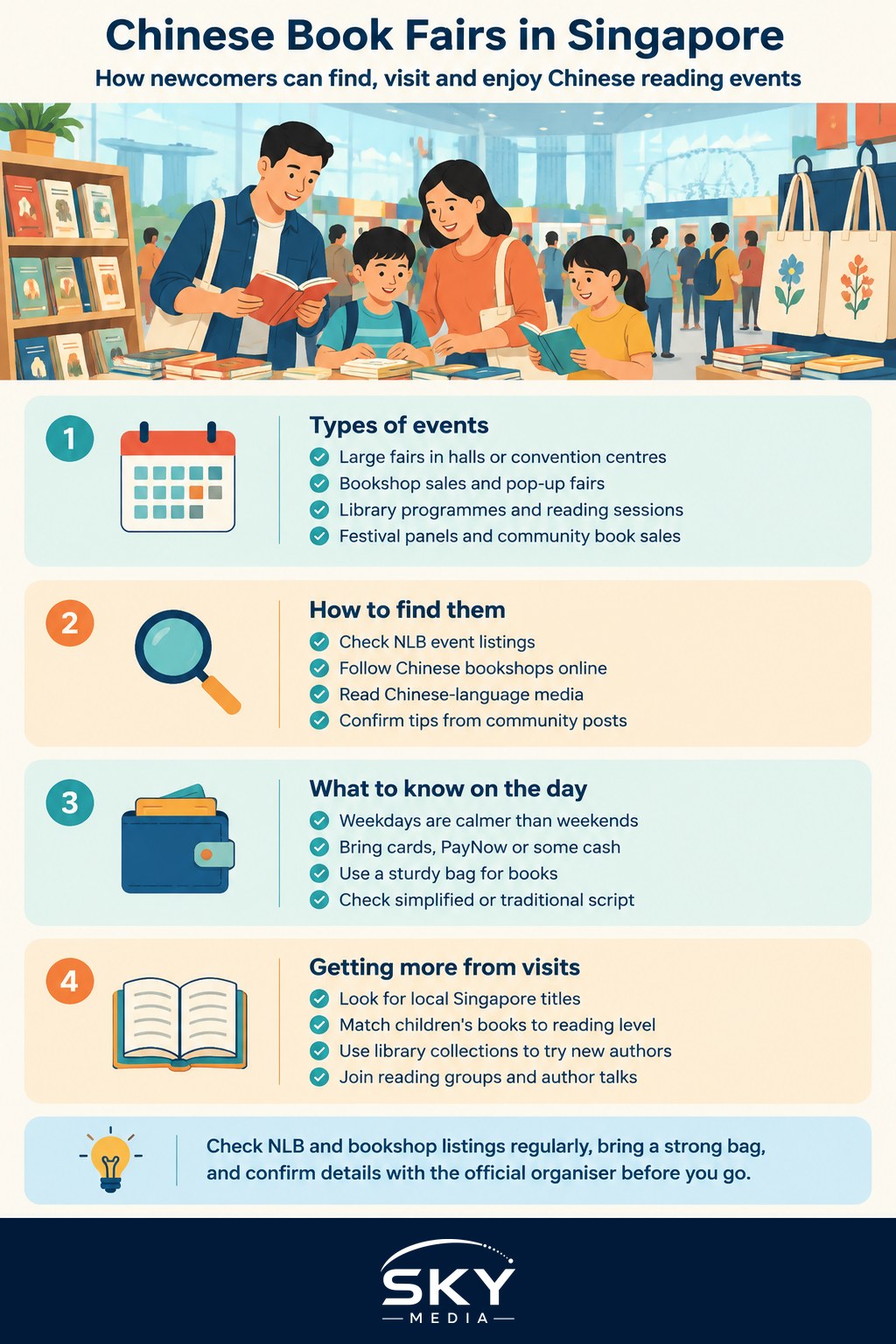
What Kinds of Chinese Book Events Happen in Singapore
At home you may be used to very large book fairs in big exhibition centres, or to browsing in a city’s flagship bookstore. Singapore is smaller, so its Chinese book scene is spread across a few different formats. Each one suits a different kind of reader.
| Event type | Where it usually happens | Best for | What to expect |
|---|---|---|---|
| Large book fair | Exhibition halls or convention centres | Bulk buying, children’s books, bargains | Many publishers and sellers, crowds on weekends, discounts on bundles |
| Bookshop sale or fair | Chinese bookshops and their pop-up spaces | New releases from China and Taiwan | Smaller scale, staff who can order titles for you |
| Library programme | National Library and regional libraries | Free talks, author sessions, reading clubs | Free or low-cost, often bilingual, registration may be needed |
| Literary festival segment | Arts venues during festival season | Meeting writers, literary discussion | Chinese-language panels alongside English ones |
| Community or school book sale | Community clubs, clan associations, schools | Secondhand books, family outings | Low prices, small selection, friendly atmosphere |
The large fairs are the closest to what you may remember from home. They often have rows of stalls selling Chinese, English and sometimes Malay books, with a strong focus on children’s titles, assessment books and popular fiction. Bookshop fairs are smaller but often better for serious readers, because the staff know the catalogue well.
How to Find Upcoming Chinese Book Fairs
Because dates and venues shift, the most reliable approach is to follow a few sources and check them regularly.
- National Library Board (NLB): The NLB runs Singapore’s public libraries. Its events listings include Chinese-language talks, storytelling for children and reading programmes. Check the NLB website or its GoLibrary event pages.
- Chinese bookshops: Most Chinese bookshops announce sales and fairs on their own websites and social media. Following two or three of them is the easiest way to hear about events early.
- Chinese-language media: Singapore’s Chinese newspapers and their websites regularly report on upcoming book fairs and author visits.
- Community groups: WeChat groups and Xiaohongshu posts from other newcomers often share event news, photos and tips. Treat these as helpful hints, then confirm details with the official organiser.
- Your child’s school: Many schools with strong Mother Tongue programmes promote Chinese book events to parents.
If you are still setting up your phone, our guide to essential apps for Chinese newcomers in Singapore covers the apps that make finding local events much easier.
Practical Tips for Your First Visit
A Chinese book fair in Singapore is relaxed compared with the busiest fairs in large Chinese cities, but a little planning still helps.
Timing and crowds
Weekends, especially during school holidays, are the busiest times. If you prefer to browse slowly, go on a weekday or early in the day. The first and last days of a large fair often have the most activity: the first day has the full range of stock, while the final day may have extra discounts on leftover titles.
Payment
Singapore stalls usually accept cards and local payment methods such as PayNow, which is Singapore’s bank transfer system linked to a phone number or NRIC. Some stalls also accept cash. Do not assume that Alipay or WeChat Pay will be accepted everywhere, even at Chinese-focused events, so bring a local card or some cash as a backup.
Bags and transport
Books are heavy. Bring a sturdy tote or a small trolley bag if you plan to buy a lot. Most large fairs are near MRT stations, but if you are buying for a whole year of reading, a taxi or ride-hailing trip home may be easier.
Simplified versus traditional
Singapore uses simplified Chinese, the same script you learned in mainland China. However, many fairs also sell books from Taiwan and Hong Kong printed in traditional characters. Check the script before you buy, especially for children, as young readers may find traditional characters confusing.
Buying Chinese Books for Your Children
Many newcomer parents visit book fairs mainly for their children. Singapore schools teach Chinese as a Mother Tongue Language, and the style and vocabulary can differ a little from what children learn in China. A few points are worth knowing.
- Look for local titles. Books written by Singapore authors use local settings, food and expressions. They help children connect Chinese with daily life here.
- Match the level. Children’s sections are often sorted by age or reading level. Ask staff for guidance if you are unsure.
- Assessment books are popular, but balance them. Many parents buy practice books at fairs. Story books and comics in Chinese are just as important for building a love of reading.
- Mix languages. Bilingual picture books can help children who are adjusting to English at school while keeping their Chinese strong.
If you are still choosing a school, our newcomer’s guide to Chinese schools in Singapore explains how Chinese is taught in the local system.
Getting More From the Chinese Reading Scene
Once you have been to a fair or two, you may want to go deeper.
Use the public library
The National Library and regional libraries hold large collections of Chinese books, magazines and children’s titles. Library membership for residents is simple to set up, and borrowing is a good way to try new authors before you buy. Check the NLB website for current membership rules and any fees for foreign residents.
Join a reading group
Libraries, community clubs and some bookshops run Chinese reading groups. These are a gentle way to practise discussion, meet people who share your interests and learn about Singapore Chinese literature, which has its own history and themes.
Attend author talks
Many fairs and festivals include talks by writers from Singapore, Malaysia, China and Taiwan. They show how Chinese culture has developed in Southeast Asia.
Explore related arts
Chinese reading pairs naturally with other Chinese-language arts. Our guide to Chinese language theatre in Singapore covers local drama groups and how to choose a show.
Etiquette and Small Differences to Notice
Singapore book events are generally orderly and friendly. A few habits will help you fit in.
- Queue patiently at cashiers and popular stalls. Queuing is taken seriously here.
- Handle books gently. Many stalls keep display copies for browsing. Use those rather than opening sealed copies.
- Bargaining is uncommon. Prices and discounts are usually fixed and clearly marked.
- Speak Chinese or English freely. Most staff at Chinese book events are comfortable in both, although some may speak with Singapore accents or use local terms. If you do not understand, just ask.
You may also notice that Singapore Chinese uses some words differently from mainland usage, and some locals mix in English, Malay or Hokkien words. This is normal and part of the local flavour.
Making Book Fairs Part of Your New Life
For many newcomers, a Chinese book fair is more than a shopping trip. It is a chance to feel at home, meet other readers and discover how Chinese culture lives on in a multicultural city. Our guide to making friends as a Chinese newcomer in Singapore has more ideas for building a social circle.
Check the NLB events pages and your favourite bookshops regularly, plan around the weekend crowds, and bring a strong bag. Your bookshelf in Singapore will fill up faster than you expect.
Further reading: How to Find Chinese Books for Children in Singapore