
Few art forms feel as calm and as quietly powerful as Chinese ink painting. With nothing more than a brush, black ink, water and paper, a skilled artist can suggest a towering mountain in mist, a spray of bamboo bending in the wind, or a single bird resting on a branch. The beauty lies in restraint. Empty space is as important as the marks themselves. In Singapore this scholarly tradition has been carried across generations by immigrant masters and local students alike, and it remains a living part of our cultural landscape.
For anyone curious about chinese ink painting singapore artists practise, it helps to understand what the art is, where it comes from, how it is made, and where it fits into our heritage today.
What Chinese Ink Painting Is
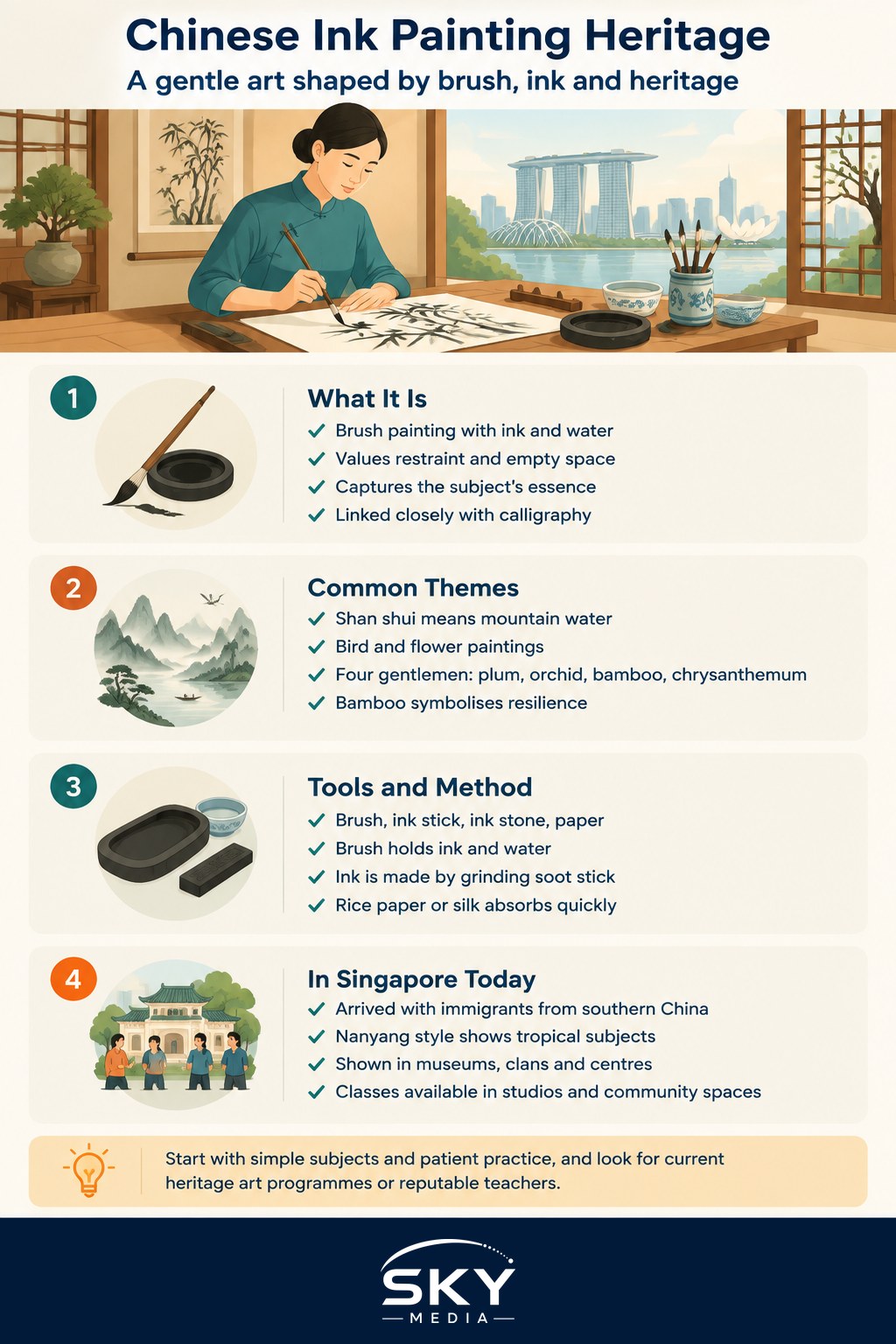
Chinese ink painting, sometimes called brush painting or ink and wash painting, is a classical East Asian art form that shares its tools and spirit with calligraphy. Rather than filling a scene with realistic detail and colour, the ink painter aims to capture the essence and inner life of a subject. A few confident strokes stand in for a whole tree. A pale wash becomes distant hills.
The art is traditionally grouped into familiar themes. Landscape painting, known as shan shui or mountain water painting, celebrates nature and the human place within it. Bird and flower painting captures blossoms, insects and small creatures. The so called four gentlemen, being plum blossom, orchid, bamboo and chrysanthemum, are practised again and again because each demands particular brush control and each carries moral meaning. Bamboo, for instance, is admired for bending without breaking, a symbol of resilience and integrity.
Origins and Cultural Meaning
Chinese ink painting grew out of a scholarly culture in which the same educated person might write poetry, practise calligraphy and paint, all with the same brush. These three pursuits were seen as expressions of one refined character. A painting was not judged only by how closely it copied nature, but by the spirit, rhythm and personality revealed in the brushwork. Many classical works pair an image with a poem and a red seal, so that word and picture speak together.
This close bond with writing is why ink painting and Chinese calligraphy are often taught side by side. Both rely on the same disciplined training of the wrist, the same sensitivity to line, and the same patient practice. To master one is to deepen the other.
How It Is Made
The traditional tools are known affectionately as the four treasures of the study. These are the brush, the ink stick, the ink stone and the paper. The brush is usually made from animal hair set in a bamboo handle, and it can hold a surprising amount of ink and water. The ink stick, made from soot and glue, is ground with a little water on the ink stone to produce fresh liquid ink. Artists control the shade from deep, glossy black to the palest silver grey simply by adjusting how much water they add.
Painting is usually done on absorbent rice paper or on silk. Because these surfaces soak up ink instantly, there is no room for hesitation or correction. A stroke, once laid down, cannot be erased. This is why ink painting demands so much practice before the brush ever touches the final sheet. The artist learns to load the brush with graded tones, then completes a bamboo leaf or a bird in one decisive movement. Finished works are often mounted as hanging scrolls, handscrolls or album leaves.
Its Place in Singapore’s Heritage
Chinese ink painting arrived with immigrants from southern China and took root as the community settled. Over the decades a distinctive local sensibility emerged, sometimes called the Nanyang style, in which classical brush techniques were used to depict tropical subjects such as coconut palms, kampong scenes, orchids and local birds. In this way an ancient art absorbed the light and life of Southeast Asia.
You will find ink painting close to the heart of Chinese cultural life here. Works are displayed and given during the Lunar New Year, exhibited in clan associations and community centres, and taught in art societies. It sits comfortably alongside the other traditional trades and crafts of Singapore that immigrant communities kept alive, and it forms part of the wider work of preserving Singapore heritage for future generations.
How to See and Learn It Today
Museums and art galleries regularly show classical and modern ink works, and temporary exhibitions often feature both historical masters and contemporary Singapore based artists. Community centres, clan associations and private studios offer beginner classes where you can learn to grind ink, hold the brush and paint your first stalk of bamboo.
If you would like to try, look for current heritage art programmes and reputable teachers rather than rushing. Start with simple subjects and be patient, because the calm confidence of a good stroke comes only with time. Whether you paint yourself or simply pause before a misty mountain scroll, chinese ink painting offers a gentle, timeless window into a scholarly tradition that Singapore is proud to keep alive.
Further reading: Traditional Sugar Painting and Dough Art · The Art of Penjing and Bonsai in Singapore