
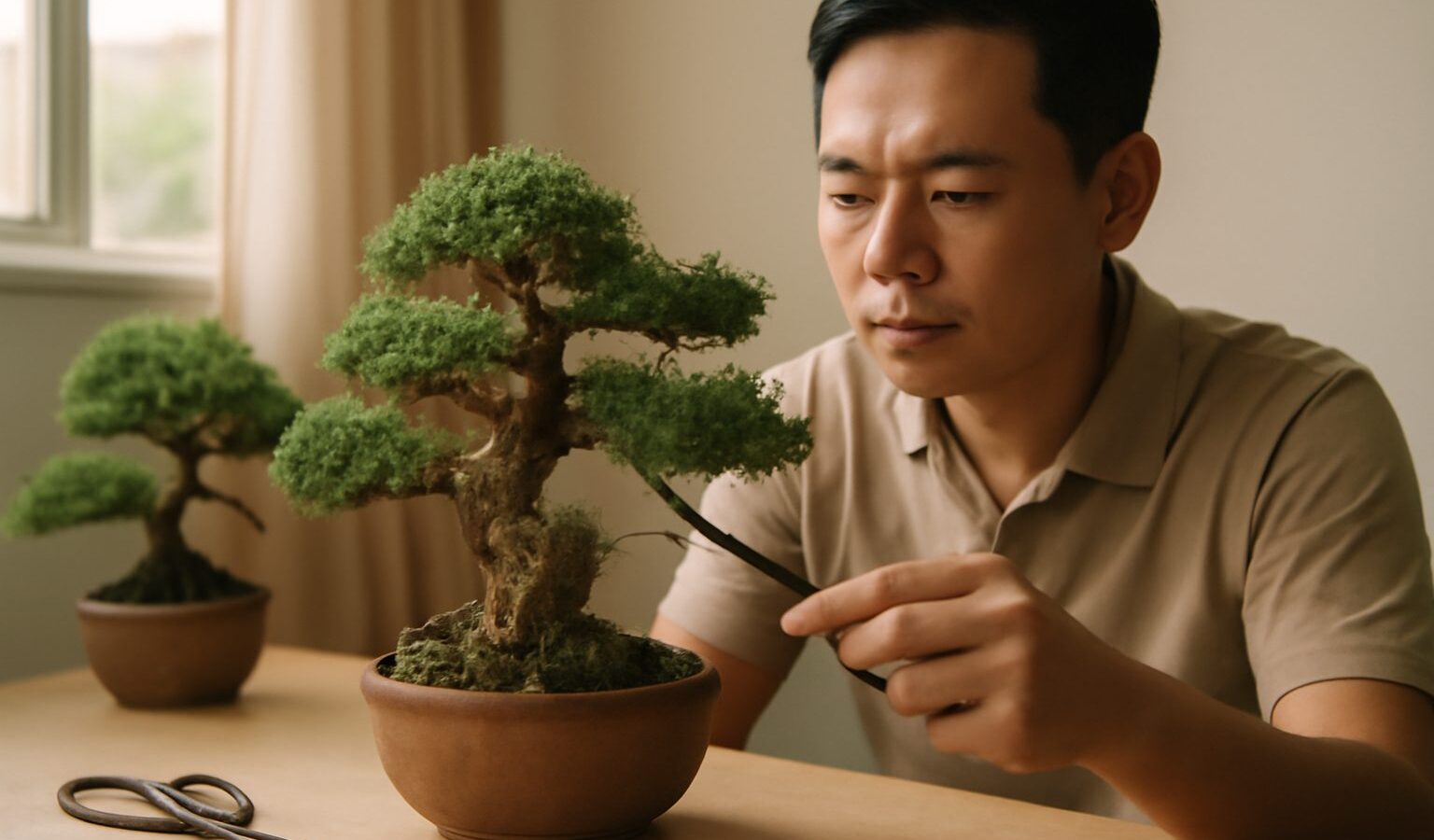
To stand before a gnarled miniature tree in a shallow tray is to look upon a whole landscape shrunk to the span of a table. The art of penjing and bonsai Singapore enthusiasts practise is a living sculpture, a patient dialogue between gardener and plant that turns a small tree into an emblem of nature’s grandeur and the passage of time.
What penjing and bonsai are
Penjing is the Chinese art of creating miniature landscapes in a container. The name refers to the tray-and-scenery form of the craft, in which trees, rocks, moss and sometimes water are arranged to evoke a natural scene in miniature. A penjing may capture a lone tree clinging to a cliff, a grove by a river, or a mountainous vista, all composed within the frame of a shallow pot. The aim is not mere smallness but the suggestion of a much larger world.
Bonsai is the closely related art of cultivating a single miniature tree, refined into its own distinct tradition. Where penjing often embraces wildness and full scenery, bonsai tends towards the disciplined shaping of one specimen into an idealised image of a mature tree. Both arts share the same deep roots, and both ask the practitioner to work with living material over many years.
The two are best understood as branches of a single tradition. Penjing is the older, broader art from which the more focused practice developed. In everyday use the terms are sometimes blurred, but the essential idea is common to both: to grow a small plant in a way that captures the spirit, form and dignity of nature at full scale.
Its heritage and philosophy
The art carries a philosophy as much as a technique. It grew from a deep reverence for nature and a desire to bring a fragment of the natural world into the home and courtyard. A well-made composition is meant to be contemplated, offering a moment of stillness and a reminder of the vastness of nature within the smallest of spaces. In this sense the craft is closer to painting or poetry than to ordinary gardening.
Time is central to the art. A tree cannot be hurried, and the gardener works in partnership with the plant’s own slow growth. Shaping, pruning and training may continue for many years, and a fine specimen may be tended across generations, passing from one keeper to the next. The mark of age, seen in a thickened trunk or a weathered form, is prized precisely because it cannot be faked. Patience is not a burden here but the very medium of the work.
For the Chinese communities who brought the art to Singapore, penjing was a cherished cultural pursuit that connected them to a long artistic heritage. Bonsai, admired across the region, found its own devoted following. Together they took root in a climate well suited to growing plants, and enthusiasts adapted their practice to the tropical conditions of the island.
Technique and forms
Creating a penjing or bonsai begins with choosing suitable material and a vision of the finished form. The gardener then shapes the tree over time through careful pruning of branches and roots, and through training that guides the direction of growth. The result should look natural and settled, as though the tree had grown that way in the wild, even though every line reflects deliberate choice.
Elements of the craft
- Selecting the plant, choosing a species and specimen with potential for shaping.
- Pruning, trimming branches and roots to control size and refine form.
- Training, guiding branches into graceful, natural-seeming lines.
- Potting, matching the tree to a container that complements its character.
- Ongoing care, watering, feeding and tending that keep the tree healthy for years.
Composition matters as much as horticulture. The gardener considers balance, the flow of the branches, the exposure of the roots and the relationship between tree, rock and pot. In penjing especially, the arrangement of stones and the shaping of the ground help tell the story of a landscape. Every element works towards a single harmonious impression, and restraint is often the greatest skill of all.
| Aspect | Penjing | Bonsai |
|---|---|---|
| Origin | Chinese tradition | Distinct tradition from shared roots |
| Focus | Miniature landscape and scenery | A single refined tree |
| Style | Often wilder and expressive | Often disciplined and idealised |
| Elements | Trees, rocks, moss, sometimes water | Chiefly the tree and its container |
| Feeling | A scene or story in miniature | A perfected image of a mature tree |
| Shared spirit | Nature captured in small form | Nature captured in small form |
Caring for a living artwork
Unlike a painting or a carving, a penjing or bonsai is never truly finished, for it is alive and always changing. This is both its challenge and its joy. The tree responds to the seasons, to water and light, and to the hand of its keeper. A neglected specimen declines quickly, while a well-tended one grows ever more beautiful with age.
Daily care forms the heart of the practice. The gardener waters with attention to the plant’s needs, guards against pests and disease, and adjusts training as the tree develops. In the tropical setting of Singapore, growers work with the humidity, heat and light to keep their plants thriving, choosing species that flourish in the local climate. The relationship is ongoing and personal, and many keepers speak of their trees almost as companions.
This lifelong tending is what gives the art its depth. A fine tree embodies the years of care poured into it, and to inherit one is to inherit that devotion. The value lies not only in the form of the plant but in the story of patience and attention it carries.
Where the art lives on today
Penjing and bonsai flourish in Singapore among dedicated hobbyists, clubs and collectors who share knowledge, hold exhibitions and pass on their skills. Gardens and cultural spaces sometimes display fine specimens, offering the public a chance to appreciate the art. Enthusiast groups welcome newcomers, and the craft spans generations, from seasoned keepers with decades of experience to curious beginners nurturing their first tree.
The art fits naturally into a city that treasures greenery. In a dense urban setting, a small tree in a pot brings a slice of nature into a flat or courtyard, and the calm of tending it offers a welcome counterpoint to a busy life. This gentle appeal helps the tradition endure and find new practitioners, ensuring that the patient art continues to be handed down.
A respectful close
The art of penjing and bonsai is a meeting of nature and human care, unfolding slowly over years and even generations. In each miniature tree lies a landscape, a philosophy and the quiet devotion of its keeper. To contemplate such a work is to be reminded that great beauty can grow in small spaces, given patience, respect and a steady, loving hand.
Explore more: Traditional trades of Singapore · Chinese calligraphy heritage · Chinese martial arts and wushu heritage