

You go to bed with a healthy leafy plant and wake up to a skeleton of chewed stalks and ragged holes. If you have found caterpillars in your garden in Singapore, you have met one of the fastest and hungriest pests a home grower faces. Our warm climate means moths and butterflies breed all year, so there is no off-season, and a small caterpillar can turn into a serious muncher in days. The upside is that caterpillars are large, visible, and among the easiest pests to deal with once you know where to look.
Spotting the Damage and the Culprit
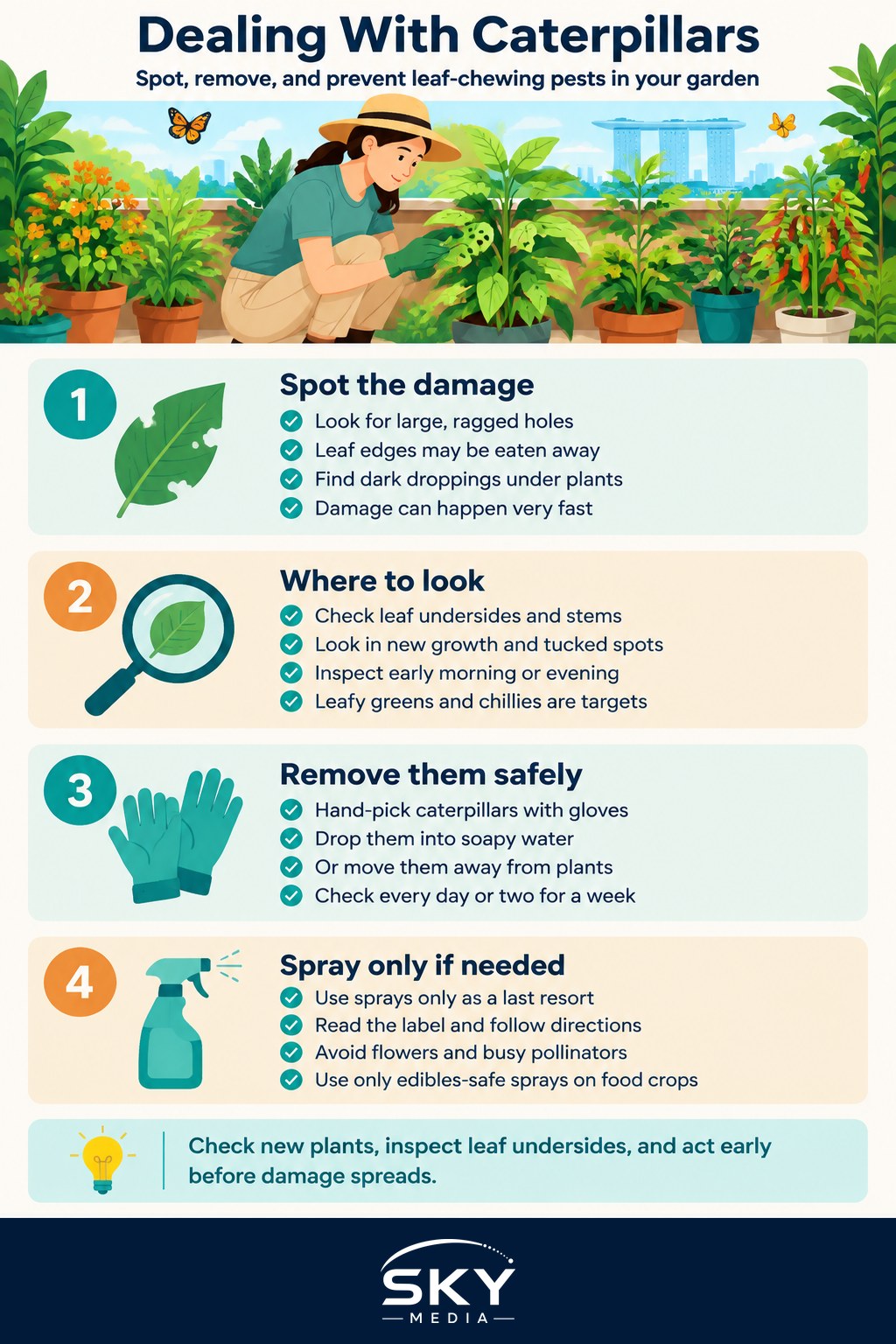
Caterpillar damage is distinctive. Look for large, irregular holes chewed right through leaves, or whole leaf edges eaten away, often much faster than any other pest could manage. You may also see their droppings, small dark pellets, scattered on lower leaves or the floor beneath the plant. These frass pellets are often the first clue that a caterpillar is hiding nearby even when you cannot see it.
The caterpillars themselves are masters of camouflage. Many are green and blend perfectly into the leaves, and they love to hide on the undersides, along stems, and tucked into new growth. Check in the early morning or evening when they are most active. Leafy greens, chilli plants, and many ornamentals are favourite targets, so these are the first places to inspect. If you are dealing with several pests at once, our broader guides on how to deal with plant pests and dealing with snails and slugs help you tell the different types of leaf damage apart, since holes alone do not always mean caterpillars.
Removing Them Safely
For most home gardens, the simplest method is also the best. Hand-picking is remarkably effective for caterpillars because they are big enough to see and slow enough to catch. Put on a pair of gloves, go over your plants leaf by leaf, and drop any caterpillars you find into a container of soapy water, or relocate them well away from your plants if you would rather not kill them. Do a careful check every day or two for a week, because eggs keep hatching and one pass rarely gets them all.
Keep a few things in mind as you work:
- Always check leaf undersides and new growth, where caterpillars and their eggs hide.
- Look for clusters of tiny eggs and rub them off before they hatch.
- A daily patrol for a week or so breaks the cycle far better than one big effort.
There is an important balance to strike here. Many caterpillars grow into butterflies and moths that pollinate our plants, so before you act, consider whether the plant can spare a few leaves. If you are trying to attract wildlife, some caterpillar activity is a sign of success, and our guides on attracting bees and pollinators and how to attract butterflies and birds to your garden explain how to grow food plants for them on purpose in a separate spot, so your vegetables and your butterflies do not have to compete.
If You Choose to Spray
For a heavy infestation on plants you cannot afford to lose, especially edibles, you may decide to use a spray. If you do, treat any product, including natural and neem-based ones, with the same care you would give a strong chemical, and follow this routine every time:
- Read the label and follow the dilution and directions exactly, because more is not better.
- Spot-test on one leaf and wait a day to check for burn before treating the whole plant.
- Keep all sprays, even natural ones, away from children, pets, and food, and store them out of reach.
- Never spray directly onto pollinators, and avoid open flowers and the times of day when bees are busy.
- For anything you grow to eat, use only sprays suitable for edibles, respect the waiting time on the label, and wash all home-grown produce well before eating.
- Spray in the cool of early morning or evening, out of strong sun, to protect the leaves.
Because sprays cannot tell a pest caterpillar from a future butterfly, use them as a last resort and target only the affected plant rather than dousing the whole garden.
Prevention helps too. Inspecting new plants before they join your collection, netting precious crops, and encouraging natural predators such as birds all keep numbers down. In Singapore’s non-stop growing season, caterpillars will always turn up sooner or later, but with a daily glance under the leaves and a gentle hand, they are one of the most satisfying pests to keep in check, and a reminder that a living garden is a busy one.
Frequently Asked Questions
How do I find caterpillars that I cannot see on my plants? Look for fresh holes and dark droppings on lower leaves or the floor beneath, then check leaf undersides, stems and new growth. Many are green and well camouflaged, so search early morning or evening when they are active.
Should I kill caterpillars or move them away? It depends on your goals. Many become butterflies or moths that pollinate, so you can relocate them well away from your crops. If they are devouring edibles you need, picking them into soapy water is a common choice.
How can I protect vegetables from caterpillars without spraying? Check plants daily for a week or so, remove eggs and caterpillars by hand, and cover precious crops with fine netting to stop moths laying eggs. Encouraging birds and other natural predators also helps.
Do caterpillar eggs look like anything in particular? They are usually tiny clusters or single dots on the undersides of leaves, in colours that blend in. Rub off any you find before they hatch. Because the details vary by species, look for anything unusual on leaf undersides.
Why do the caterpillars keep returning after I clear them? In Singapore moths and butterflies breed all year, so new eggs keep arriving and hatching. One clear-out rarely finishes the job. A short daily patrol and netting are more effective than a single big effort.
Further reading: Building an Insect Hotel for Your Garden in Singapore