
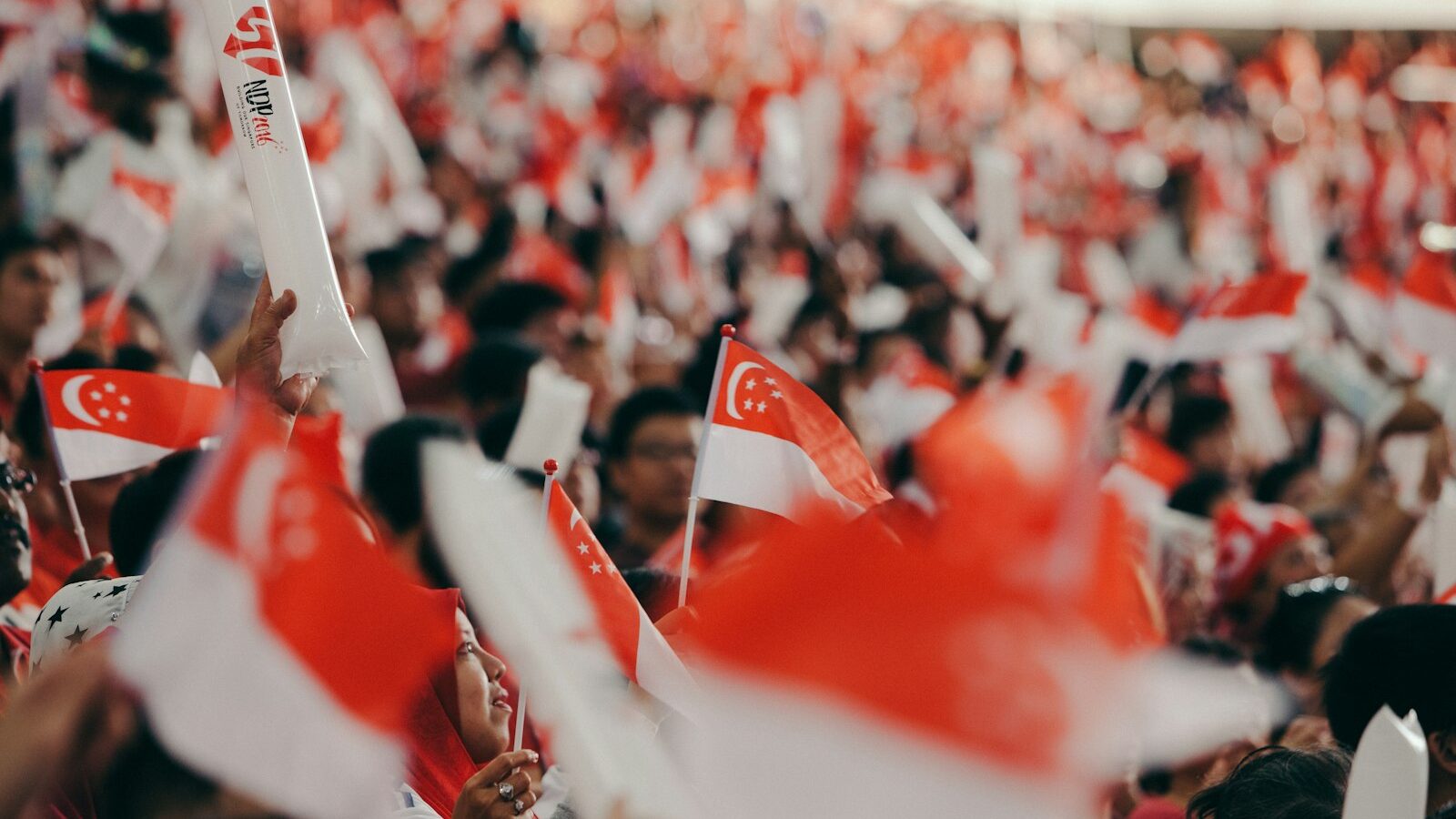
Every August the red and white flags go up along HDB corridors, the jets roar overhead during rehearsals and the fireworks light up Marina Bay. Young children notice all of it, and the questions follow: “Why is everyone wearing red?” “Whose birthday is it?” If you want to explain National Day to kids in a way that actually sticks, the trick is to start small, use what they can see and touch, and let the bigger ideas grow with them year by year.

Start With “Singapore’s Birthday”
For children under about six, the easiest frame is a birthday. Every child understands birthdays: there is a special day, people celebrate together, there are decorations, songs and sometimes a party. You can say something like:
- “On 9 August, Singapore has its birthday. It is the day Singapore became its own country.”
- “Everyone who lives here celebrates together, a bit like a very big family party.”
- “The flags are like birthday decorations, and the fireworks are like the candles.”
You do not need to explain the politics of 1965 to a four-year-old. The birthday idea is accurate enough to build on later.
As children reach five or six, you can add one more layer: “Before 1965, Singapore was part of another country. Then Singapore became independent, which means it started looking after itself and making its own decisions.” The word “independent” is a useful one to teach, because children already know the feeling of doing something by themselves, like tying their own shoes or packing their own school bag.
Explaining Independence by Age
Children take in history best through stories and feelings, not dates. Here is a rough guide by age; follow your own child’s curiosity.
| Age | What to explain | How to say it |
|---|---|---|
| 2 to 4 | National Day is a celebration | “It’s Singapore’s birthday, so we wear red and white and wave flags.” |
| 4 to 6 | Singapore became its own country | “Singapore grew up and started taking care of itself, like you learning to do things on your own.” |
| 6 to 8 | People worked hard to build the country | “When Singapore started, it had no big army, few jobs and not much water. People worked together to build homes, schools and the airport.” |
| 8 and up | Why the day matters to people | “Your grandparents remember when life was very different. Let’s ask them what they remember.” |
For the six to eight group, concrete comparisons help. Point to your HDB block and explain that many families once lived in kampongs, villages of wooden houses, and that public housing was built so more people could have a safe home. If grandparents are around, invite them to share a memory. A short real story from Ah Ma or Grandpa usually beats any book.
If your child asks a hard question, such as “Why did Singapore leave?”, it is fine to say, “The leaders at the time had different ideas about how to run things, so they agreed Singapore would go its own way.” Our guide on how to explain difficult concepts simply has more tips for questions you are not sure how to pitch.
What the Flag Means, in Child-Friendly Words
The national flag is the symbol children see most, so it is a natural teaching tool. The official meanings are simple enough to share almost word for word:
- Red stands for universal brotherhood and equality of people. For kids: “Red means we are all one big family and everyone is equal.”
- White stands for pervasive and everlasting purity and virtue. For kids: “White means being good and kind.”
- The crescent moon stands for a young nation on the rise. For kids: “The moon is new and growing, like Singapore, and like you.”
- The five stars stand for democracy, peace, progress, justice and equality. For kids: “The five stars are five good wishes for our country.”
A fun game is to count the stars on every flag you pass on the way to the playground. Older children can try to remember all five ideals, perhaps one per finger.
You can also explain simple flag manners: we do not let the flag touch the ground, and we treat it with care. For specific flag display rules at home, check the official guidance on gov.sg.
Making Sense of the Parade
The National Day Parade, or NDP, is a lot for a small child to take in: soldiers marching, tanks, helicopters, music, performers and fireworks. Before you watch, on TV or in person, give a quick preview so nothing feels scary.
- The marching contingents: “These are people who protect Singapore and help keep us safe. They practise for months to march together.”
- The flypast and the flag: “The helicopter carries a big flag across the sky so everyone can see it.”
- The loud bangs: For noise-sensitive children, explain that there will be loud booms from the guns during the salute and fireworks. Ear defenders or earplugs designed for children are worth packing if you are attending in person or watching from a fireworks spot.
- The songs: Learn one or two National Day songs together before the day so your child can sing along. Familiar music makes the whole event feel like theirs.
Children who are curious about the soldiers and military vehicles may enjoy the related idea of keeping Singapore safe together. Our piece on explaining Total Defence Day to your child builds on this nicely.
Simple National Day Activities for the Long Weekend
Hands-on activities make abstract ideas real. Pick one or two that suit your child’s age and energy.
- Make your own flag. Paper, red and white crayons and a stencil of a crescent and stars are all you need. Our list of easy National Day crafts for kids has more ideas, including bunting and paper lanterns.
- Dress up in red and white. Let your child choose their own outfit. It gives them a sense of taking part.
- Cook or eat a local favourite. Talk about how Singapore food mixes Chinese, Malay, Indian and Peranakan flavours, just like the people who live here.
- Make a “Singapore birthday card”. Ask your child to draw what they love about Singapore, such as the playground, the MRT or their grandparents’ house.
- Spot the symbols. On walks, look for flags, the Merlion, or the national flower (the Vanda Miss Joaquim orchid) in pictures and decorations.
- Watch the parade together. Even if you skip the full broadcast, watching the opening, the flypast or the fireworks together creates a family tradition.
When National Day Overlaps With Hungry Ghost Month
National Day often falls during the seventh lunar month, so your child may see offerings, joss paper burning and getai stages near your estate at the same time as the flags. Children sometimes mix the two up or ask why some people are burning paper while others are celebrating. A simple answer works: “Different families have different traditions. Some families remember their ancestors this month, and everyone celebrates Singapore’s birthday too.” For a gentle way to talk about the festival itself, see our guide on explaining Hungry Ghost Month to children.
This overlap is a nice teaching moment: many cultures and beliefs share the same neighbourhood, which is one of the ideas the flag’s red stands for.
Keep the Conversation Going Year to Year
You do not have to cover everything in one August. Each year, your child will be ready for a little more. A toddler who waved a flag at three may, by seven, ask what the five stars mean, and by ten be curious about what life was like in 1965. Many parents find it helps to keep a small family tradition, such as making a new flag every year or taking a photo in red and white, so children can look back and see themselves growing up alongside the country’s birthdays.
Above all, let it be joyful. When you explain National Day to kids with warmth and curiosity rather than facts to memorise, they come away with a sense of belonging, and that is the part that lasts.
Further reading: National Day Countdown Activities for Families: A 14-Day Plan