

Running your hand along your dog’s side and feeling something that was not there before is unsettling. Most owners jump straight to the worst outcome. The reassuring truth is that many lumps turn out to be harmless, but the only way to know is to have a vet check it. This guide explains what to do when you find a lump on dog or cat skin, how vets work out what it is, and what pet cancer care can look like if the news is not good.
This is general information, not veterinary advice. Every animal is different, and your vet is the right person to examine, test and advise on your pet.
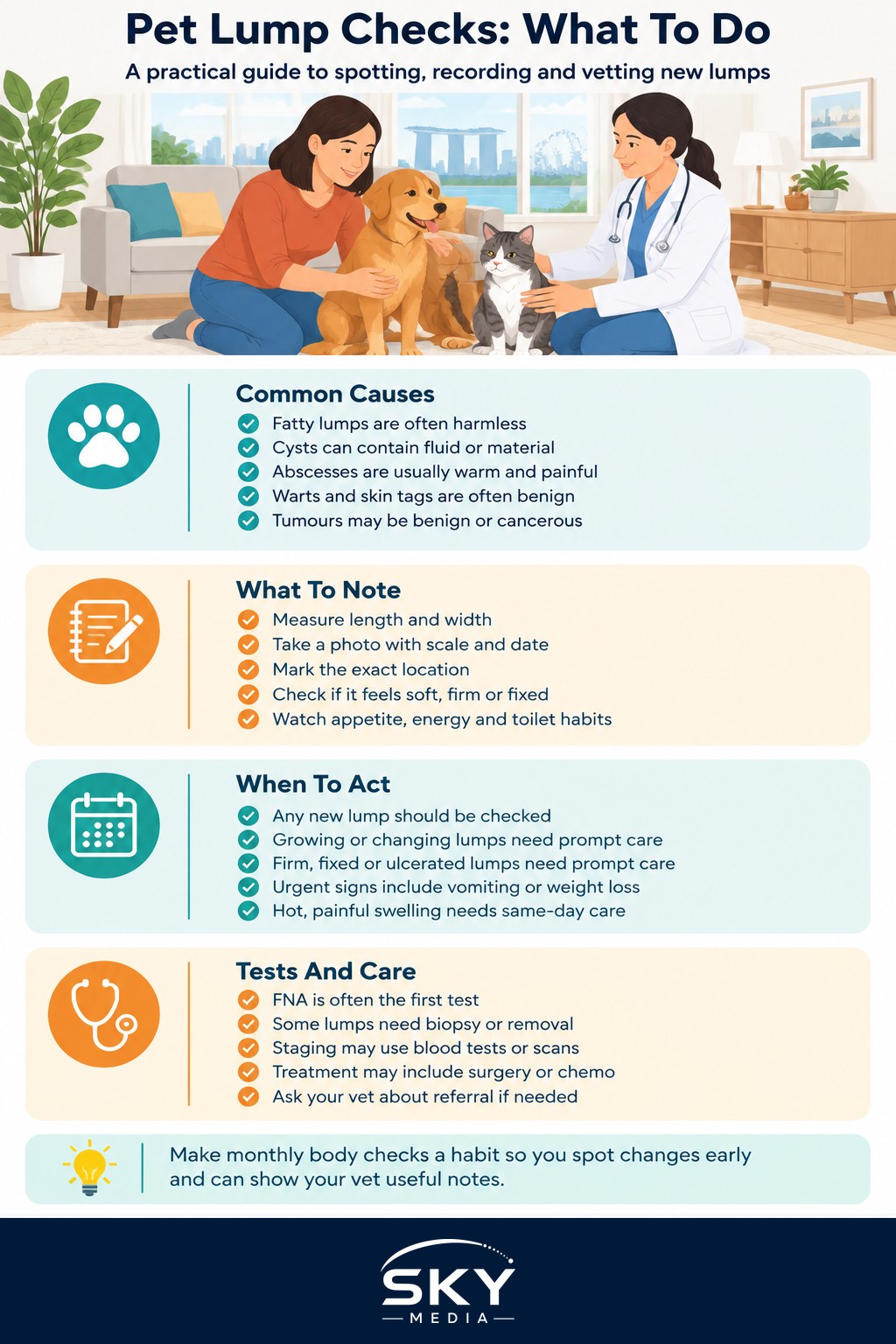
What a Lump Could Be
Lumps under or on the skin have many possible causes. Some of the more common ones vets see include:
- Fatty lumps (lipomas): soft, movable lumps under the skin, common in middle-aged and older dogs. They are usually benign, though they still need checking because they can look like other things.
- Cysts: fluid or material trapped in a sac in the skin. Some burst or become infected.
- Abscesses: pockets of infection, often after a bite, scratch or a foreign object such as a grass seed. These tend to be warm and painful.
- Warts and skin tags: small growths that are often harmless, especially in older animals.
- Insect bite or vaccine reactions: swelling that usually settles over days or a few weeks.
- Tumours: growths that may be benign or malignant (cancerous). Some, such as mast cell tumours in dogs, can look and feel innocent, which is why vets do not diagnose by touch alone.
The key point is that you cannot tell a harmless lump from a cancerous one just by feeling it. Size, softness and movement give clues, but they are not reliable on their own.
How to Record the Lump Before Your Vet Visit
Good notes help your vet a great deal. When you first find a lump:
- Measure it. Use a ruler or tape measure and note the length and width. You can also compare it to a familiar object, such as a pea or a coin.
- Photograph it with something for scale beside it, and note the date.
- Note its location precisely, for example “left side, just behind the last rib”. A simple body sketch on your phone helps if your pet has several lumps.
- Feel its texture. Is it soft or firm? Does it move freely under the skin, or does it feel fixed to deeper tissue?
- Watch for changes in your pet’s behaviour, appetite, energy, weight or toilet habits.
Do not squeeze, lance or try to drain any lump yourself. That risks infection and, with some tumour types, can trigger a reaction.
When to Worry and How Quickly to Act
Any new lump deserves a vet check, but some signs mean you should book sooner rather than later. The table below is a general guide only.
| What you notice | Suggested next step |
|---|---|
| Small, soft lump that has not changed in size | Book a routine vet appointment soon and keep measuring it |
| Lump that is growing, changing shape or colour | See your vet promptly, ideally within days |
| Lump that is firm, fixed or ulcerated (open, bleeding or weeping) | See your vet promptly |
| Lump with lethargy, poor appetite, vomiting, weight loss or breathing changes | Seek veterinary care urgently |
| Hot, painful swelling with fever or your pet refusing to eat | Seek veterinary care the same day |
A useful rule many vets share is that a lump that is growing, or has been present for around a month, should be sampled rather than simply watched. Ask your vet what they recommend for your pet.
Fine-Needle Aspirates and Biopsies Explained
The most common first test for a lump is a fine-needle aspirate (FNA). The vet inserts a thin needle into the lump to collect cells, spreads them on a slide and looks at them under a microscope, either in the clinic or by sending them to a laboratory for a pathologist to review. Many pets tolerate this without sedation because it is quick and similar to a vaccination.
An FNA can often identify a lipoma, cyst or abscess, and it can sometimes identify specific tumour types. It has limits, though. Some lumps do not release enough cells, and some results come back as “inconclusive”. In those cases your vet may suggest:
- A biopsy: removing a small piece of tissue, or sometimes the whole lump, so a pathologist can examine its structure. This usually needs sedation or anaesthesia.
- Histopathology after removal: if the lump is removed completely, it is often sent to the lab to confirm what it was and whether the edges (margins) are clear of abnormal cells.
If a lump is confirmed as cancerous, the vet may recommend staging: blood tests, X-rays, ultrasound or other scans to see whether the disease has spread. Staging helps decide which treatment makes sense.
Costs for tests, surgery and specialist care vary widely between clinics and cases. Ask your vet for an estimate before each step, and check whether any pet insurance policy you hold covers diagnostics and cancer treatment, as cover and exclusions differ by insurer.
What Pet Cancer Care Can Involve
A cancer diagnosis in a pet is hard news, but it is not always the end of good quality time. Treatment depends on the type of cancer, how far it has spread, the pet’s age and health, and what your family can manage. Common options include:
- Surgery to remove the tumour, often the main treatment for skin and soft tissue cancers when they are caught early.
- Chemotherapy, which in pets is generally aimed at controlling disease and keeping the animal comfortable. Your vet will explain what to expect for your pet.
- Radiation therapy, available through some specialist veterinary centres for certain tumour types.
- Palliative care, focused on pain relief, appetite and comfort when cure is not realistic.
In Singapore, general practice vets can handle many cases and may refer you to a veterinary specialist or a referral hospital for advanced imaging, oncology or complex surgery. Ask your vet whether referral makes sense and what it would involve.
Make decisions together with your vet. Questions worth asking include:
- What type of lump is it, and is it likely to spread?
- What are the treatment options, and what does each aim to achieve?
- How will treatment affect my pet’s daily life?
- What signs of pain or decline should I watch for at home?
Supporting Your Pet at Home
Whatever the diagnosis, small changes help. Keep your pet at a healthy weight, follow medication instructions exactly as your vet gives them, and keep surgical wounds clean and protected from licking. Be careful with treats and table scraps during treatment; our list of foods that are toxic to dogs and cats is worth keeping handy. If you travel or work long hours, a reliable carer matters more than usual, so see our guide to hiring a pet sitter or dog walker who can follow a care routine.
Finally, make lump checks a habit. Once a month, run your hands over your pet’s whole body, including the armpits, belly, legs and tail. Early detection gives your vet the most options, and in many cases, the lump you find will be nothing more than a harmless fatty lump.
Further reading: Understanding Your Pet’s Blood Test Results · Dog Dementia: Canine Cognitive Dysfunction Explained · Mange in Dogs: Demodectic vs Sarcoptic