
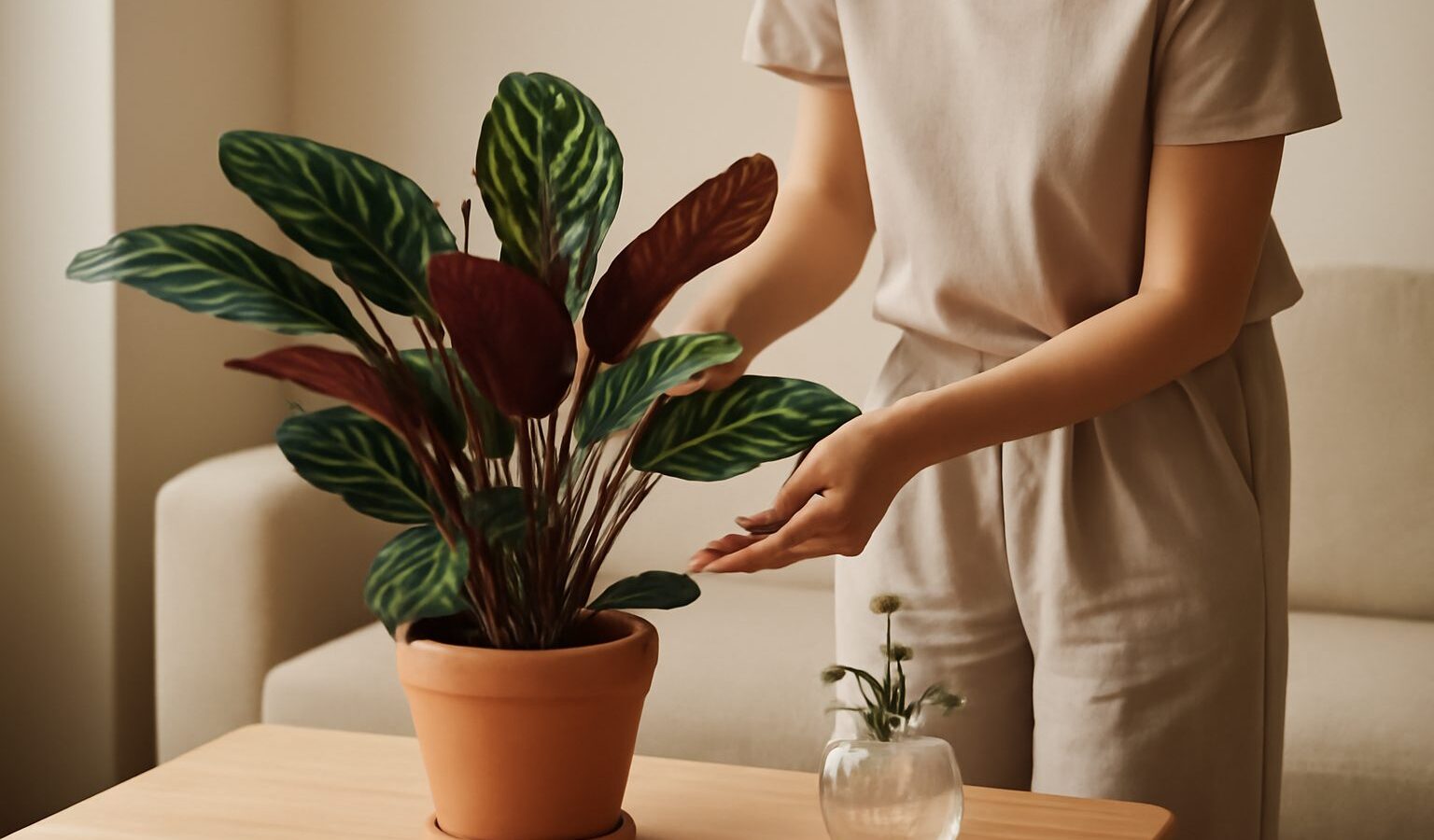
Calatheas are the plant world’s living artwork, with leaves patterned in stripes, feathers and blushes of pink or purple that many painted fabrics would envy. They also have a reputation for being fussy, but honestly, calathea care in Singapore is often easier than in colder countries, because our warm, humid air is exactly what these rainforest plants crave. The trick is understanding what they dislike: harsh sun, dry aircon draughts and hard, stagnant water. Get those right in your HDB flat or condo and a calathea will unfurl beautiful new leaves that even fold up at night, giving the whole prayer plant group its charming nickname.
Meet the Prayer Plants
Calatheas, and their close cousins now often sold under the name goeppertia, belong to a family of tropical plants known as prayer plants. The name comes from a daily rhythm: many raise and lower their leaves through the day, so they lie flat to catch morning light and fold upward at dusk like hands in prayer. That movement is a good sign of a healthy, contented plant.
Popular types you will see at a garden centre include the rattlesnake calathea with wavy edged leaves, the peacock calathea with feathery markings, the round leaved orbifolia, and the deep maroon undersides of others. They all want broadly the same care, so once you learn one, you can grow the lot. Unlike many aroids, calatheas are generally regarded as non-toxic to cats and dogs, which makes them a reassuring choice for a home with pets, though it is always wise to discourage nibbling of any houseplant.
Light and Placement in a Bright Flat
The single most common mistake is too much light. In the wild, calatheas live on the shaded forest floor, so direct Singapore sun quickly bleaches their patterns and scorches the edges. Give them bright, indirect light instead: a spot a metre or two back from a window, behind a sheer curtain, or in a well lit interior corner. An east-facing window with gentle morning light suits them, while a hot, unshaded west balcony does not.
If the colours fade to plain green, the plant is likely getting too much light or too little; adjust and watch. Calatheas also dislike being moved around constantly, so once you find a settled spot they are happy with, leave them be. Keep them away from the direct blast of an aircon or a fan, as moving dry air is one of their biggest enemies indoors.
Watering, Humidity and Soil
Here is where calatheas earn their diva label, though it is really about consistency. They like the potting mix to stay lightly and evenly moist, never bone dry and never waterlogged. Check the top centimetre or two: when it starts to feel dry, water thoroughly until it drains from the base, then empty the saucer. Do not let a saucer sit full of water, both because soggy roots rot and because standing water breeds Aedes mosquitoes, so tip it out and change any standing water at least weekly in line with NEA guidance.
Water quality matters more for calatheas than for tougher plants. They can react to the minerals and chlorine in tap water with crispy brown tips, so many growers use rainwater, or tap water left to stand overnight. If you harvest rainwater, keep the store covered and sealed to stop mosquitoes breeding, and check current NParks, PUB and NEA guidance.
Humidity is your secret weapon in Singapore. These plants love it above roughly sixty per cent, which our outdoor air easily provides, though aircon indoors can dry things out. Group plants together, use a tray of damp pebbles topped up regularly, or keep them in a naturally humid, bright room. Plant into a light, airy mix based on quality potting soil with added perlite and a little bark or coco coir, in a pot with drainage holes.
Feeding and Repotting
Calatheas are not heavy feeders. During the warm growing season, which for us runs almost year round, a balanced liquid fertiliser at half the labelled strength once a month is plenty. They are sensitive to salt build-up, so avoid overfeeding and flush the pot occasionally with plain water to rinse out excess.
Repot every year or two, in the warmer, brighter part of the year, moving up just one pot size so the roots are not swimming in wet mix. This is also the moment to divide a large clump, which is the main way to make more calatheas. Gently separate the plant into sections, each with roots and leaves, then pot them up and keep them warm, humid and shaded while they recover. Trim off any tired outer leaves at the base with clean scissors.
Fixing Common Calathea Problems
Most calathea complaints show up in the leaves, and the causes are usually water related. Work through the table below, change one factor, and give the plant a couple of weeks before judging the result. New leaves emerging healthy is your sign the fix worked; old damaged leaves will not repair, so you can trim them once fresh growth is coming through.
| Symptom | Likely cause | What to do |
|---|---|---|
| Crispy brown leaf edges | Dry air or minerals in tap water | Raise humidity, switch to rainwater or stood water |
| Curling, tightly rolled leaves | Underwatering or too much heat and sun | Water evenly, move to cooler bright shade |
| Yellowing lower leaves | Overwatering or a soggy pot | Let the top of the mix dry, check drainage |
| Faded, washed-out pattern | Too much direct light | Move back from the window to indirect light |
| Fine webbing, speckled leaves | Spider mites in dry air | Rinse leaves, raise humidity, use insecticidal soap |
For pests such as spider mites, which thrive in dry aircon air, start gently: rinse the foliage, raise humidity, then use insecticidal soap or a neem-based spray if they persist. If you turn to any stronger product, follow its label exactly, keep it away from children and pets, and ventilate the room.
Enjoying Your Calathea Long Term
Calatheas reward attention rather than neglect, so a few minutes of observation each week goes a long way. Watch whether the leaves fold up at night, feel the mix before watering, and wipe dust off the broad leaves so they can breathe and show their colours. On a balcony, keep pots secured against wind and follow your HDB, town council or condo rules for shared spaces. Start with one easy variety, learn its rhythm in your particular flat, and you will soon see why these prayer plants have such a devoted following.
Explore more
For more lush, humidity-loving foliage, read our guides to caring for ferns in Singapore and caring for peace lilies. If you want to try bolder leaf shapes next, see caring for alocasia and aroids.