
For many people who grew up in mainland China, the scent of sweet osmanthus, 桂花 (guìhuā), means autumn. It drifts through parks in Hangzhou, Guilin and Suzhou around the Mid-Autumn Festival and turns up in tea, wine and sticky rice cakes. After moving here, it is natural to want that scent on your balcony too. The good news is that an osmanthus plant in Singapore can grow well. The honest news is that it behaves differently from the trees you remember, and a little adjustment goes a long way.
This guide explains what changes in the tropics, which type to choose, and how to care for it in a pot at an HDB flat, condo or landed home.
How Singapore Differs From Osmanthus Country
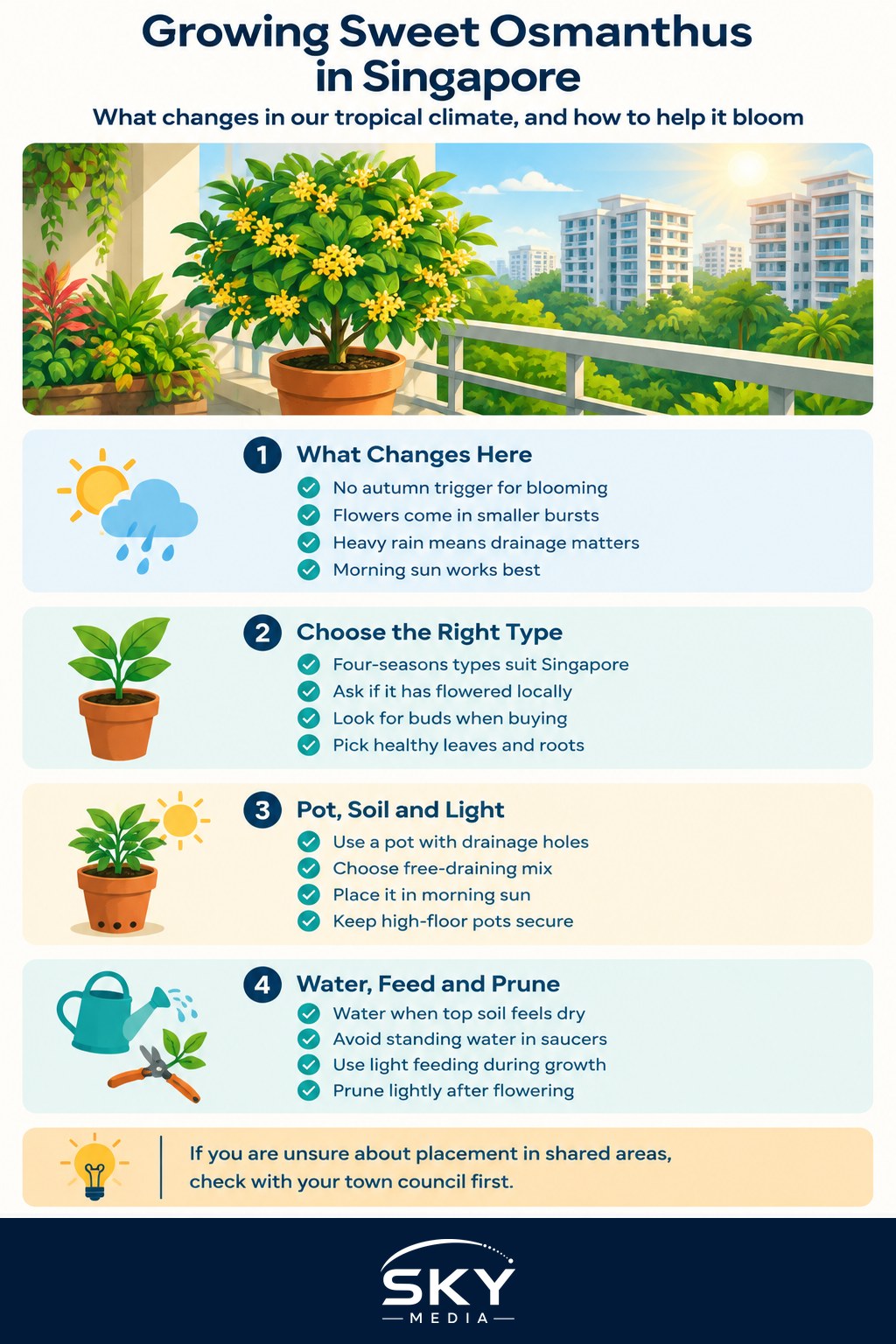
Sweet osmanthus (Osmanthus fragrans) is native to southern and central China, where it enjoys warm, wet summers and a cooler autumn. In much of China, that drop in temperature helps trigger the main flush of flowers. Singapore has no autumn. It is hot and humid all year, with heavy rain in the monsoon months.
The result is that osmanthus here tends to flower in smaller, scattered bursts rather than one dramatic season. Some plants flower several times a year; others mostly grow leaves. Do not be discouraged if your plant does not perfume the whole block in September. A few clusters of tiny flowers on a balcony are still enough to fill a room.
| Factor | Typical conditions in central China | Conditions in Singapore | What it means for you |
|---|---|---|---|
| Temperature | Hot summer, cool autumn, cold winter | Warm to hot all year | Fewer, smaller flower flushes; choose a repeat-flowering type |
| Rainfall | Seasonal | Frequent heavy rain, high humidity | Excellent drainage is essential to avoid root rot |
| Sunlight | Strong summer sun, softer in autumn | Intense overhead sun most days | Full morning sun is ideal; very harsh afternoon sun can scorch pots |
| Soil | Often slightly acidic, loamy | Potting mix you choose | Use a free-draining mix, slightly acidic if possible |
Choosing the Right Type of 桂花
In China, gardeners usually talk about four main groups, and knowing them helps when you shop:
- 金桂 (jīn guì): golden-yellow flowers, strongly fragrant, the classic autumn type.
- 银桂 (yín guì): pale cream or white flowers, sweet and light scent.
- 丹桂 (dān guì): orange to reddish flowers, very striking colour.
- 四季桂 (sì jì guì): the “four seasons” type, which flowers on and off through the year.
For Singapore, the four-seasons type is usually the most rewarding, because it is less dependent on a cool spell to bloom. Plant labels at local nurseries are not always detailed, so ask the seller whether the plant has flowered in Singapore before, and whether it is a repeat-flowering kind. A plant that is already in bud when you buy it is a good sign it has adjusted to local conditions.
Look for a healthy plant with dark green, glossy leaves, no sticky residue or white specks on the undersides, and roots that are not circling tightly out of the drainage holes.
Pot, Soil and Position
Most newcomers will grow osmanthus in a container, and it suits pots well.
Pot. Start with a pot only slightly larger than the nursery pot, with several drainage holes. Terracotta breathes and dries faster, which helps in the wet months; plastic holds moisture longer and is lighter for high floors. Raise the pot on feet so water drains freely.
Soil. Osmanthus dislikes waterlogged roots. Mix a good potting soil with extra perlite or coarse bark so water runs through quickly. It prefers slightly acidic conditions, so a mix sold for acid-loving plants, or the addition of some composted bark, can help.
Light. Aim for at least four to six hours of direct sun, ideally in the morning. An east-facing corridor or balcony often works well. If your space gets fierce afternoon sun reflecting off concrete, watch for scorched, yellowing leaf edges and move the pot slightly back if needed. In deep shade, the plant may survive but rarely flowers.
Placement rules. If you live in an HDB flat, remember that common corridors must be kept clear for fire safety. Your town council sets the rules for plants in shared areas, so check with them before placing a large pot outside your door. Secure pots on ledges and high balconies so they cannot fall.
Watering, Feeding and Pruning
Watering. Water deeply when the top two to three centimetres of soil feel dry, then let excess drain away. In dry spells this may be daily; during the rainy season, an outdoor pot may need very little extra water. Never leave the pot standing in a saucer of water.
Feeding. During active growth, use a balanced slow-release fertiliser or a diluted liquid feed at the strength on the label. Once the plant is established and you want flowers, a feed slightly higher in phosphorus and potassium can encourage buds. Too much nitrogen gives lots of leaves and few flowers. Organic options such as compost or well-rotted manure in small amounts also work.
Pruning. Osmanthus is slow-growing, so prune lightly. Remove dead or crossing branches and trim after a flush of flowering to keep a compact shape. Avoid hard pruning just before you hope for flowers, as buds form on existing growth.
Repotting. Every two to three years, or when roots fill the pot, move up one size and refresh the soil.
Pests, Problems and Fixes
In Singapore’s humidity, osmanthus is fairly tough, but watch for a few common issues:
- Scale insects and mealybugs: small bumps or white fluffy spots on stems and leaf undersides, often with sticky honeydew. Wipe them off with a cloth or cotton bud, and use a horticultural soap or oil if they persist.
- Spider mites: fine speckling and webbing in hot, dry spots. Rinse the leaves, especially undersides, and raise humidity around the plant.
- Yellow leaves: often too much water or poor drainage. Check that the pot drains and let the soil dry slightly.
- No flowers: usually too little sun, too much nitrogen, or a type that needs cooler weather. More light and patience usually help.
Keep fallen leaves and saucers clear, and do not let water collect anywhere. NEA asks every household to prevent stagnant water to stop mosquito breeding, and plant saucers are a common culprit.
Enjoying the Flowers: Tea, Desserts and Scent
When your plant does flower, the tiny blossoms last only a few days. Many people enjoy them simply by bringing the pot indoors for an evening. If you want to use the flowers in food, such as 桂花糕 (osmanthus cake), 桂花茶 (tea) or a spoon of homemade osmanthus syrup over 酒酿 (sweet fermented rice), only use flowers from a plant that has not been sprayed with pesticides. Shake them gently onto a clean cloth, pick out leaves and stalks, and use them fresh or dry them in a cool, airy place. If you have any allergy concerns, check with a doctor first.
Dried osmanthus and osmanthus syrup are also easy to find in Chinese supermarkets and dried goods shops in Singapore, so you can enjoy the flavour while your own plant settles in.
Pairing Osmanthus With Other Tropical Plants
Osmanthus works well as the fragrant centrepiece of a small container garden. Pair it with plants that share similar sun and drainage needs. Our wider guide to gardening in Singapore’s tropical climate explains local soil, light and rain patterns in more detail. If you have room for something bolder and lower maintenance, heliconias and other tropical flowers thrive with almost no adjustment. And if you hope to grow a taste of home alongside the scent, see our guide to growing guava and tropical fruit trees in pots.
With good drainage, plenty of morning sun and some patience, your osmanthus can become a small, fragrant link between your old home and your new one.
Further reading: Growing Crown of Thorns (Euphorbia Milii) in Singapore