

Perched on a gentle rise near Mohamed Sultan Road, the Hong San See Temple is widely regarded as one of the most beautiful traditional Chinese temples in Singapore. A national monument built by the Hokkien community, it is a masterwork of southern Chinese temple craftsmanship and a serene retreat from the busy river district around it. The Hong San See Temple Singapore experience rewards anyone with an eye for detail and a love of heritage.
What It Is and Who It Serves
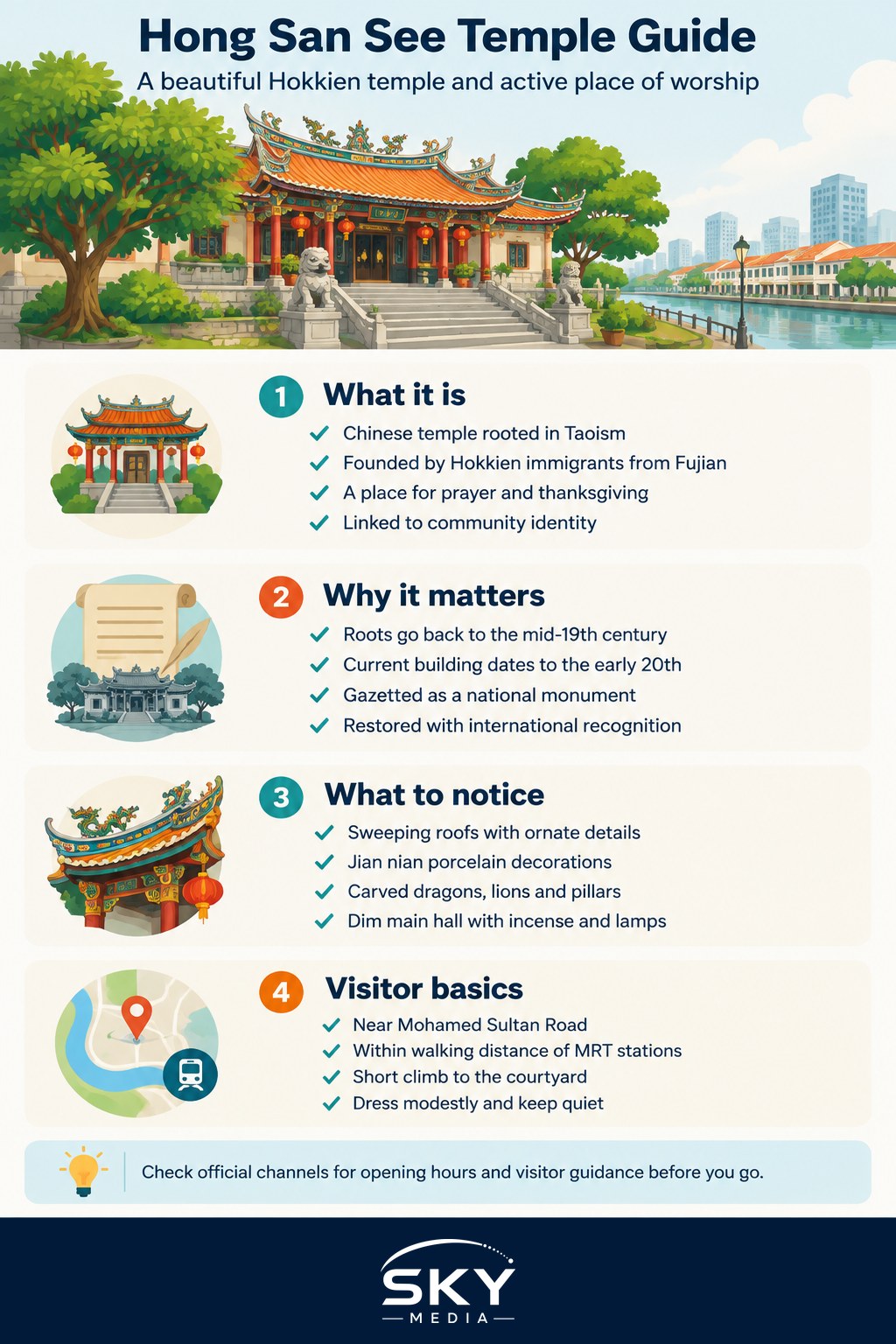
Hong San See, whose name can be understood as temple on Phoenix Hill, is a Chinese temple rooted in the traditions of Taoism and Chinese folk religion. It was founded by immigrants from the Nan An district of Fujian province, part of the wider Hokkien community that formed one of the largest dialect groups among Singapore’s early Chinese settlers. The temple is principally associated with the veneration of a revered deity brought from the ancestral homeland, and it has long served as both a place of worship and a focal point of community identity.
For Chinese folk religion, temples like this are where the sacred and the social meet. Devotees come to pray for blessings, health, and good fortune, to give thanks, and to mark festivals. The temple also functioned historically as a gathering point that helped a migrant community maintain its bonds far from home. Those keen to understand this tradition more fully may enjoy our guide to Chinese temples and Taoism in Singapore.
History and Significance
The temple’s roots stretch back to the mid-nineteenth century, and the present building was constructed in the early twentieth century on its elevated site. Its architectural and cultural value has been formally recognised, and it has been gazetted as a national monument. In more recent times, a careful and highly regarded restoration returned the temple to its full splendour, work that earned international conservation recognition for the sensitivity and skill involved.
That combination of authenticity and expert restoration is what makes Hong San See so significant. It is not a reconstruction or a replica but a genuine historic temple, lovingly maintained. It stands among the finest examples of Hokkien temple architecture in the region and takes a deserved place among the country’s most admired national monuments in Singapore.
Architecture and Notable Features
Hong San See is a showcase of southern Chinese temple art. Its roofs sweep upward at the eaves and are crowned with intricate decorations, including dragons and mythological figures crafted in the cut-and-paste porcelain technique known as jian nian. The timber structure is held together in the traditional manner, and the beams, brackets, and panels are richly carved with scenes from legend and history.
Visitors will notice finely detailed stone carvings at the entrance, including guardian lions and pillars wrapped with sculpted dragons, as well as painted door gods that watch over the threshold. Inside, the main hall is atmospheric and dim, lit by the glow of lamps and the smoke of incense, with the principal deity enshrined at the centre. Every element, from the granite columns to the ceramic figures on the ridge, reflects the devotion and craftsmanship of the artisans who created it.
Its Role Today
Today Hong San See remains an active temple, observing its calendar of prayers and festivals and welcoming devotees who continue to seek blessings there. Its elevated, tranquil setting, framed by mature trees and just a short walk from the Singapore River, also makes it a favourite with heritage enthusiasts, photographers, and students of architecture. It manages to be at once a living religious site and a celebrated cultural treasure, honouring its congregation while opening a window onto tradition for all who visit.
How to Get There
The temple sits near Mohamed Sultan Road, in the vicinity of the Singapore River and the River Valley area. The nearest MRT stations include Fort Canning and Clarke Quay, both within a reasonable walk. Buses serving the River Valley and surrounding roads also bring visitors close by. Because the temple is set slightly above street level, a short climb brings you to its peaceful courtyard.
As this is a working temple with its own schedule, check the official channels for current opening hours and any visitor guidance before you go. Do not depend on unofficial sources for such details.
Respectful Visitor Etiquette
Hong San See is an active place of worship, so approach it with quiet respect. Dress modestly, keeping shoulders and knees covered. Speak softly, and be mindful not to disturb anyone who is praying or making offerings. If you wish to take photographs, be considerate, avoid using flash near worshippers, and ask temple staff if you are unsure whether photography is permitted in a particular area.
Do not touch the altars, statues, offerings, or ritual objects, and take care around burning incense and candles. If you choose to observe rather than participate, that is entirely appropriate. Always defer to any signs and to the guidance of the temple caretakers. For a broader primer before your visit, see our notes on temple worship etiquette for newcomers.
Whether you come to pray or simply to admire, Hong San See Temple offers one of the most rewarding encounters with Chinese heritage that Singapore has to offer.
Frequently Asked Questions
What does the name Hong San See mean and which deity is worshipped there? Hong San See can be understood as the temple on Phoenix Hill. It was founded by Hokkien immigrants from the Nan An district of Fujian, and it is principally associated with a revered deity brought from the ancestral homeland. Check the temple’s official channels for details on its deities.
What is jian nian and where can I see it at the temple? Jian nian is the cut-and-paste porcelain technique used to make decorative figures. At Hong San See you can see it on the upswept roof ridges, where dragons and mythological figures crown the eaves. Look up as you enter the courtyard.
Is the temple suitable for photographers and architecture students? Yes, the carved beams, stone guardian lions, dragon pillars and painted door gods are all of interest. Be considerate, avoid flash near worshippers, and ask staff if photography is allowed in a particular area. Respect people who are praying.
How steep is the climb to the temple, and is it accessible for seniors? The temple sits slightly above street level, so there is a short climb to the courtyard. Seniors or those with limited mobility may want to take it slowly or check ahead with the temple about access. Wear comfortable shoes.
Can I light incense or pray if I am not Taoist? Visitors are welcome to observe, and joining in is a personal choice. If you wish to pray, ask the caretakers how it is done and take care with burning incense and candles. Observing quietly is equally appropriate.
Further reading: Leong San See Temple · Kong Meng San Phor Kark See Monastery