
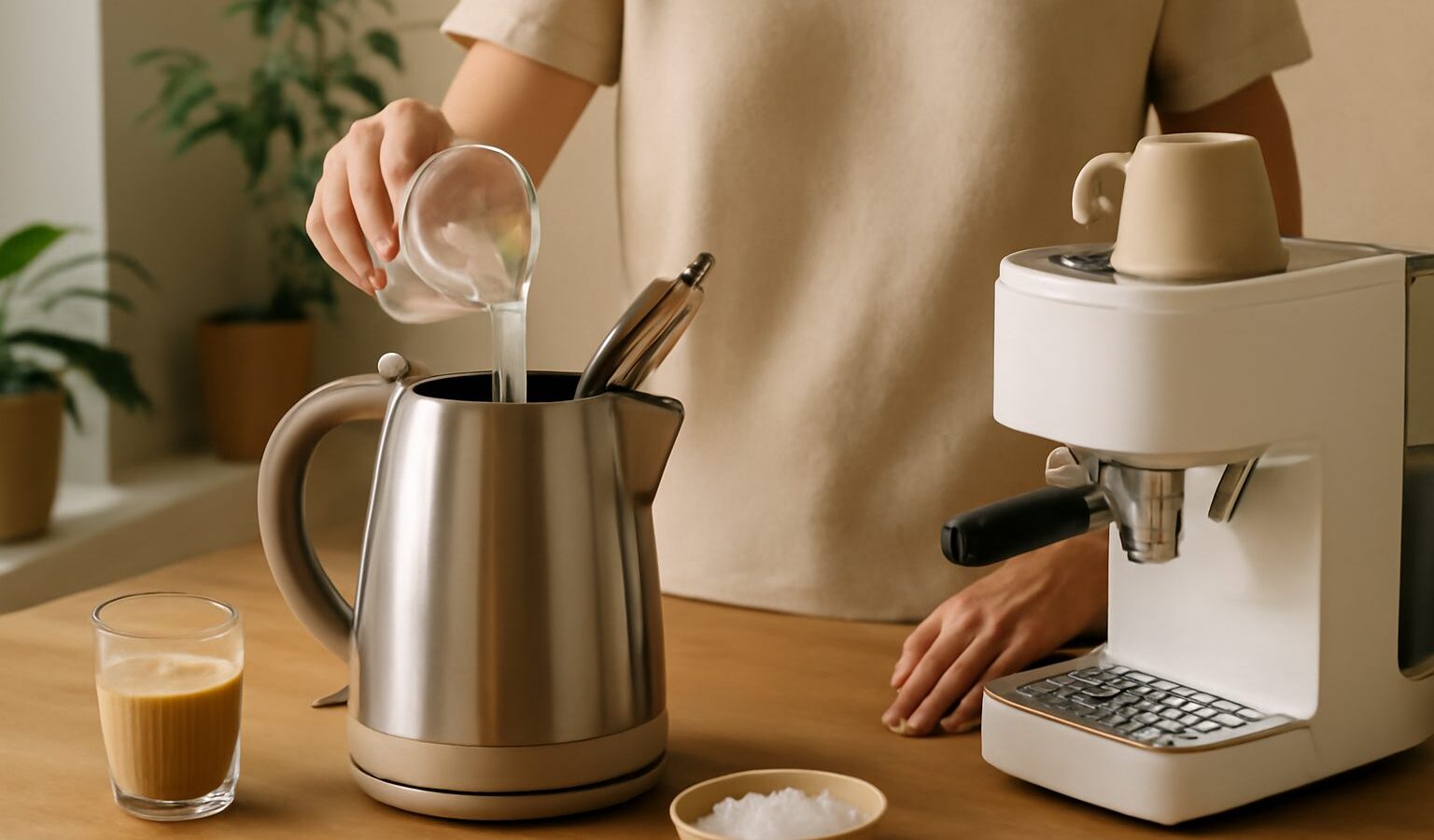
If your morning brew tastes flat or your kettle takes forever to boil, mineral build-up is usually the culprit. Learning to descale your kettle and coffee machine keeps both appliances efficient, saves electricity, and protects the taste of every cup. It is a ten-minute job with items you already have in the kitchen.

Why Limescale Forms
Limescale is the chalky white or greenish crust that appears inside kettles, on heating elements, and around the water tank of a coffee machine. It comes from dissolved calcium and magnesium in tap water. Singapore water is treated and relatively soft, but repeated boiling concentrates minerals and slowly leaves deposits behind. Over time this crust insulates the heating element, so the appliance works harder, uses more power, and heats less evenly. Left long enough, it can clog the narrow tubes inside a coffee machine and cause weak, lukewarm coffee.
The good news is that limescale dissolves easily in a mild acid. You do not need a branded descaler. White vinegar or food-grade citric acid does the job for a few cents.
Safety First
Before you start, keep these rules in mind.
- Always unplug the appliance and let it cool fully before cleaning. Never pour liquid into a switched-on kettle or a hot machine.
- Never mix bleach with vinegar or any other cleaning chemical. The fumes are dangerous. Descaling uses acid on its own, and water, nothing else.
- Ventilate the kitchen. Open a window or switch on the exhaust fan, as warm vinegar has a sharp smell.
- Let every part dry fully before you reassemble or store it. In our humid climate, trapped moisture invites mould and odour.
- Check your appliance manual first. A few machines, especially those with aluminium parts, advise against vinegar and prefer citric acid.
How to Descale Your Kettle
This method works for both plastic and stainless steel electric kettles.
- Empty the kettle and unplug it.
- Fill it halfway with a mix of equal parts white vinegar and water. For a badly furred kettle, use slightly more vinegar.
- Boil the solution, then switch the kettle off and unplug it.
- Leave it to soak for 30 to 60 minutes. You will see the crust loosen and float.
- Pour the solution out. Use a soft sponge or an old toothbrush to wipe away any stubborn patches around the base and element. Do not scrape metal elements with anything hard.
- Rinse two or three times with clean water. To clear any lingering smell, boil a full kettle of fresh water and discard it, then repeat once.
- Wipe the outside and leave the lid open to air-dry.
For a citric acid version, dissolve one to two tablespoons of citric acid powder in a full kettle of water, boil, soak for 20 minutes, then rinse. Citric acid leaves almost no odour, which many people prefer.
How to Descale a Coffee Machine
The steps vary slightly by type, but the principle is the same: run a mild acid through the water path, then flush thoroughly.
Drip and filter machines
- Empty the carafe and remove any coffee grounds and the paper filter.
- Fill the water tank with equal parts water and white vinegar, or a citric acid solution.
- Run half a brewing cycle, then pause the machine for 30 minutes so the solution sits in the tubes.
- Finish the cycle, discard the liquid, then run two or three full cycles of clean water to rinse out all traces of acid.
Pod and espresso machines
- Follow the manufacturer instructions, as many have a built-in descaling mode.
- Fill the tank with descaling solution or a citric acid mix rather than strong vinegar, which some seals dislike.
- Run the cycle into a large container, let it rest, then flush with several tanks of clean water.
- Wash the drip tray, pod holder, and removable parts in warm soapy water and dry them fully.
Taste the first coffee after descaling. If you notice any sourness, run one more clean water cycle.
How Often Should You Descale
Frequency depends on how often you use the appliance and how much you notice build-up.
| Appliance | Light use | Daily use | Warning signs |
|---|---|---|---|
| Electric kettle | Every 2 months | Monthly | White flakes, slow boil, spots on water |
| Drip coffee machine | Every 2 to 3 months | Monthly | Slow drip, weak coffee, longer brew time |
| Pod or espresso machine | Every 3 months | Every 4 to 6 weeks | Descale light on, sputtering, cooler coffee |
Mark a reminder on your phone so it does not slip. Regular light descaling is far easier than tackling a thick crust once a year.
Extra Tips for Better Results
- Empty the kettle after each use rather than leaving standing water, which speeds up deposits.
- Use filtered or boiled-and-cooled water in your coffee machine if you want to slow build-up.
- Wipe the outside of both appliances weekly with a damp cloth to keep them looking clean.
- Store the kettle with the lid open so the inside dries out between uses.
- Keep a small tub of citric acid in the pantry. It is cheap, odourless, and works on shower heads and tiles too.
A Quick Note on Coffee Oils
Descaling clears minerals, but coffee machines also collect oily residue from the beans. Once a month, wash the carafe, filter basket, and any removable spouts with warm water and a little dish soap. This stops rancid oils from tainting the flavour, which no amount of descaling will fix.
Keep Every Brew Fresh
Descaling is one of those small habits that quietly pays off. Your kettle boils faster, your coffee tastes brighter, and your appliances last years longer. Set a simple reminder, keep vinegar or citric acid handy, and the whole job becomes a painless part of your kitchen routine.
Explore more: Deep clean your kitchen · Clean your fridge properly · Build a home cleaning routine
Frequently Asked Questions
Is it safe to drink from a kettle that has just been descaled? Yes, provided you rinse it thoroughly and boil and discard fresh water once or twice first. Leftover acid can leave a sour taste and smell. If the taste lingers, rinse and boil again until the water tastes completely neutral.
Should I use vinegar or citric acid to descale? Both work, so it comes down to preference and your appliance manual. Vinegar is easy to find but leaves a strong smell, while citric acid is nearly odourless and gentler on some parts. Aluminium parts and some seals suit citric acid better.
Can I descale a kettle with a stainless steel or glass interior the same way? Yes, the same mild acid method works on stainless steel and glass kettles. Avoid steel wool or hard scrapers, which scratch the surface. If your model has a plastic or mixed interior, check the manual before using vinegar.
What happens if I never descale my kettle or coffee machine? Scale thickens over time, so the appliance takes longer to heat, wastes electricity and may heat unevenly. In a coffee machine, it can block the narrow tubes and the coffee comes out weak or lukewarm. In the worst case, the heating part can fail early.
When is a coffee machine too far gone for descaling at home? If water barely flows, the machine leaks, makes loud noises or shows an error after descaling, there may be a blockage or a fault. Stop and check the manual or the manufacturer’s service channel. Repeated forceful attempts can damage seals.
Further reading: Choosing a Kettle for Your Kitchen · Choosing a Coffee Grinder