
Few things say more about Singapore’s soul than a plate shared across a banana leaf. Indian food in Singapore is not one cuisine but many, brought over generations and settled into the island’s everyday rhythm. Whether you grew up here or arrived last month, this guide walks you through the broad families of dishes, where they thrive, and how to order and eat them with confidence and respect.
The Indian community here traces roots to many regions, and the food reflects that. You will find delicate South Indian vegetarian cooking sitting a few doors from rich North Indian curries, and a distinctly local Indian-Muslim tradition that many Singaporeans simply call mamak. Understanding these threads makes ordering far less daunting and a lot more rewarding.
The Big Three: South Indian, North Indian, and Indian-Muslim
At its simplest, it helps to think of Indian food in Singapore in three broad streams. None is better than the others, and plenty of eateries blur the lines, but the framing gives you a map.
South Indian cooking leans toward rice, lentils, and a wonderful range of vegetarian dishes. Flavours tend to be lighter and tangier, with coconut, curry leaves, mustard seed, and tamarind doing much of the work. This is the home of the dosa and the banana leaf meal.
North Indian cooking brings the dishes many newcomers already know: creamy curries, tandoori grills, breads such as naan and roti, and fragrant rice. Expect more dairy, wheat, and warming spice, and richer gravies built on onion and tomato.
Indian-Muslim food is a Singapore and Malaysia specialty, sometimes called mamak fare. It is where roti prata, murtabak, and teh tarik live, along with hearty biryani and briyani-style rice. It is casual, generous, and open at all hours in many neighbourhoods.
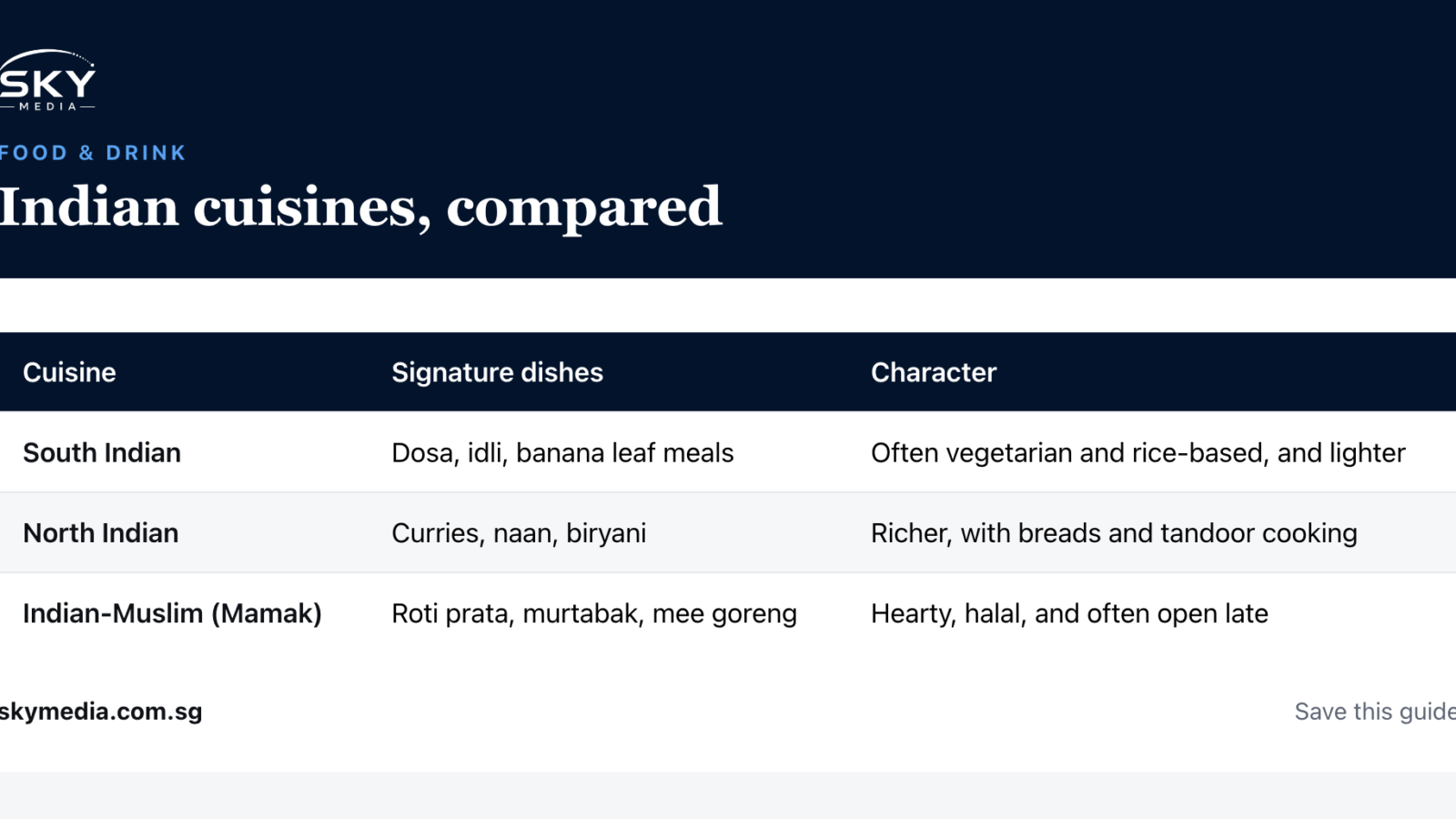
Here is how the big three compare:
| Cuisine | Signature dishes | Character |
|---|---|---|
| South Indian | Dosa, idli, banana leaf meals | Often vegetarian and rice-based, and lighter |
| North Indian | Curries, naan, biryani | Richer, with breads and tandoor cooking |
| Indian-Muslim (Mamak) | Roti prata, murtabak, mee goreng | Hearty, halal, and often open late |
South Indian: Dosa, Idli, and the Banana Leaf Meal
If you try only one thing from the south, make it a dosa. This is a large, crisp, savoury crepe made from fermented rice and lentil batter, often folded around a spiced potato filling to become a masala dosa. It arrives with small bowls of sambar, a soupy lentil and vegetable stew, and a couple of chutneys such as coconut and tomato. Tear off a piece, scoop, and eat.
Alongside the dosa you will meet its gentle cousins. Idli are soft, steamed rice cakes, mild and comforting, ideal if you prefer something easy on the palate. Vada are savoury fried lentil doughnuts with a crisp shell. Uttapam is a thicker, softer pancake studded with onion and chilli. All of these pair with the same sambar and chutneys, so a first-timer can order a small spread and taste widely.
The grand version of a South Indian meal is served on a banana leaf. A fresh leaf is laid before you, and rice is heaped in the centre with a rotating cast of vegetable curries, dhal, sambar, rasam, pickle, and pappadum around the edge. Many banana leaf spreads are vegetarian, though some places offer fish, mutton, or chicken as add-ons. Refills of rice and the vegetable sides are often included, so pace yourself.
A quick etiquette note on the banana leaf: when you have finished, fold the leaf toward yourself, from the far edge inward. In local custom, folding it this way is the polite signal that you enjoyed the meal.
North Indian: Curries, Naan, and Biryani
North Indian menus reward slow, shared eating. Order a couple of gravies, a bread or two, and some rice, then pass everything around. Popular curries include butter chicken and its milder tomato-cream family, palak paneer with spinach and cheese, dhal makhani, and various mutton and chicken masalas. Vegetarians are well served here, with paneer, chickpeas, and vegetable dishes in abundance.
The breads are half the joy. Naan is the soft, pillowy tandoor-baked bread, plain or brushed with garlic or butter. Roti and chapati are wholemeal flatbreads, a little chewier and less rich. Use them to scoop, not stab.
Then there is biryani, a celebration in a single dish. Layered rice is cooked with spices and marinated meat or vegetables until fragrant and gently steamed together. Versions differ across communities, and you will find both North Indian and Indian-Muslim takes across the island. It usually comes with a cooling raita of yoghurt and cucumber, and perhaps a hard-boiled egg or a small curry on the side. It is filling, so one portion often satisfies a hungry person on its own.
Indian-Muslim and Mamak Favourites
Roti prata is the dish many locals grew up on. It is a fried, flaky flatbread, crisp at the edges and soft within, served with a dish of curry for dipping. Order it plain, or ask for an egg version, or go sweet with a little sugar. It is popular for breakfast and again late at night.
Murtabak is prata’s stuffed, hearty relative: dough folded around minced meat, onion, and egg, then griddled and cut into squares. It is a meal in itself. To drink, reach for teh tarik, a strong, sweet milk tea that is theatrically pulled between two cups to build its frothy top. Its coffee cousin is kopi styled the Indian-Muslim way.
Vegetarian and Halal Notes
Two practical points make ordering much easier.
- Vegetarian dining is genuinely easy. South Indian eateries in particular often serve entirely vegetarian menus, and vegetarian eating is woven into the tradition rather than treated as an afterthought. If you avoid dairy too, ask specifically, since ghee, butter, paneer, and yoghurt appear often.
- Halal options are widespread, especially within the Indian-Muslim stream, where prata, murtabak, biryani, and teh tarik are staples. Not every Indian eatery is halal-certified, though, so if this matters to you, look for certification or ask the staff directly rather than assuming.
Where It Thrives
The heartland of Indian food in Singapore is Little India, a lively district where the aromas of spice shops, garland stalls, and busy kitchens fill the streets. It is the natural place to browse for little india food, from a quick dosa breakfast to a leisurely banana leaf lunch to late-night prata. That said, you certainly do not need to travel there to eat well. Prata shops, biryani stalls, and North Indian restaurants are spread across housing estates, hawker centres, food courts, and malls all over the island.
How to Order and Eat
Newcomers sometimes feel unsure about the how, so here is a short, friendly checklist.
- Start small and share. Order one bread, one gravy, and one rice or dosa between two people, then add more once you know what you love.
- Ask about spice. Many kitchens will adjust heat, and staff are usually happy to point you to milder or richer dishes.
- Eating with your hands is welcome, especially with a banana leaf meal or prata. Use your right hand, mix a little rice with gravy using your fingertips, and enjoy. A spoon and fork are always fine too, so do whatever feels comfortable.
- Sip something cooling. A mango lassi, a plain yoghurt lassi, or a teh tarik balances a spicy plate nicely.
Dishes Newcomers Should Try First
If you are just getting started, this shortlist covers the breadth without overwhelming you:
- Masala dosa, for a crisp, savoury introduction to the south.
- Banana leaf meal, for a full, shared, mostly vegetarian experience.
- Butter chicken with garlic naan, for an approachable North Indian classic.
- Biryani, for a fragrant, satisfying one-plate meal.
- Roti prata with curry, for the beloved local everyday favourite.
Take it dish by dish and you will build your own map soon enough. Indian food in Singapore is deep, warm, and endlessly generous, and the best way to learn it is simply to pull up a chair, order a little of everything, and eat.
Explore more: Must-try hawker food in Singapore · A guide to halal food in Singapore · Singapore’s ethnic enclaves