
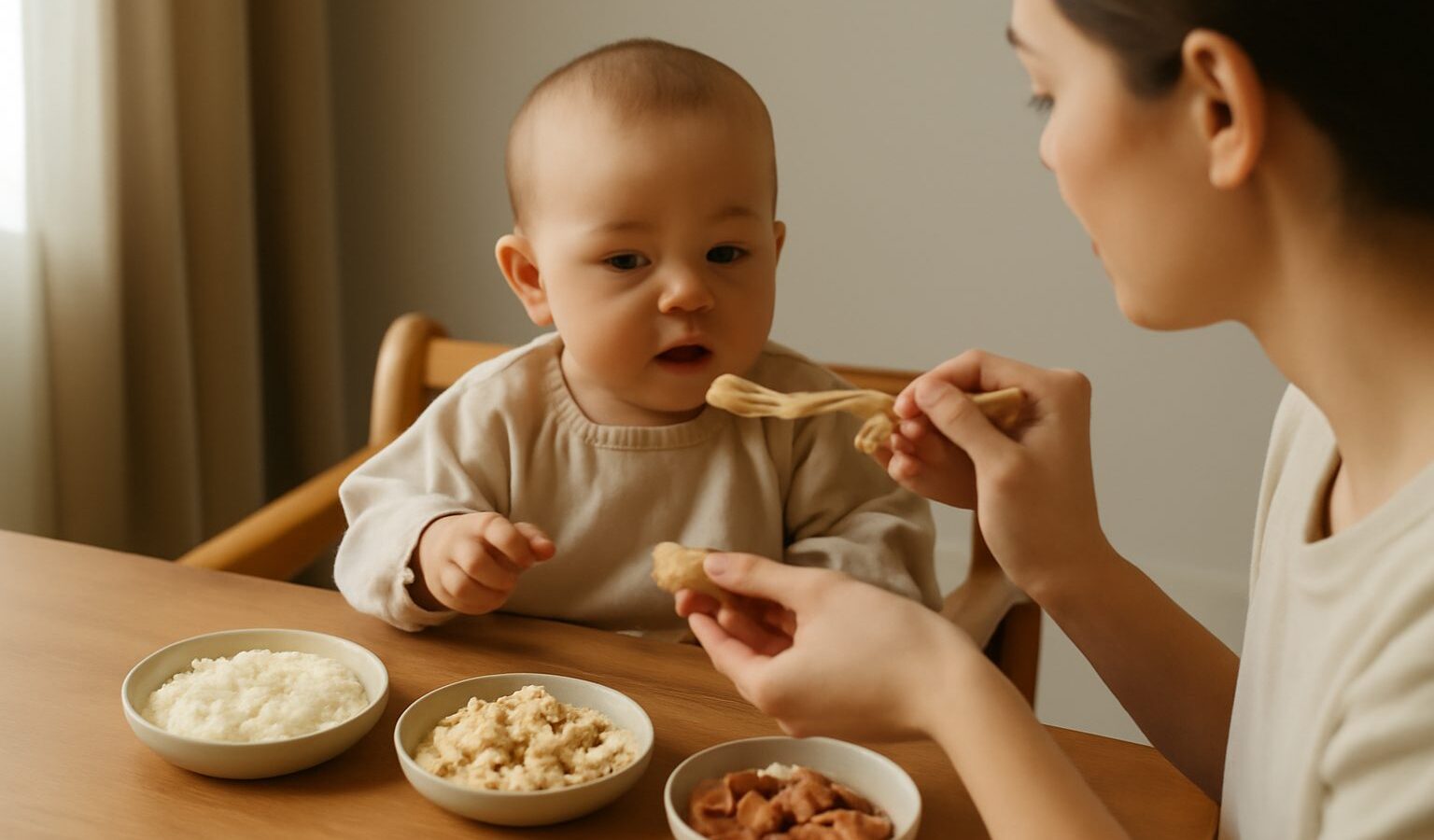
Few parts of weaning make new parents pause quite like introducing allergenic foods. You have finally got the hang of purees or finger foods, and now you are being told to offer your baby egg, peanut and shellfish, the very things you may have been taught to fear. If you feel a flutter of worry each time you open the fridge, you are in good company. This is one of the most common questions tired parents bring to their polyclinic or paediatrician, and it deserves a calm, unhurried answer.
This guide is general information for Singapore families, not medical advice. Every baby is different, and your own doctor knows your child’s history, family background and health. Please treat what follows as a way to feel more confident asking questions, and always follow the guidance of your paediatrician, KKH, NUH or your polyclinic doctor for your particular child.
What “allergenic foods” actually means
Allergenic foods are simply the foods most often linked to allergic reactions. The usual ones parents hear about include egg, peanut and other tree nuts, cow’s milk, wheat, soy, fish and shellfish, and sesame. In multicultural Singapore, sesame and shellfish come up often because they appear so early in local cooking, from oyster sauce to prawn noodles to sesame oil chicken.
An allergy is different from a simple dislike or a tummy that is still learning. A true food allergy involves the immune system reacting to a food. Most babies will never develop one. For those who do, the reaction is usually mild, and knowing what to look for helps you respond calmly rather than fearfully.
Current thinking has shifted a great deal over the last decade. Where parents were once told to delay these foods, the general direction of guidance now is that introducing common allergens in the first year, alongside other solids, may be helpful rather than harmful for most babies. This is exactly the kind of area where advice keeps evolving, so ask your doctor what the latest local guidance says for your child rather than relying on what an older relative remembers.
When and how to begin
Introducing allergenic foods usually fits into the same window as starting other solids, once your baby is showing signs of readiness and your doctor agrees it is time. If you have not started solids yet, it helps to read our guide on starting solids and baby-led weaning first, then fold allergens into that same gentle process.
A calm, practical approach many families find reassuring:
- Start when your baby is well. Choose a day when your little one is not feverish, teething badly or already unsettled, so you can read their response clearly.
- Offer one new allergen at a time. Leave a few days before adding another, so if something does bother your baby you have a better idea of what it was.
- Begin with a small taste. A little smooth peanut butter thinned with water or mixed into porridge, well-cooked egg mashed into rice, a small amount of yoghurt. Never offer whole nuts or hard, round pieces to a baby or young child, as these are a choking risk.
- Watch, then build up. If all is well, you can gradually include that food in ordinary meals so it becomes a normal part of the family diet.
- Do it earlier in the day. Introducing something new in the morning or at lunch, rather than late evening, means you are awake and able to respond if needed.
There is no need to rush through a checklist in a single week. Weaving these foods into everyday hawker-inspired home meals, over weeks and months, is perfectly fine.
Reading your baby’s response
Most reactions, if they happen at all, show up quickly, often within minutes to a couple of hours. Learning the difference between a mild reaction, something unrelated and a genuine emergency helps you act with a clear head. The table below is a general guide only, not a diagnosis. When in doubt, call your doctor, and for any severe reaction call 995 straight away.
| What you may notice | What it might mean | A calm next step |
|---|---|---|
| A few hives or redness around the mouth, mild itching | A possible mild reaction | Stop the food, watch closely, speak to your doctor before offering it again |
| Some loose stools or a little vomiting once, baby otherwise happy | Often unrelated to allergy, tummy still adjusting | Note it down, mention it at the next visit, keep offering variety |
| Swelling of the lips, tongue or face, widespread hives | A more significant reaction | Seek medical care promptly, call your doctor or head to A&E |
| Trouble breathing, noisy breathing, floppiness, pale or blue colour | A severe reaction (anaphylaxis) | Call 995 immediately, this is an emergency |
Keep this in proportion. Severe reactions are uncommon, and the vast majority of babies try these foods with nothing more than a happy, messy face. Knowing the signs is about confidence, not fear.
Families who may need a doctor’s plan first
Some babies benefit from a chat with the doctor before you begin at home. Speak to your paediatrician or polyclinic first if your baby has moderate to severe eczema, an existing diagnosed food allergy, or a strong family history of allergies, as your doctor may want to guide the timing or suggest doing the first taste in a supervised setting. This is not a reason to delay indefinitely, simply a reason to get personalised advice.
If your baby has already had a reaction to a food, do not keep experimenting on your own. Book a review, and ask whether an assessment or a written action plan would help. Trust your instinct here. You know your child, and asking is always the right call.
Keeping it calm and part of family life
The emotional side of this matters as much as the practical steps. It is easy for allergen introduction to make mealtimes tense, and babies are quick to pick up on a worried face hovering over the high chair. A few things help keep it light:
- Model normal eating. Let your baby see you and older siblings enjoying the same foods. Familiarity and repetition do a lot of quiet work.
- Expect refusals. A baby turning their head away from egg one week and loving it the next is completely normal, and not a sign of allergy.
- Do not force. Pressure tends to backfire. Offer, relax, and try again another day.
- Ask for support if the worry is heavy. If the anxiety around feeding feels constant, that is worth acknowledging, especially in the tender early months. Our piece on coping with postnatal depression and anxiety may help, and you can reach mindline at 1771 if you need to talk.
Building these foods into your child’s diet is really the start of a longer story: raising a curious, comfortable eater. Once allergens are safely part of the mix, everything folds into ordinary family meals, and our guide to building healthy family mealtimes picks up from there.
When to seek help
Trust yourself, and do not wait if something feels wrong. Call 995 for any sign of trouble breathing, significant swelling, floppiness or a baby who seems very unwell after eating. For milder concerns, a rash you are unsure about, repeated tummy upset, or a food you suspect but cannot pin down, book a visit rather than guessing. Our guides on recognising common childhood illnesses and knowing when to see a doctor for your child can help you judge the everyday wobbles.
Introducing allergenic foods is one of those parenting tasks that sounds far scarier than it usually is. Go gently, offer one thing at a time, watch your baby with a calm eye, and keep your doctor in the loop. Most families find that within a few months these once-worrying foods have quietly become just another part of dinner, and the fear fades into a distant memory. You are doing a caring, thoughtful job simply by wanting to get it right.