
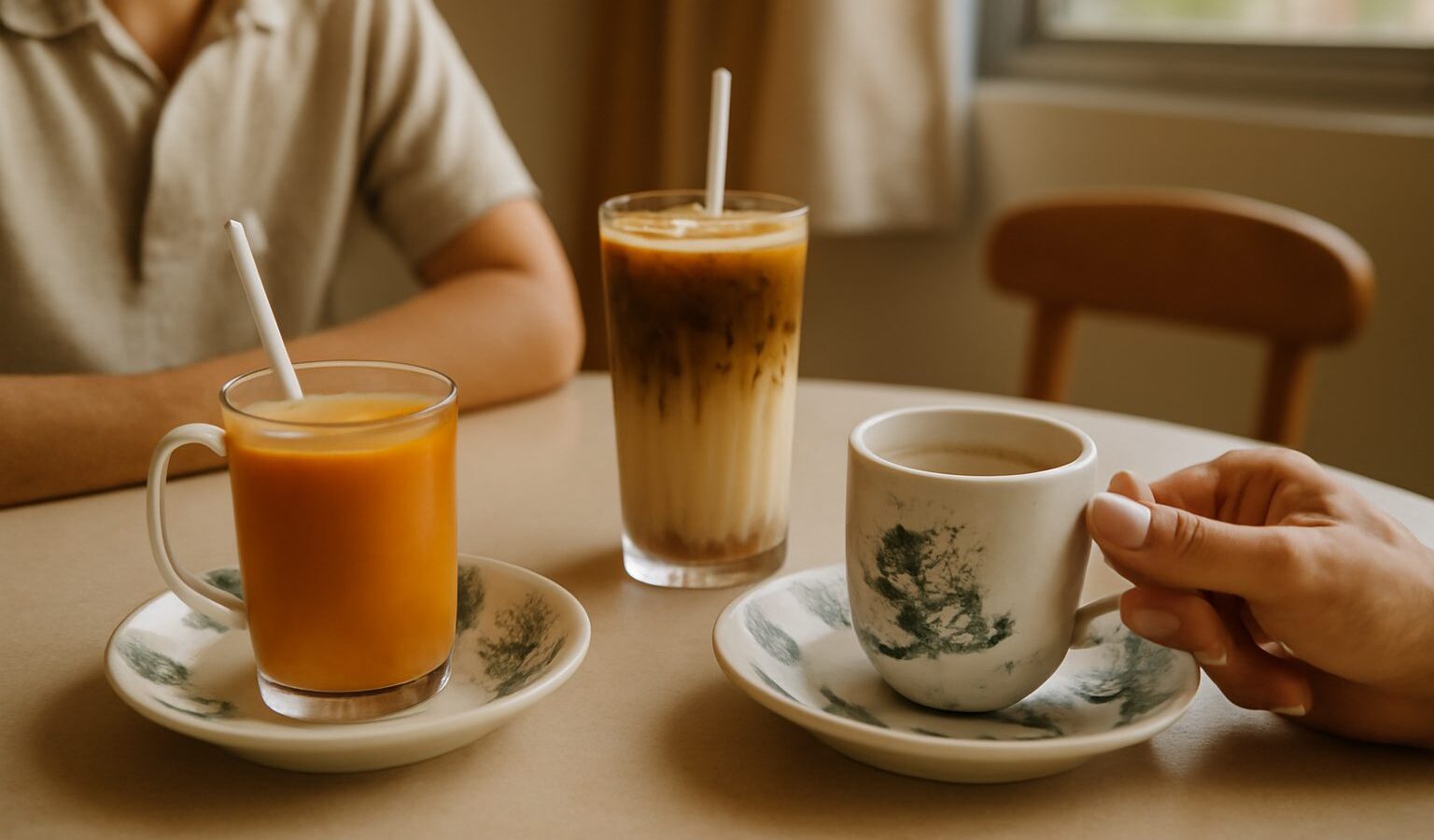
Walk up to any kopitiam drinks stall in Singapore and the coffee gets all the attention, but the uncle behind the counter is pouring far more than kopi. Tea, malted chocolate, rose-pink syrups, roasted barley and freshly pressed sugarcane all share the same steamy counter, and each one comes with its own little grammar of ordering. If you have already learned to call for your coffee like a regular, this guide picks up where the beans end and walks you through everything else on the board, so your next order sounds just as at home.
The beauty of the kopitiam drinks stall is that almost everything is built from a small set of parts: a base (tea, Milo, Horlicks), a sweetener (condensed or evaporated milk, sugar), and a temperature. Learn the parts and the whole menu opens up.
Teh and the Tea Family
Teh is the tea half of the counter, brewed strong from a robust black tea and pulled together with condensed and evaporated milk in much the same way as kopi. Order plain “teh” and you get it hot, sweet and milky. From there the same modifiers you use for coffee apply, which is why the two stalls feel like siblings.
- Teh O is tea with sugar but no milk, clean and brisk.
- Teh C uses evaporated milk and sugar, lighter and less sweet than standard teh.
- Teh peng is iced tea, poured over plenty of ice for the afternoon heat.
- Teh halia is tea with ginger, warming and faintly spicy, a favourite when you feel a cold coming on.
- Teh tarik, literally “pulled tea”, is aerated by pouring it between two vessels from a height until it foams. You see it most at Indian Muslim eateries and prata shops, and it pairs beautifully with a morning roti.
If you want it less sweet across any of these, add “siew dai”; for extra sweet, “gah dai”; and for no sugar at all, “kosong”. These words travel across the whole menu, not just the tea.
Milo, Horlicks and the Malted Drinks
The malted drinks are the comfort corner of the kopitiam. Milo, the malted chocolate everyone grows up with, turns up in several forms. Ordered hot it is thick and cocoa-sweet; ordered “Milo peng” it is iced. The showpiece is the Milo Dinosaur, a cold Milo crowned with a small mountain of undissolved Milo powder on top, rich enough to feel like a dessert. A “Milo Godzilla” pushes it further with ice cream or other toppings, though exactly what goes in varies from stall to stall, so it is worth a glance at the sign.
Horlicks and Ovaltine sit alongside Milo for those who prefer a maltier, less chocolatey cup. All three can be made with water or milk, hot or iced, and take the same sweetness modifiers as everything else. These drinks are gentle, filling and a reliable choice for children or anyone who wants something soothing rather than caffeinated.
The Cooling Drinks: Bandung, Barley, Chin Chow and More
When the weather bites, locals reach for the non-tea, non-coffee coolers. These are the drinks that make a kopitiam feel like a neighbourhood institution.
- Bandung is milk flavoured with rose syrup, unmistakable for its pink colour and floral sweetness. Some versions add grass jelly or a splash of soda.
- Barley water is made by boiling barley until the water turns nutty and soft, then sweetening it lightly. It is served hot or iced, and often with a wedge of lime as “barley lime”.
- Chin chow, or grass jelly drink, is a dark herbal jelly served in sweetened water, slippery and mildly bittersweet, believed by many to be cooling for the body.
- Sugarcane juice is pressed fresh from stalks at stalls with a rolling press, grassy-sweet and best over ice, sometimes with a squeeze of lemon.
- Lime juice, or “lime ping”, is tart, refreshing and one of the most common ways to cut through an oily hawker meal.
- Soya bean milk (tau huay zui) is smooth, faintly beany and lightly sweet, and pairs classically with a plate of you tiao.
Names and recipes vary between families, regions and stalls, so if something sounds unfamiliar, just ask the uncle or auntie what is in it. A short chat is part of the experience, and details differ from place to place, so treat the descriptions here as a general guide rather than a fixed recipe.
Reading the Order Like a Local
The magic word order at a kopitiam runs base, then milk or sugar modifier, then temperature. So “teh C siew dai peng” is tea with evaporated milk, less sugar, iced. It feels like a code at first, then becomes second nature. A quick reference:
| You say | What you get | Good to know |
|---|---|---|
| Teh peng | Iced milk tea | The default afternoon cooler |
| Teh C kosong | Tea with evaporated milk, no sugar | For unsweetened but still creamy |
| Milo peng | Iced malted chocolate | Ask for “Dinosaur” for the powder crown |
| Bandung | Rose milk | Bright pink, floral and sweet |
| Barley ping | Iced barley water | Add lime for extra refreshment |
| Sugarcane | Fresh-pressed cane juice | Best when pressed to order |
A few practical notes. Many stalls take payment on collection rather than at a table, so keep small change handy. Prices, drink names and availability change from stall to stall and over time, so check the board and confirm anything unusual before you order. If a stall is busy, calling your order clearly and confidently keeps the line moving and earns you a nod from the regulars.
Making the Most of Your Cup
Kopitiam drinks are meant to partner food, not stand alone. A teh tarik with roti prata, a soya bean milk with you tiao, or an iced lime juice against a plate of char kway teow are pairings locals reach for without thinking. Hot drinks tend to open a meal; iced coolers close it, or carry you through a sticky afternoon.
Do not be shy about experimenting. Order the same base three ways across a week, hot, iced, and kosong, and you will quickly find your house style. That, more than any menu, is how regulars end up with an order the uncle already knows by heart.
Explore more
For the coffee half of the counter, read our guide on how to order kopi like a local, and for the wider ritual of the coffee shop itself, see our kopitiam culture guide. If you want the full landscape of what Singaporeans sip, our local drinks guide rounds it all up.