
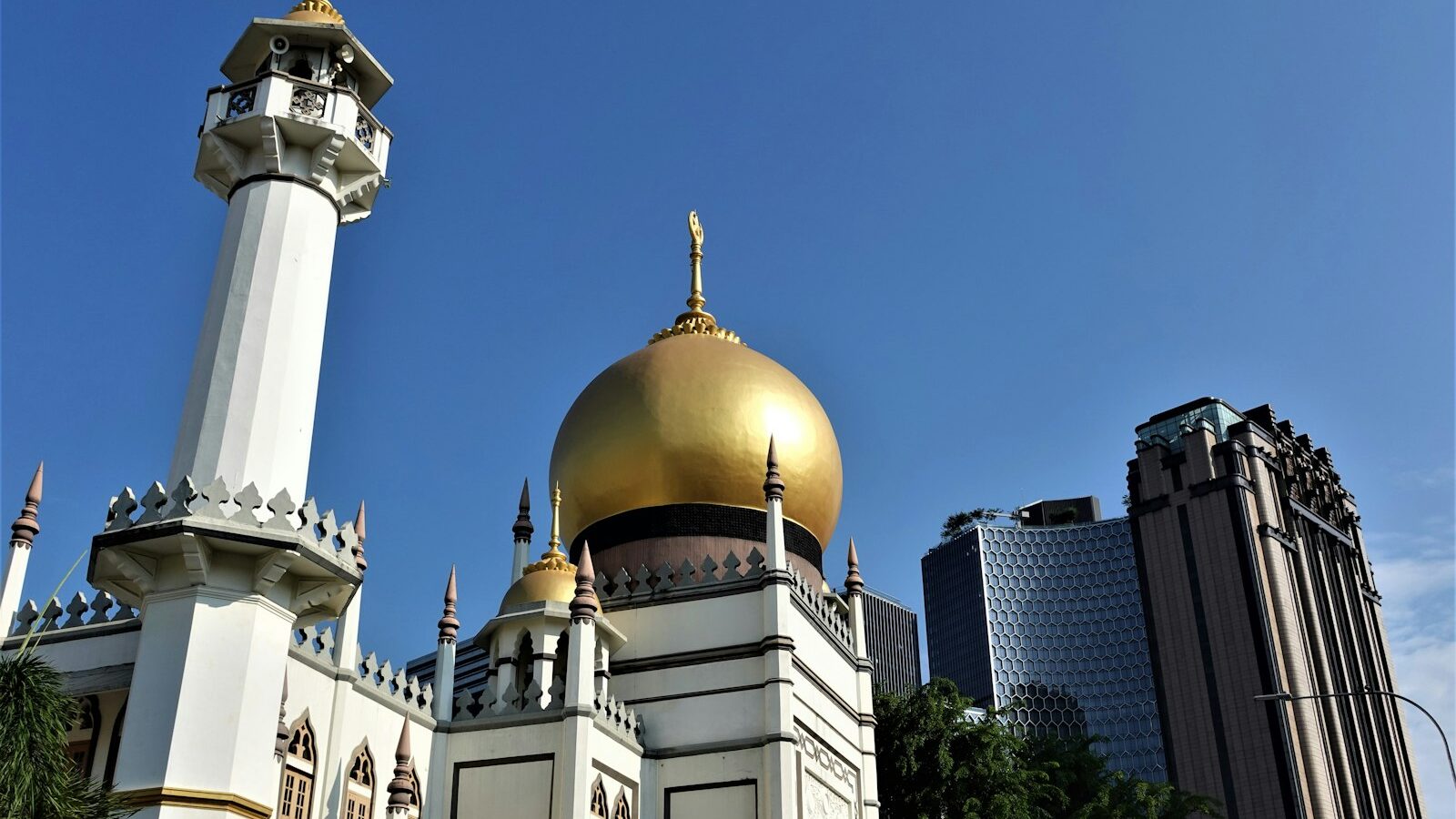
Few buildings anchor a neighbourhood the way Sultan Mosque anchors Kampong Glam. Its great golden domes rise at the end of Bussorah Street, drawing the eye from far down the pedestrian mall and giving the historic Malay-Muslim quarter its unmistakable skyline. For anyone exploring Sultan Mosque Singapore, the building is both an active place of worship and a national monument that tells the story of the island’s Muslim community across two centuries. This guide walks through its history, its architecture and what to know before you visit.
Origins in the heart of Kampong Glam
The mosque’s story begins with the founding of modern Singapore and the settlement of Kampong Glam as a royal and Muslim quarter. After the treaties that reshaped the island in the early nineteenth century, land in this district was set aside for the Sultan and the Malay-Muslim community, and a mosque was built here in the 1820s with support from the colonial authorities of the day. That first structure served the growing community of Malays, Arabs, Bugis, Javanese and other Muslim traders and settlers who made Kampong Glam their home.
Over the following decades the surrounding streets filled with textile shops, perfumeries, printing houses and eating places serving pilgrims and traders. The mosque sat at the centre of this life, and by the early twentieth century the original building was ageing and too small for the congregation. The community resolved to rebuild it on a far grander scale, and it is that rebuilt mosque, completed in the early twentieth century, that visitors see today.
The building you see today
The present Sultan Mosque was designed by the architect Denis Santry of the well-known firm Swan and Maclaren, and it is a striking example of the Indo-Saracenic style, a blend of Islamic, Malay, Persian, Moorish and European influences that was popular across the region in that era. The two large golden domes, the tall minarets at the corners and the balustraded prayer hall give the building its dignity and symmetry.
One much-loved detail rewards a closer look. The base of each dome is ringed with a dark band that, on inspection, is made up of the ends of glass bottles. The story passed down is that when funds were raised for the rebuilding, poorer members of the community who could not give money donated glass bottles instead, so that every family, rich or poor, could see their contribution built into the mosque. Whether you read it as history or as cherished tradition, it captures the communal spirit behind the building.
Inside, the main prayer hall is spacious and calm, lit by chandeliers and framed by tall arches, and it can hold a very large congregation, filling to capacity on Fridays and during the festive periods of Ramadan and the two Eids. The mosque was gazetted as a national monument in the 1970s, recognising its architectural and historical importance to Singapore.
A living centre of community life
Sultan Mosque has never been only a building to admire. It remains the principal mosque of Kampong Glam and a focal point for the wider Malay-Muslim community. During Ramadan the streets around it come alive with a bazaar and the warm bustle of families gathering to break their fast, and the area around Bussorah Street and Kandahar Street glows with lights and stalls. Weddings, religious classes and community events fill its calendar through the year.
The neighbourhood around the mosque carries the same heritage. Kampong Glam is home to the Malay Heritage Centre at the former Istana Kampong Gelam, to the textile and rug shops of Arab Street, and to Haji Lane with its murals and independent boutiques. The mosque and its surroundings together form one of the best-preserved historic quarters in Singapore, conserved by the authorities for their cultural value.
How the mosque compares within its quarter
To see where Sultan Mosque sits among the landmarks of Kampong Glam, this quick comparison helps orient a first visit.
| Landmark | What it is | Why visit |
|---|---|---|
| Sultan Mosque | The district’s principal mosque and a national monument | Golden domes, grand prayer hall, living centre of worship |
| Malay Heritage Centre | Museum at the former royal palace grounds | Story of the Malay community and Kampong Glam |
| Bussorah Street | Pedestrian mall leading to the mosque | Best view of the domes, cafes and heritage shophouses |
| Arab Street | Traditional textile and craft lane | Fabrics, rugs, perfumeries and old trades |
Visiting Sultan Mosque respectfully
Sultan Mosque welcomes visitors of all backgrounds outside prayer times, and a visit is a chance to appreciate both faith and architecture. As it is an active place of worship, a few points of etiquette make the visit comfortable for everyone.
- Dress modestly. Shoulders and knees should be covered, and robes are usually available at the entrance for visitors who need them.
- Remove your shoes before entering the prayer hall, as is customary.
- Keep your voice low, especially when prayers are in progress, and follow any guidance from the mosque staff about which areas visitors may enter.
- Be considerate with photography, avoid photographing worshippers without permission, and switch phones to silent.
- Visiting hours are set around the five daily prayers and the busy Friday congregation, so plan around these. Always check the mosque’s official channels for current visiting times, as they can change during Ramadan and on public holidays.
Getting there is easy. The mosque sits on Muscat Street off North Bridge Road, and the nearest MRT station is Bugis, a short walk away, with several bus services stopping nearby. Come with time to spare, because the lanes of Kampong Glam reward slow wandering, from a cup of coffee on Bussorah Street to the fabric shops and the heritage centre a few minutes away.
Sultan Mosque endures as one of Singapore’s most recognisable landmarks precisely because it has stayed true to its purpose. It is a working mosque at the heart of a living community, a monument that grew from the contributions of ordinary people, and a graceful reminder of the deep roots of the Muslim community in the Singapore story.
Explore more
If Kampong Glam has sparked your interest in Singapore’s places of worship and community landmarks, continue with the story of Nagore Dargah and the Indian-Muslim community on Telok Ayer Street, one of the oldest shrines in the country. From there, cross into Chinatown for Thian Hock Keng, the island’s oldest Hokkien temple, and Sri Mariamman, Singapore’s oldest Hindu temple, to see how communities of every faith shaped the heritage streets we walk today.